

Ducted Air Conditioning Sydney vs Split System: Which Is Better for Your Home in 2026?
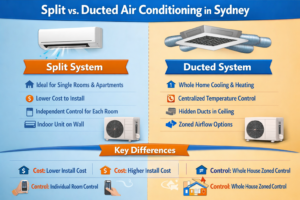
Ducted air conditioning is generally the better choice for Sydney homeowners who want heating and cooling throughout several rooms, while split system air conditioning is usually more affordable for one or two rooms. The right option depends on your property’s size, installation budget, ceiling space and how many rooms you use regularly.
For a four-bedroom family home, a properly designed ducted reverse-cycle system can provide convenient whole-home comfort. For a Sydney apartment or smaller townhouse, one or two split systems may deliver better value.
Before spending thousands of dollars, understanding the differences in installation costs, electricity consumption, comfort and maintenance can help you avoid choosing an unsuitable system.
This guide compares ducted and split system air conditioning in Sydney using indicative 2026 installation prices and practical considerations for local homes.
Quick Verdict: Ducted vs Split System Air Conditioning
| Your situation | Usually the better option |
|---|---|
| Cooling one bedroom | Split system |
| Cooling a small apartment | Split system |
| Heating and cooling a 3-bedroom house | Depends on layout and usage |
| Whole-home comfort in a 4–5 bedroom house | Ducted |
| Limited installation budget | Split system |
| Minimal visible indoor equipment | Ducted |
| Limited ceiling or roof space | Split system |
| Independent temperature control in selected rooms | Multiple splits or suitable zoned ducted design |
Bottom line: Choose ducted air conditioning for convenient whole-home comfort. Choose split systems when affordability, flexibility and targeted room cooling are your priorities.
1. What Is Ducted Air Conditioning and How Does It Work?
Ducted air conditioning uses a central indoor unit connected to insulated ductwork that distributes conditioned air through ceiling or other appropriately positioned outlets.
A reverse-cycle ducted system provides both heating and cooling, making it suitable for Sydney’s warm summers and cooler winter mornings.
Most residential systems include:
- An indoor fan-coil unit and outdoor unit.
- Insulated ducts and air outlets.
- A return-air grille and filter.
- A central controller.
- Optional zoning and smart controls.
Zoning allows selected areas of the house to be conditioned independently, subject to the system’s design and minimum airflow requirements.
This makes ducted air conditioning particularly attractive for homeowners with multiple bedrooms, open-plan living areas or frequently occupied rooms.
For professional system planning, explore ducted air conditioning installation Sydney.
2. How Is a Split System Different?
A split system consists of an indoor unit connected to an outdoor unit using refrigerant pipework and electrical connections.
Unlike ducted air conditioning, a conventional single-head split primarily conditions one room or a connected open-plan area.
For example, a Sydney homeowner may install a split system in the living room and another in the master bedroom rather than conditioning the entire house.
Split systems generally provide:
- Lower initial installation costs.
- Independent control for each installed indoor unit.
- Heating and cooling through reverse-cycle technology.
- Straightforward servicing access.
- Flexible installation for selected rooms.
However, installing multiple individual split systems may require several outdoor units, depending on the design.
A multi-split arrangement can connect multiple compatible indoor units to one outdoor unit, although its installation cost and suitability require separate assessment.
3. Ducted Air Conditioning Sydney Cost vs Split System Cost in 2026
For many homeowners, the biggest question is how much each system costs to install.
In Sydney, a single split system typically has a lower upfront cost than a ducted system. However, the comparison becomes more complicated when several rooms require heating and cooling.
Estimated installation prices in Sydney
| Air conditioning system | Indicative supplied and installed cost |
|---|---|
| Small bedroom split system | $1,250–$2,600 |
| Medium living-room split system | $1,900–$3,700 |
| Large split system | $2,300–$4,750 |
| Multi-split system | $4,500–$10,000+ |
| Small-home ducted system | $8,000–$12,000 |
| Standard family-home ducted system | $11,000–$18,000 |
| Large or complex ducted installation | $17,000–$25,000+ |
Prices are approximate 2026 Sydney planning estimates, not guaranteed KYNEX quotations. Actual costs depend on system capacity, brand, installation complexity, electrical requirements, access and property layout.
Why does ducted air conditioning cost more?
Ducted installation involves additional equipment and labour, including ductwork, outlets, return-air arrangements, zoning components and ceiling-space access.
A double-storey home, for example, may require more complicated duct routing than a single-storey property.
Other factors influencing ducted air conditioning installation costs include the number of zones, switchboard capacity, outdoor-unit positioning and the property’s insulation.
Practical tip: Obtain an itemised quote showing the equipment model, capacity, duct layout, zoning and electrical work before choosing an installer.
4. Which Is Cheaper to Run: Ducted or Split System?
A split system is often cheaper to operate when you only need to heat or cool one room. Ducted air conditioning can be more convenient when several rooms require conditioning simultaneously.
However, there is no reliable universal hourly running cost that applies to every installation.
Electricity consumption depends on:
- System efficiency and capacity.
- Outdoor temperatures.
- Thermostat settings.
- Insulation and window performance.
- Number of occupied rooms.
- Daily operating hours.
- Electricity tariffs.
For example, a family using one bedroom at night may consume less electricity with a correctly sized bedroom split than with a larger ducted system.
Conversely, several independent split systems operating simultaneously may narrow the running-cost difference compared with an efficiently designed zoned ducted system.
Does zoning save electricity?
Zoning can reduce unnecessary conditioning by allowing homeowners to focus on occupied areas.
But turning off zones does not guarantee a proportional reduction in electricity use. Savings depend on the equipment, airflow design, minimum operating capacity and how the system is controlled.
When comparing quotes, ask installers to explain expected energy use under your actual household routine rather than relying on generic running-cost claims.
5. Is Ducted Air Conditioning Worth It for a 3-Bedroom House in Sydney?
For a three-bedroom home, ducted air conditioning may be worthwhile if multiple rooms are occupied regularly and the homeowner wants consistent whole-house temperature control.
Consider two different Sydney households.
Household A: A couple living in a three-bedroom townhouse uses the living room during the day and one bedroom at night.
Two appropriately sized split systems may offer excellent value because unused rooms rarely need conditioning.
Household B: A family with children regularly uses three bedrooms, a study and an open-plan living area.
A zoned ducted system may provide greater convenience, especially when several rooms need heating or cooling around the same time.
The decision should be based on how the household uses the home, not the bedroom count alone.
6. Is Ducted Better for a 4-Bedroom or Double-Storey Sydney Home?
For larger family homes, ducted air conditioning becomes particularly attractive.
A well-designed system can provide centralised control, concealed indoor equipment and conditioned air throughout several rooms.
However, double-storey homes require careful planning.
Upper floors often experience greater summer heat exposure, and poorly designed ductwork can leave upstairs bedrooms uncomfortable even when downstairs temperatures are satisfactory.
Before installing ducted air conditioning in a double-storey house, request an assessment of heat load, insulation, ceiling access, airflow, return-air positioning and appropriate zoning.
Some homes may benefit from separate systems for upstairs and downstairs rather than one central arrangement.
Important: Bigger equipment does not automatically mean better cooling. Correct sizing and air distribution are essential.
7. What About Sydney Apartments, Terraces and Townhouses?
Sydney properties vary considerably, from modern apartments in Chatswood to older terraces in Newtown and family homes across the Sutherland Shire.
An apartment with limited ceiling access may be better suited to a wall-mounted split system.
An Inner West terrace may have restricted roof space, narrow access or challenging outdoor-unit placement.
A newer townhouse with suitable ceiling cavities may accommodate either option.
Apartment owners should also check applicable strata requirements before approving an outdoor-unit location, facade penetration or changes affecting common property.
These considerations make an on-site assessment important.
A suitable system must work with the building’s physical constraints, not just the homeowner’s preferred brand or budget.
8. Advantages and Disadvantages of Ducted Air Conditioning
Advantages
Whole-home comfort: Suitable designs can heat and cool numerous rooms from one central arrangement.
Concealed appearance: Indoor equipment is largely hidden, with discreet ceiling or wall outlets.
Centralised controls: Homeowners can manage operating modes, schedules and compatible zoning.
Convenience: One properly designed solution may be simpler to operate than several independent indoor units.
Disadvantages
Higher upfront investment: Ductwork, controls and labour increase installation costs.
Space requirements: Ceiling cavities and suitable duct routes are necessary.
Installation complexity: Retrofitting older properties may involve additional work.
Design sensitivity: Incorrectly sized ducts, poor zoning or inadequate return airflow can compromise performance.
For homeowners who want a complete heating and cooling solution, the advantages can justify the additional investment. For those conditioning only one room, ducted installation may be unnecessary.
9. How to Choose the Best Air Conditioning System for Your Sydney Home
Before committing to either system, consider five questions.
How many rooms require conditioning? If you regularly use several rooms, ducted may deserve consideration. If only one or two rooms need cooling, start by comparing split systems.
What is your installation budget? Compare total supplied-and-installed prices, including electrical work and any necessary building modifications.
Does your home have suitable space? An installer should assess roof access, ceiling cavities, outdoor-unit locations and pipework routes.
How important is appearance? Ducted provides a more concealed indoor finish, while wall-mounted splits remain visible.
How will you use the system? Households operating air conditioning for long periods should prioritise appropriate capacity, efficiency and controls.
KYNEX Air Conditioning can help you compare suitable options through its air conditioning installation Sydney services.
10. What Should You Ask Before Accepting an Installation Quote?
Not every air conditioning quote includes the same equipment or installation work.
Ask the installer to confirm the system’s model, cooling and heating capacities, electrical scope, installation locations, warranty terms and any exclusions.
For ducted systems, also request the number of outlets, zoning configuration, return-air arrangement and a clear explanation of the proposed duct layout.
In NSW, air conditioning and refrigeration work must be performed by appropriately licensed or certified people. Refrigerant-handling requirements also apply where relevant.
Check the credentials of the contractor before proceeding.
A properly detailed quotation makes it easier to compare value rather than selecting a system based solely on the lowest advertised price.
11. Frequently Asked Questions
Is ducted air conditioning better than split system air conditioning in Sydney?
Ducted is often better for whole-home comfort, while split systems are generally more economical for conditioning individual rooms. The best option depends on property size, layout, budget and usage.
Is ducted air conditioning expensive to run?
It can consume more electricity when conditioning a large area than a smaller split system serving one room. Actual consumption depends on efficiency, zoning, insulation, weather and usage.
Can ducted air conditioning be installed in an existing Sydney house?
Yes, many existing homes can accommodate ducted systems, provided there is suitable space for equipment, ductwork and air outlets. Some properties require substantial modifications.
Does ducted air conditioning increase property value?
It may improve comfort and buyer appeal, but there is no guaranteed increase in resale value. Any financial benefit depends on the property and local market conditions.
Can I install ducted air conditioning without roof space?
Conventional ceiling-ducted installations generally require suitable space for equipment and ducts. Alternative equipment locations or system designs may be possible, but some homes are better suited to split systems.
Which air conditioning system is best for Sydney’s climate?
Both reverse-cycle ducted and split systems can provide effective heating and cooling in Sydney when correctly sized, installed and maintained.
Final Verdict: Should You Choose Ducted or Split System Air Conditioning?
For homeowners comparing ducted air conditioning Sydney options, the most important consideration is how much of the property needs regular heating and cooling.
Choose ducted air conditioning when you want convenient whole-home comfort, concealed indoor equipment and suitable zoning across several regularly used rooms.
Choose split system air conditioning when you need an affordable solution for selected rooms, have limited ceiling space or want greater flexibility over individual installations.
Neither system is automatically the best choice for every property.
At KYNEX Air Conditioning, homeowners can explore suitable residential air conditioning Sydney solutions based on home size, comfort requirements and installation considerations.
Planning an air conditioning upgrade? Contact KYNEX Air Conditioning on 0484 595 959 to discuss your property’s requirements and request an installation quote before making your decision.