
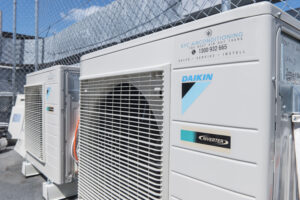
The best air conditioning for Sydney climate conditions is usually an energy-efficient reverse-cycle system that is correctly sized for the property. A split system is often suitable for one or two main rooms, a multi-split system can work well when several separate rooms need conditioning, while a zoned ducted system is often better suited to whole-home heating and cooling.
Sydney does not experience exactly the same conditions across the entire metropolitan area. Coastal suburbs can feel humid and benefit from sea breezes, while Western Sydney can experience much higher summer temperatures.
For this reason, the best air conditioner should not be chosen by brand or price alone. Your home’s insulation, orientation, ceiling height, windows, room size and how many areas you want to cool all matter.
Quick Answer
For most Sydney households, reverse-cycle air conditioning provides one of the best combinations of summer cooling, winter heating and energy efficiency.
As a general guide:
- Choose a split system when you mainly need to condition one or two rooms.
- Consider a multi-split system when several separate rooms need air conditioning but outdoor-unit space is limited.
- Consider zoned ducted air conditioning when you want comfortable temperatures throughout most or all of the home.
Which Type of Air Conditioning Is Best for Sydney?
There is no single air-conditioning system that is best for every Sydney property.
The most suitable option depends largely on the size of the home, how many rooms need conditioning and how those rooms are used.
Reverse-Cycle Split System
A reverse-cycle split system is often suitable for:
- Bedrooms
- Living rooms
- Apartments
- Home offices
- Open-plan living areas
- Smaller homes
Its main advantage is that you can cool or heat the area you are actually using instead of conditioning the entire property.
For many Sydney apartments and smaller homes, this can provide a practical balance between comfort, installation cost and energy efficiency.
Multi-Split Air Conditioning
A multi-split air-conditioning system connects several indoor units to one outdoor unit.
This can be useful for:
- Apartments
- Townhouses
- Smaller homes
- Properties with limited outdoor-unit space
- Homes where several bedrooms require individual temperature control
The system needs to be designed carefully because the installer must consider the combined capacity of the indoor units and how many rooms may be operating at the same time.
Ducted Air Conditioning
Ducted air conditioning is usually more suitable for larger homes where the homeowner wants an integrated heating and cooling solution.
A central indoor unit distributes conditioned air through ducts to outlets located throughout the property.
Modern ducted systems can also include zoning, allowing different sections of the house to be switched on or off separately.
If whole-home comfort is your priority, learn more about ducted air conditioning installation in Sydney.
Why Does Sydney’s Climate Affect Your Air Conditioner Choice?
Sydney households need an air-conditioning system capable of handling both hot summer weather and cooler winter conditions.
This is one reason reverse-cycle air conditioning is so practical for Sydney homes.
The same system can cool the property during summer and reverse its refrigeration cycle to provide heating during winter.
Sydney’s climate can also vary significantly depending on where you live.
During the 2025–26 summer, Greater Sydney experienced above-average maximum temperatures. Sydney Observatory Hill recorded a summer mean maximum temperature of 28.1°C and reached 42.2°C on 10 January 2026.
Holsworthy reached 43.5°C on the same day.
This illustrates why the air-conditioning requirements of a Western Sydney home may be very different from those of a property closer to the coast.
What Air Conditioning Works Best in Coastal Sydney?
Homes around the Eastern Suburbs, Northern Beaches and other coastal areas can experience humid weather.
During humid conditions, temperature is not the only factor that affects comfort.
Moisture in the air can make a room feel warmer and less comfortable even when the temperature is not extremely high.
Many modern reverse-cycle air conditioners include a dry or dehumidification mode.
Dry mode removes moisture from the indoor air and can make humid conditions feel more comfortable.
What Air Conditioning Works Best in Western Sydney?
Western Sydney can experience significantly hotter summer temperatures than areas closer to the coast.
This means correct air-conditioner sizing becomes particularly important.
A system selected only according to floor area may struggle if the room also has:
- Large west-facing windows
- Strong afternoon sun
- Poor insulation
- High ceilings
- Large glass areas
- Limited shading
- Upstairs heat exposure
For this reason, the system capacity should ideally be based on the actual heat load of the property rather than a simple square-metre calculation.
Split vs Multi-Split vs Ducted Air Conditioning in Sydney
Split Systems: Best When You Mainly Use One Area
A reverse-cycle split system can be an excellent option when you spend most of your time in one living room, bedroom, home office or open-plan area.
You avoid conditioning rooms that are not being used.
Modern inverter split systems can also adjust their output as the room approaches the selected temperature rather than repeatedly operating at maximum power.
Split systems can be particularly suitable for:
- Apartments
- Smaller houses
- Bedrooms
- Living areas
- Home offices
- Granny flats
Multi-Split Systems: Useful When Outdoor Space Is Limited
A multi-split air conditioner connects several indoor units to one outdoor condenser.
This can be useful when you want air conditioning in several rooms but do not want multiple outdoor units around the property.
Multi-split systems can work particularly well in:
- Apartments
- Townhouses
- Narrow blocks
- Homes with limited outdoor-wall space
However, the system must be designed properly.
The installer needs to consider the total capacity of the connected indoor units, pipework distances and how many rooms are likely to operate at the same time.
Ducted Air Conditioning: Best for Whole-Home Comfort
If you want consistent heating and cooling throughout a larger property, ducted air conditioning may be more convenient.
A ducted system generally includes:
- A central indoor unit
- Ductwork
- Supply-air outlets
- A return-air grille
- A thermostat or controller
- Optional zoning controls
Zoning allows you to condition selected areas instead of running the entire house at once.
For example, you may use the living zones during the day and bedroom zones during the evening.
If this type of system suits your property, read more about ducted air conditioning installation in Sydney.
Quick Decision Guide
If you mainly use one room, start by considering a split system.
If several separate rooms need independent air conditioning but outdoor space is limited, consider a multi-split system.
If you want discreet whole-home air conditioning, consider a zoned ducted system.
What Size Air Conditioner Does a Sydney Home Need?
The correct air-conditioner capacity is normally measured in kilowatts or kW.
However, floor area alone is not enough to accurately calculate the required system size.
A professional assessment should consider:
- Room dimensions
- Total floor area
- Ceiling height
- Wall insulation
- Ceiling insulation
- Floor insulation
- Window area
- Type of glass
- Property orientation
- North-facing or west-facing sun
- External shading
- Number of occupants
- Open-plan layouts
- Upper-floor heat exposure
- Air leakage
- Local Sydney climate conditions
Why Is an Oversized Air Conditioner a Problem?
Bigger is not automatically better when choosing air conditioning.
An oversized air conditioner may reach the selected temperature very quickly and then cycle on and off more frequently than necessary.
This may reduce efficiency and affect indoor comfort.
An undersized system can cause the opposite problem.
It may run for long periods while struggling to achieve the desired room temperature.
This is why a proper heat-load calculation is better than simply choosing the largest system within your budget.
How Do You Choose an Energy-Efficient Air Conditioner for Sydney?
Start by determining the correct system capacity.
Once you know roughly what size system is appropriate, compare the energy efficiency of models with similar capacities.
Australian air conditioners use the Zoned Energy Rating Label to help consumers compare energy performance.
The label provides information about:
- Cooling capacity
- Heating capacity
- Energy consumption
- Cooling efficiency
- Heating efficiency
- Climate-zone performance
When comparing air conditioners, consider:
- Cooling star rating
- Heating star rating
- Estimated annual energy consumption
- Indoor noise levels
- Outdoor noise levels
- Inverter technology
- Temperature controls
- Timers
- Scheduling options
- Dry or dehumidification mode
- Zoning options
Does a Higher Star Rating Always Mean Lower Running Costs?
Not necessarily.
Energy-star ratings should ideally be compared between air conditioners with similar capacities.
A large air-conditioning system may have a strong energy-efficiency rating but still consume more electricity overall than a smaller system because it is delivering considerably more heating or cooling.
The best approach is therefore:
- Determine the correct capacity.
- Compare suitable models of similar size.
- Review their seasonal energy efficiency.
- Consider how many hours the system will normally operate.
What Temperature Should You Set Your Air Conditioner to in Sydney?
NSW energy guidance recommends approximately 24°C to 26°C during summer and around 18°C to 20°C during winter.
Extreme thermostat settings usually do not make a room reach a comfortable temperature dramatically faster.
Setting an air conditioner to 18°C on a very hot day, for example, does not necessarily cool the room faster than selecting a more realistic temperature.
Other ways to improve comfort and reduce the load on the air conditioner include:
- Using ceiling fans
- Closing blinds during strong afternoon sun
- Using external shading
- Improving insulation
- Closing doors to unused rooms
- Sealing major air leaks
What Air Conditioning Is Best for Different Sydney Homes?
Small Sydney Apartment
A reverse-cycle split system is often the first option worth considering.
It provides heating and cooling for the main living area without requiring a large ducted installation.
Two-Bedroom Apartment
A split system or multi-split system may be appropriate.
The choice depends on whether the bedrooms also need independent air conditioning.
Inner West Terrace or Narrow Home
Properties in areas such as the Inner West can have limited roof space, narrow layouts and restrictions on outdoor-unit placement.
Possible options may include:
- Individual split systems
- Multi-split systems
- Compact ducted systems
The available ceiling and outdoor space can strongly influence the final choice.
Large Sydney Family Home
A zoned ducted system may be more practical when several bedrooms and living areas require regular heating and cooling.
Zoning can also help prevent unnecessary conditioning of unused rooms.
Home Office Plus Living Room
Individual split systems or a multi-split system may work well.
This allows the home office to operate during working hours without conditioning the rest of the house.
Renovation or New Build
A renovation or new-build project can be an ideal time to consider ducted air conditioning.
Ducts, outlets, electrical requirements and the indoor unit can be planned before ceilings and other finishes are completed.
Common Air Conditioning Mistakes Sydney Homeowners Should Avoid
1. Choosing Air Conditioning Based on Price Alone
The cheapest air conditioner or installation quote is not necessarily the lowest-cost option over the life of the system.
You should also consider:
- Energy efficiency
- Installation quality
- Correct system sizing
- Controls
- Warranty conditions
- Maintenance requirements
- Serviceability
2. Buying an Oversized System
More cooling capacity does not automatically create better comfort.
An oversized system may operate inefficiently and may not control indoor conditions as well as a correctly sized unit.
3. Ignoring Insulation and Sun Exposure
Two rooms with exactly the same floor area can require different cooling capacities.
For example, an upstairs room with large west-facing windows may experience much greater afternoon heat than a shaded ground-floor bedroom.
4. Forgetting Outdoor-Unit Placement
The outdoor condenser requires adequate airflow and suitable access for future servicing.
Other considerations include:
- Noise
- Distance from neighbours
- Maintenance access
- Air circulation
- Pipework length
- Appearance
5. Cooling the Entire Home When It Is Not Necessary
If only one part of the property is occupied, there may be little benefit in cooling every room.
Split systems or ducted zoning can help reduce unnecessary air-conditioning use.
6. Ignoring Air Conditioner Maintenance
Dirty filters can restrict airflow and affect system performance.
NSW energy guidance recommends cleaning filters every few months.
If your existing system is not performing properly, professional air conditioning maintenance in Sydney may help identify airflow, drainage, electrical or equipment problems.
Are There NSW Air Conditioning Rebates or Incentives in 2026?
Yes.
As of August 2026, the NSW Government offers an Air Conditioner Energy Saving incentive for eligible energy-efficient air-conditioning installations and replacements.
The NSW Government gives examples of an upfront discount of up to approximately $550 when installing a new 6kW system and up to approximately $560 when replacing an existing air conditioner with an eligible 6kW split system.
These figures are examples rather than guaranteed discounts.
The actual incentive may depend on:
- The air-conditioning system
- Energy efficiency
- Installation type
- Existing equipment
- Approved supplier requirements
- Current scheme conditions
Government rebates and incentives can change, so eligibility should always be checked before relying on a particular discount when comparing quotes.
The NSW Government also currently describes zero-interest Home Energy Saver loans of up to $15,000 for eligible homeowners or landlords, subject to eligibility requirements.
When Should You Ask an Air Conditioning Installer for Advice?
Professional advice can be particularly useful when:
- You do not know what capacity your home requires
- Several rooms need air conditioning
- You are comparing ducted and multi-split systems
- Your property receives strong western sun
- You have large windows
- Ceiling space is limited
- Outdoor-unit space is limited
- You are renovating
- You are building a new home
- You want zoning
- You want smart controls
- Your existing air conditioner needs replacing
- You want to investigate NSW energy incentives
Instead of asking an installer for a particular model immediately, explain how you use your property.
Tell them:
- Which rooms need conditioning
- When those rooms are occupied
- Whether bedrooms need overnight cooling
- Whether heating is also important
- Whether you want independent zones
- What problems you have with the existing system
This information can help the installer recommend a more suitable solution.
How KYNEX Air Conditioning Can Help
KYNEX Air Conditioning provides air-conditioning installation and related services in Sydney.
The company’s website covers split systems, multi-split systems, ducted air conditioning and other residential air-conditioning solutions.
If you are considering a new system, KYNEX can assess the property and discuss suitable air conditioning installation options in Sydney based on your home’s layout and requirements.
If you are researching the best reverse cycle air conditioning for Sydney homes, energy efficient air conditioning for Sydney climate, or the best home air conditioning system for Sydney weather, a site assessment can help narrow the options based on the property rather than guesswork.
Frequently Asked Questions
Is Reverse-Cycle Air Conditioning Good for Sydney?
Yes.
Reverse-cycle air conditioning is particularly suitable for Sydney because the same system can provide cooling during summer and heating during winter.
Australian Government energy guidance describes reverse-cycle air conditioning as generally one of the most energy-efficient options for combined heating and cooling.
Correct system sizing is still important.
Is Split or Ducted Air Conditioning Better in Sydney?
Neither system is automatically better.
A split system is often more practical when only one or two rooms need regular air conditioning.
Ducted air conditioning becomes more attractive when several rooms or the entire home require heating and cooling.
Zoned ducted systems can also allow you to condition selected sections of the home.
What Is the Best Air Conditioner Temperature for Sydney Summer?
NSW energy guidance recommends approximately 24°C to 26°C during summer.
The exact temperature that feels comfortable depends on humidity, clothing, activity and personal preference.
Using ceiling fans, shading and blinds can also improve comfort without requiring very low thermostat settings.
Should I Use Dry Mode During Humid Sydney Weather?
Dry mode can be useful when indoor conditions feel muggy rather than extremely hot.
It helps remove moisture from the air, which can make the room feel more comfortable.
During very hot weather, normal cooling mode may still be more suitable.
How Many kW Does My Sydney Air Conditioner Need?
There is no universal kW requirement based only on the number of bedrooms or the size of the floor area.
The correct capacity depends on:
- Room size
- Insulation
- Ceiling height
- Windows
- Orientation
- Solar exposure
- Occupancy
- Local conditions
A professional heat-load assessment can provide a more reliable answer.
Does a Higher Energy Star Rating Always Mean Lower Running Costs?
Not always.
Star ratings are most useful when comparing air conditioners with similar capacities.
A much larger system may still consume more electricity overall even if its efficiency rating is strong.
Choose the correct system capacity first, then compare energy performance.
Is There an Air-Conditioning Rebate in NSW in 2026?
The NSW Government currently offers an Air Conditioner Energy Saving incentive for eligible new installations and replacement systems.
The amount depends on the equipment and scheme requirements.
Because government programs can change, confirm the current eligibility criteria before purchasing an air conditioner.
Final Takeaway
For most Sydney homes, the best starting point is a correctly sized, energy-efficient reverse-cycle air conditioner.
A split system usually makes sense when you mainly need to condition one or two areas.
A multi-split system can work well when several rooms require individual indoor units but outdoor space is limited.
A zoned ducted system may be the better choice when whole-home comfort and discreet ceiling outlets are priorities.
The system type is important, but it is only part of the decision.
Correct sizing, insulation, sun exposure, energy efficiency, installation quality and the way your household actually uses the air conditioner can have just as much impact on comfort and running costs.