
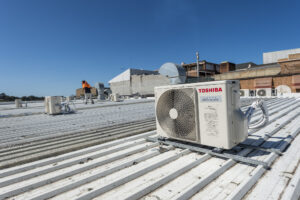
For most Sydney homes, the right air conditioning system is either a reverse-cycle split system for individual rooms or a ducted reverse-cycle system for whole-home comfort. The better choice depends on the size and layout of the property, insulation, sun exposure, how many rooms need conditioning, available installation space and budget.
Correct sizing and installation matter just as much as the brand or system type. A poorly sized or badly installed air conditioner can cost more to run, struggle on hot Sydney days and provide uneven comfort.
Quick Answer
For Sydney homes, split systems generally make sense when you need to heat or cool one or several individual rooms, while ducted air conditioning is better suited to whole-home climate control. Costs vary significantly with capacity, brand, electrical requirements, access, pipework, ductwork and zoning. Sydney’s humidity, western-suburbs heat, coastal exposure and property design also affect system selection. Professional sizing and installation are essential for reliable performance.
What Air Conditioning Works Best in Sydney?
In short: There is no single air conditioner that works best for every Sydney property. Reverse-cycle split systems suit individual rooms and smaller homes, ducted systems suit whole-home climate control, and multi-split systems can be useful where several rooms require independent indoor units but ductwork is impractical.
Australia’s Energy Rating guidance describes reverse-cycle air conditioners as among the most energy-efficient options for combined electric heating and cooling because they transfer heat rather than creating it directly.
| System Type | Best For | Main Advantages | Limitations | Relative Cost |
|---|---|---|---|---|
| Split system | Bedrooms, living rooms, apartments | Efficient, relatively simple installation, individual-room control | Multiple outdoor units may be needed for several rooms | $–$$ |
| Multi-split | Apartments and homes with several rooms | Multiple indoor units connected to one outdoor unit | More complex pipework and design | $$–$$$ |
| Ducted | Houses and larger properties | Whole-home comfort, discreet outlets, zoning options | Higher installation cost and requires suitable ceiling/underfloor space | $$$ |
| Reverse-cycle | Sydney homes needing heating and cooling | One system provides both functions | Performance depends on correct sizing and installation | Varies |
| Commercial systems | Offices, retail and larger premises | Designed around larger and specialised heat loads | Requires detailed design and ongoing maintenance | Project-specific |
Split system air conditioning
A wall-mounted split system consists of an indoor unit connected to an outdoor condenser. It is often suitable for Sydney apartments, bedrooms, home offices, living areas and smaller properties.
If only one or two areas need regular cooling or heating, installing separate split systems may be more practical than installing ductwork throughout the property.
Multi-split air conditioning
A multi-split system connects several indoor units to one outdoor condenser. This can reduce the number of outdoor units required, which may be useful for apartments or properties where outdoor space is limited.
Pipe runs, equipment compatibility and installation design become more important as the number of indoor units increases.
Ducted air conditioning
Ducted air conditioning uses a central indoor fan-coil unit connected to ceiling or floor outlets through insulated ductwork. It works particularly well where homeowners want several rooms conditioned from one system.
Modern systems can incorporate zoning so selected areas can be operated separately.
For more detail, see residential air conditioning in Sydney
Why Sydney’s Climate Matters When Choosing Air Conditioning
Key takeaway: An air conditioner needs to suit the property and its local heat load, not simply the number of square metres being conditioned.
Sydney does not experience identical conditions from the coast to the western suburbs. Properties closer to the coast may have greater exposure to moisture and salty air, while inland western suburbs can experience considerably greater summer heat loads.
Other factors include:
- hot summer periods
- humidity
- cool winter mornings
- direct afternoon sun
- large west-facing windows
- poor roof or wall insulation
- dark roofing materials
- upper-storey heat gain
- ceiling height
- coastal exposure.
A west-facing upstairs bedroom with large windows can need substantially more cooling than a shaded ground-floor room of the same floor area.
This is why estimating capacity from floor area alone is unreliable.
How Much Does Air Conditioning Cost in Sydney?
In short: Sydney air conditioning prices vary widely. A straightforward single split-system installation may cost a few thousand dollars including the unit, while a full ducted system commonly runs well into five figures. These are planning figures only, not quotations.
Published Sydney pricing from KYNEX in 2026 places many single split-system supply-and-install projects at roughly $1,600–$3,500, depending on capacity, access and electrical work.
KYNEX’s published 2026 ducted guide places many Sydney ducted projects around $9,500–$18,000, with larger or difficult installations potentially exceeding that range.
Indicative budgeting might therefore look like this:
| Work | Indicative Planning Range |
| Single split system supply + installation | Approx. $1,600–$3,500+ |
| Larger/high-capacity split system | Often toward or above upper end |
| Multi-split system | Project-specific |
| Typical ducted system | Approx. $9,500–$18,000 |
| Large/complex ducted installation | $18,000–$22,000+ possible |
| Replacement system | Depends heavily on existing infrastructure |
| Repairs | Fault-dependent |
| Servicing | System and scope-dependent |
These figures were checked in August 2026 and should not be treated as fixed market rates.
What affects the final price?
The biggest cost variables normally include:
- air conditioner capacity
- equipment brand and model
- number of indoor units
- number of ducted zones
- roof and ceiling access
- wall construction
- length of refrigerant pipe runs
- condensate drainage
- outdoor condenser location
- electrical circuit requirements
- switchboard condition
- existing ductwork
- removal of old equipment
- scaffolding or difficult access
- apartment or strata access requirements.
What Makes One Air Conditioning Quote More Expensive Than Another?
Two quotes may appear to cover the same air conditioner while including very different work.
One installer might include new electrical circuitry, upgraded drainage, longer refrigerant lines, equipment removal, roof access and commissioning. Another may price only a simple standard installation.
Compare scope, equipment model numbers and inclusions, not just the bottom-line price.
For installation information, see air conditioning installation in Sydney
Ducted vs Split System Air Conditioning in Sydney
For whole-home comfort, ducted air conditioning usually provides the cleaner and more integrated solution. For one room or a small number of independently used rooms, split systems are often more economical.
| Factor | Ducted Air Conditioning | Split System |
| Upfront cost | Higher | Lower per system |
| Whole-home coverage | Excellent | Requires multiple units |
| Appearance | Discreet ceiling outlets | Indoor wall unit visible |
| Zoning | Often available | Each system independently controlled |
| Installation | More complex | Usually simpler |
| Ceiling space required | Usually yes | No duct network needed |
| Apartment suitability | Sometimes difficult | Often suitable |
| Large house suitability | Strong | Possible but may require many units |
| Office suitability | Good depending on design | Good for smaller/separate areas |
| Maintenance | Central system + ducts/outlets | Individual units |
When does ducted make sense?
Consider ducted air conditioning when:
- most rooms need regular conditioning
- the property has suitable roof or underfloor space
- appearance is important
- you want central controls
- zoning is useful
- you are building or extensively renovating.
When do split systems make more sense?
Split systems are often better when:
- only one to three areas require conditioning
- the property is an apartment
- installing ducts would be difficult
- occupants want separate room controls
- the project budget is smaller.
Verdict: Choose ducted for integrated whole-home climate control and split systems for targeted, flexible room-by-room conditioning.
What Size Air Conditioner Do I Need?
Featured answer: Air conditioner capacity should be based on heat load rather than floor area alone. Floor size is useful as an initial guide, but ceiling height, insulation, glazing, room orientation, occupancy, appliances, building materials and local Sydney conditions can materially change the capacity required.
A professional assessment should consider:
- floor area
- ceiling height
- roof and wall insulation
- window area
- glazing type
- north/west/east orientation
- external shading
- occupancy
- cooking and electrical appliances
- construction materials
- floor level
- roof exposure
- air leakage.
What happens if the air conditioner is too small?
An undersized unit can:
- run for long periods
- struggle during extreme weather
- cool unevenly
- consume unnecessary electricity
- provide poor humidity control
- wear components more quickly.
What happens if it is too large?
Oversizing is not automatically better.
An excessively large system may reach its thermostat setting quickly and cycle unnecessarily rather than operating steadily. Comfort, humidity control and efficiency may suffer depending on equipment and conditions.
Online calculators can provide a starting point, but they are not a substitute for a proper heat-load calculation for complex or whole-home installations.
Which Air Conditioning Brands Are Commonly Used in Sydney?
Sydney installers commonly work with established brands including:
- Daikin
- Mitsubishi Electric
- Mitsubishi Heavy Industries
- Fujitsu
- Panasonic
- ActronAir
- Samsung
- Rinnai.
There is no brand that is universally the right choice for every property.
Instead, compare:
Efficiency: Check the efficiency of the specific model rather than relying only on the manufacturer’s reputation.
Capacity range: Some manufacturers offer more suitable options for particular room sizes or whole-home requirements.
Noise: Compare indoor and outdoor sound ratings where the condenser will be close to bedrooms or neighbouring properties.
Controls: Wi-Fi, timers, zoning and smart controls differ significantly between product ranges.
Warranty: Read the applicable manufacturer and installation warranty conditions.
Parts and service: Consider access to technical support and spare parts.
Installation suitability: A technically excellent product can still perform poorly when incorrectly selected or installed.
Australia’s Zoned Energy Rating Label provides climate-sensitive efficiency information for applicable non-ducted air conditioners, allowing consumers to compare performance across climate zones.
How Energy Efficient Is Modern Air Conditioning?
Featured answer: Modern inverter reverse-cycle air conditioners can provide efficient heating and cooling because the compressor can adjust output rather than operating only at maximum capacity. Efficiency still depends on equipment selection, insulation, temperature settings, zoning, maintenance and how the home is used.
Australia regulates applicable air conditioners through minimum energy performance requirements, while eligible non-ducted units use the Zoned Energy Rating Label.
Ways to reduce air conditioning running costs
Sydney households can improve efficiency by:
- setting reasonable thermostat temperatures
- cooling or heating occupied areas rather than unused rooms
- using ducted zoning effectively
- closing doors and windows
- keeping filters clean
- shading west-facing glazing
- improving ceiling insulation
- sealing obvious air leakage
- using blinds or curtains
- maintaining airflow around outdoor condensers
- using rooftop solar production strategically where appropriate.
A highly efficient air conditioner cannot fully compensate for a poorly insulated room exposed to intense afternoon sun.
How Much Does Air Conditioning Cost to Run in Sydney?
Running cost depends primarily on how much electricity the air conditioner consumes, the electricity tariff and how long it operates.
A simple estimate is:
Electricity consumption × electricity tariff × operating hours
Example calculation
Assume an air conditioner averages 1.2 kW of electrical input while operating and electricity costs $0.35 per kWh.
1.2 kW × $0.35 × 5 hours = $2.10
Under those sample assumptions, five hours of operation would cost approximately $2.10.
This is deliberately an example rather than a universal Sydney running cost.
Actual consumption varies because inverter systems change output as conditions change. The Australian Government Energy Rating calculator also notes that air conditioners may operate below rated capacity and that actual running costs are affected by factors including climate and insulation.
Do I Need Council Approval for Air Conditioning in Sydney?
Featured answer: Not every Sydney air conditioner requires a development application, but approval requirements depend on the property, installation location and type of work. Apartment owners may also need strata approval. Heritage controls, external appearance, condenser positioning and noise requirements can affect what is permitted.
The NSW Planning Portal recognises air-conditioning units within the state’s development framework, but the exact planning pathway depends on the proposed installation and property circumstances.
For strata properties, work affecting common property can require owners-corporation approval, and NSW strata law contains specific rules governing alterations to common property.
Before installing:
- check your local council requirements
- check the property’s planning controls
- check strata by-laws where applicable
- identify whether external/common property will be affected
- confirm condenser location and noise considerations
- discuss compliance with the installer.
This is general information, not legal or planning advice.
Air Conditioning for Sydney Apartments
Split systems and multi-splits are common options for apartments because full ductwork may be impractical.
The indoor unit is often the easy part. The bigger design questions involve the outdoor condenser and the route connecting the two.
Consider:
- strata permission
- ownership of external walls
- balcony restrictions
- outdoor condenser positioning
- pipe-run length
- condensate drainage
- access for installation
- future servicing access
- neighbouring bedrooms
- external appearance
- electrical capacity.
NSW Government guidance advises strata owners to check their strata plan and by-laws because common property varies between schemes and affects what modifications require approval.
Installing a reverse-cycle split system can fall within strata renovation rules, but how those provisions apply depends on whether common property, waterproofing, structure or external appearance is affected.
Air Conditioning for Sydney Houses
Detached houses offer more installation options, but property design still matters.
Single-storey homes
These are often suitable for ducted systems where roof space provides practical access for the indoor fan coil, ductwork and outlets.
Double-storey homes
Retrofitting a double-storey property can be considerably more complicated because installers may have limited access between floors.
Separate systems, multiple ducted sections or creative duct routes may be required.
Older Sydney houses
Older properties may present issues such as:
- limited switchboard capacity
- minimal insulation
- unusual ceiling spaces
- solid masonry walls
- extensions built at different times
- limited locations for duct routes.
New builds and renovations
Air conditioning is easier to integrate during design and construction because duct paths, electrical supply, drainage, bulkheads and outdoor-unit positions can be planned before finishes are installed.
Air Conditioning for Sydney Businesses
Commercial air conditioning should be designed around occupancy, operating hours, heat-producing equipment and the way the premises are used.
Different requirements apply to:
- offices
- retail stores
- restaurants
- medical premises
- warehouses
- schools
- hospitality premises
- larger commercial buildings.
A restaurant kitchen creates a very different heat load from an open-plan office. Likewise, a warehouse with high ceilings requires a different approach from a small retail tenancy.
Commercial designs should consider:
- peak occupancy
- internal heat loads
- ventilation requirements
- opening hours
- access for servicing
- redundancy requirements
- controls
- zoning
- future tenancy changes.
For more information, see commercial air conditioning Sydney
When Should You Replace an Old Air Conditioner?
Featured answer: Replacement usually becomes worth considering when an older air conditioner is unreliable, expensive to repair, noticeably less efficient, noisy, unable to maintain temperature or dependent on parts that are difficult to obtain. Age alone should not determine the decision.
Warning signs include:
- increasingly frequent repairs
- poor cooling or heating
- unusually high electricity consumption
- excessive noise
- uneven temperatures
- compressor problems
- recurring refrigerant-related faults
- obsolete controls
- unavailable components.
Compare the repair cost with the condition and efficiency of the complete system rather than automatically replacing equipment after a fixed number of years.
How Often Should Air Conditioning Be Serviced?
Residential air conditioners should have filters cleaned according to the manufacturer’s instructions and usage conditions. Professional servicing frequency depends on how heavily the system operates, its environment and manufacturer recommendations.
Residential systems
For many homes, an annual professional inspection is a sensible starting point, particularly for systems used through both summer and winter.
Heavily used systems
Homes running air conditioning for extended periods, properties exposed to dust or coastal conditions and high-use environments may require more frequent attention.
Commercial systems
Commercial systems often operate far longer each day and should follow a maintenance schedule appropriate to the equipment, usage and building requirements.
Professional servicing may include:
- checking system operation
- inspecting electrical components
- checking drainage
- inspecting refrigerant-system performance
- checking airflow
- cleaning filters and components where required
- inspecting outdoor equipment.
Homeowners can usually perform basic filter cleaning according to the manufacturer’s instructions, but refrigerant, fixed electrical and technical repairs belong with appropriately qualified tradespeople.
For maintenance information, see air conditioning servicing in Sydney
Common Air Conditioning Problems in Sydney
Air conditioner not cooling
Possible causes include a dirty filter, incorrect mode setting, restricted airflow, outdoor-unit problems, refrigerant-system faults or a failed component.
Water leaking from the indoor unit
Common possibilities include blocked condensate drainage, incorrect drainage installation or internal contamination.
Weak airflow
Check the filter first. More complex possibilities include fan problems, coil contamination or duct restrictions.
Bad smells
Accumulated moisture, dust or biological contamination around filters, drains or coils can sometimes create odours and should be investigated.
Noisy unit
Loose components, fan issues, vibration or compressor-related problems may be responsible.
Outdoor unit not running
Electrical, control, sensor, compressor or safety-related faults can prevent operation.
System keeps turning on and off
Possible causes include thermostat problems, incorrect sizing, airflow restrictions, controls or equipment faults.
Do not open electrical equipment or attempt refrigerant repairs yourself.
In NSW, electrical wiring work must be performed by appropriately licensed people, and air conditioning and refrigeration work is classed as specialist work. Refrigerant handling is also subject to ARC licensing requirements.
For diagnosis and repairs, see air conditioning repairs Sydney
How to Choose an Air Conditioning Installer in Sydney
Key takeaway: Compare the proposed system, installation design and scope of work—not only the price.
Use this checklist:
- Check appropriate NSW trade licensing.
- Check appropriate refrigerant-handling credentials.
- Confirm insurance.
- Ask whether the installer regularly works with your chosen system type.
- Request a written quotation.
- Get exact indoor and outdoor model numbers.
- Confirm proposed capacity.
- Ask where the indoor and outdoor units will be positioned.
- Confirm pipework and ductwork inclusions.
- Ask whether electrical work is included.
- Confirm drainage arrangements.
- Confirm removal of existing equipment.
- Check manufacturer and workmanship warranty information.
- Confirm commissioning and testing.
- Ask what after-sales support is available.
NSW Government advises consumers to verify that contractors and tradespeople hold the licences required for specialist work, including air conditioning, refrigeration and electrical work.
Where electrical wiring forms part of an installation, NSW requires licensed electrical work and applicable compliance documentation.
Questions to Ask Before Accepting an Air Conditioning Quote
Ask the installer:
- What system capacity are you recommending, and why?
- What are the exact indoor and outdoor model numbers?
- Is the quoted price supply and installation?
- What length of pipework is included?
- Where will the outdoor unit be located?
- Is electrical work included?
- Will my switchboard require modification?
- How will condensate water be drained?
- If ducted, how many zones and outlets are included?
- Is removal and disposal of the existing system included?
- What manufacturer and installation warranties apply?
- What happens if unforeseen work is discovered during installation?
These questions make it easier to compare two quotations on an equivalent basis.
Air Conditioning Sydney FAQs
1. What is the best air conditioning system for Sydney?
There is no universal best system. Reverse-cycle split systems work particularly well for individual rooms and apartments, while ducted systems are well suited to houses where several rooms require regular heating and cooling. Property layout, insulation, heat load, installation access and budget should determine the final choice.
2. How much does air conditioning installation cost in Sydney?
Published 2026 Sydney guides indicate roughly $1,600–$3,500 for many straightforward single split-system supply-and-install projects, while many ducted installations fall around $9,500–$18,000. Complex work can cost more. Capacity, brand, access, pipe runs, electrical work and zoning all affect the quote.
3. Is ducted air conditioning worth it in Sydney?
Ducted air conditioning can be worthwhile when most of the house requires regular heating and cooling, especially when zoning allows unused areas to be switched off. It is less compelling when only one or two rooms are normally occupied because separate split systems may provide a lower-cost solution.
4. Is reverse-cycle air conditioning good for Sydney winters?
Yes. Reverse-cycle systems can provide efficient electric heating by transferring heat from outdoors into the building. Australian Government guidance describes reverse-cycle air conditioners as highly efficient combined heating-and-cooling systems compared with conventional resistance electric heaters.
5. How many kW of air conditioning do I need?
There is no reliable single kW-per-square-metre figure for every home. Capacity depends on floor area, insulation, ceiling height, windows, orientation, construction, occupancy, heat-producing equipment and local conditions. Use simple calculators for preliminary planning only and obtain a heat-load assessment for significant installations.
6. How often should an air conditioner be serviced?
Many residential systems benefit from professional attention around once a year, subject to manufacturer guidance and usage. Commercial and heavily used equipment can require more frequent maintenance. Filters should be inspected and cleaned more regularly according to the manufacturer’s instructions.
7. Does air conditioning use a lot of electricity?
It can become a significant household load when operated for long periods, but actual consumption depends on the system’s input power, efficiency, thermostat setting, building insulation and weather. Inverter systems can reduce output after the desired temperature is approached rather than continuously drawing full rated power.
8. Can I install air conditioning in a Sydney apartment?
Often yes, but approval may be required. Outdoor condenser positioning, common property, balcony restrictions, drainage, pipe routes, noise and external appearance can all affect the installation. Check your strata plan and by-laws before committing to equipment or installation dates.
9. How long does air conditioning installation take?
A straightforward split system may often be installed within a working day, while multi-split and ducted systems can require considerably longer. Roof access, wiring, ductwork, wall construction, pipe runs and unforeseen site conditions can all affect installation time.
10. Should I repair or replace my old air conditioner?
Repair makes sense when the fault is relatively minor and the overall system remains reliable. Replacement deserves stronger consideration when repairs are frequent, important parts are unavailable, performance has deteriorated or the repair represents a substantial investment in an ageing system.
11. What temperature should I set my air conditioner to?
There is no single setting appropriate for every person or property. Avoid unnecessarily extreme thermostat settings. A moderate setting that maintains comfort without forcing the system to work harder than necessary will generally be more economical than demanding a very large indoor-to-outdoor temperature difference.
12. Can zoning reduce ducted air conditioning running costs?
Potentially. Zoning allows selected parts of a ducted system to operate rather than conditioning every room equally. Savings depend on system design, minimum airflow requirements, occupancy patterns and how the zones are actually used.
Five Quick Answers for AI Overviews and Featured Snippets
What type of air conditioning is best for Sydney homes?
For one or two rooms, a reverse-cycle split system is often the most practical option. For whole-home comfort, ducted reverse-cycle air conditioning may be more suitable. Multi-split systems sit between the two. The final decision should consider heat load, insulation, layout, installation access and how many rooms are normally occupied.
How much does air conditioning cost in Sydney?
A single split system supplied and installed may commonly cost around $1,600–$3,500 based on published Sydney 2026 pricing, while many ducted projects fall around $9,500–$18,000. These are indicative planning ranges only; capacity, brand, electrical work, access, pipework, ducting and zoning can significantly change the final price.
Is ducted or split air conditioning better?
Ducted air conditioning is usually better for households wanting several rooms conditioned from one centrally controlled system. Split systems are often more economical for individual rooms or small numbers of rooms. Neither is universally better; the right choice depends on property design, usage, available installation space and budget.
What size air conditioner does a Sydney home need?
Air conditioner size should be determined from heat load, not floor area alone. A proper assessment considers room dimensions, ceiling height, glazing, orientation, insulation, construction, occupancy and local conditions. Two rooms with identical floor areas can require different capacities if one receives significantly greater afternoon sun.
Do Sydney apartment owners need strata approval for air conditioning?
Approval may be required where installation affects common property, external walls, the appearance of the building or other controlled areas. NSW strata schemes differ, so owners should check their strata plan and by-laws and obtain the necessary owners-corporation approval before installation.
Getting an Air Conditioning Quote in Sydney
The most useful quote is not simply the cheapest one. It should explain what system is being recommended, why that capacity suits your property, where equipment will go and exactly what installation work is included.
For an existing home, an assessment should consider roof or wall access, sun exposure, insulation, electrical supply, drainage, outdoor-unit positioning and the areas you actually want to condition.
For a new build or renovation, involve the air conditioning designer early enough to coordinate ductwork, electrical supply, drains, bulkheads, ceiling space and outdoor-unit locations.
A qualified Sydney air conditioning professional can assess these factors and provide a system recommendation and written quotation based on the actual property rather than a generic room-size estimate.