

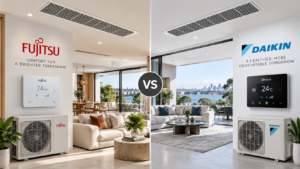
For Fujitsu vs Daikin ducted air conditioning, there is no honest winner for every Sydney house. Both offer capable systems. The better ducted air conditioning Sydney choice is the exact model that matches your home’s cooling load, roof space, airflow requirements, zoning plan, electrical supply and budget—and is then installed correctly.
If you are deciding between the two brands, do not start with the logo.
Start with your house.
A 14 kW system that has been correctly sized and connected to well-designed ducts can be a much better investment than a larger premium system installed with poor airflow.
That is the main takeaway from this comparison.
Quick Answer: Fujitsu vs Daikin Ducted Air Conditioning
Sydney homeowners should compare Fujitsu and Daikin using these factors:
| What to Compare | Why It Matters |
|---|---|
| Exact model | Specifications vary within each brand |
| Cooling capacity | Must match the home’s heat load |
| Heating capacity | Important for winter use |
| Indoor-unit dimensions | Determines whether it fits the roof |
| Static pressure | Affects how the fan works with duct resistance |
| Efficiency | Helps compare like-for-like systems |
| Sound ratings | Important near bedrooms and neighbours |
| Zoning | Affects comfort and how the house is used |
| Controller | This is what you interact with every day |
| Electrical supply | Larger systems may have different requirements |
| Refrigerant | Varies between ranges |
| Warranty | Check the actual current terms |
| Installation design | Often matters more than the badge |
| Total installed cost | Compare complete jobs, not equipment alone |
Current 2026 product information shows that both brands offer multiple ducted formats and capacities rather than one standard whole-home product. Fujitsu’s current R32 reference range spans compact bulkhead equipment through large high-static ducted systems, while Daikin’s Australian range includes standard, compact and Premium Inverter ducted products.
Is Daikin or Fujitsu Better for Sydney?
The better question is:
Which exact Daikin or Fujitsu model better suits your Sydney home?
Consider two houses.
Sydney Home A
- three bedrooms
- single storey
- good insulation
- modest windows
- easy roof access
- mainly occupied in the evening
Sydney Home B
- four bedrooms
- two storeys
- high ceilings
- large west-facing windows
- open-plan living
- upstairs bedrooms
- multiple rooms occupied throughout the day
Both homes may suit ducted air conditioning.
They probably should not receive the same system just because one particular brand is popular.
KYNEX’s current Sydney guidance takes the same approach: correct sizing, duct layout, return air and zoning should be planned around the building before equipment is chosen.
Daikin Ducted Air Conditioning Sydney: What Stands Out?
Daikin currently offers a broad Australian ducted range.
Its Premium Inverter range has expanded to include newer 18 kW and 20 kW R32 systems in addition to smaller whole-home capacities. Daikin also offers its standard Inverter Ducted range across numerous capacities, including equipment designed for restricted roof spaces.
That gives an installer flexibility when designing systems for:
- smaller family homes
- four-bedroom houses
- larger two-storey properties
- demanding heat loads
- limited roof spaces
What should you check on a Daikin quote?
Do not accept:
“Daikin ducted — 16 kW.”
Ask for:
- indoor-unit model
- outdoor-unit model
- nominal cooling capacity
- heating capacity
- indoor-unit dimensions
- controller supplied
- zoning system
- electrical requirements
- refrigerant
- number of outlets
- return-air design
- installed price
KYNEX’s current 2026 guide shows why this matters. A Daikin 16 kW system may have equipment worth only part of the total project price once ductwork, outlets, zoning, electrical work and installation are included.
Fujitsu Ducted Air Conditioning Sydney: What Stands Out?
Fujitsu’s current Australian reference material also shows a broad ducted range.
Its 2026 R32 line-up includes:
- bulkhead systems from about 2.5–5.0 kW
- mid-static slimline systems from 5.0–13.0 kW
- high-static systems from 7.1–16.0 kW
- larger high-static systems from 18.0–22.4 kW
Single-phase and three-phase options are available within relevant parts of the range.
That means a Fujitsu ducted system review should never simply say:
“Fujitsu is good.”
The useful question is:
Which Fujitsu model are we discussing?
A slimline 8.5 kW system and a large high-static 22.4 kW unit solve very different problems.
Fujitsu vs Daikin: Which Has the Better Capacity Range?
For an ordinary Sydney homeowner, this usually should not decide the purchase.
Both brands offer capacities that cover a wide range of residential projects.
Daikin currently offers residential ducted options extending above 20 kW across its Australian range, while Fujitsu’s current R32 reference material extends to 22.4 kW in its large high-static category.
But suppose your home needs roughly 12.5 kW.
It does not matter much that another model from either manufacturer can produce more than 20 kW.
Your goal is not to buy the most air conditioning.
Your goal is to buy the right amount.
Is Bigger Better?
No.
This is probably the biggest mistake people make while shopping for the best ducted air conditioner Sydney homes can use.
Imagine receiving two quotes:
Quote A
Daikin 16 kW.
Quote B
Fujitsu 14 kW.
It is tempting to think:
“16 is bigger, so it must be better.”
Not necessarily.
The installer should first assess:
- floor area
- ceiling height
- insulation
- glazing
- direction of major windows
- room use
- roof exposure
- number of occupants
- zones likely to operate together
Bedroom count alone is not enough.
KYNEX’s 2026 material makes exactly this point when discussing larger Daikin systems: two four-bedroom homes can have completely different heat loads because of glazing, levels, insulation and orientation.
Which Is Better for a Tight Sydney Roof Space?
This is where model-level comparison becomes useful.
Daikin’s current Inverter Ducted range specifically includes compact indoor-unit designs intended for tighter roof spaces.
Fujitsu’s current range includes separate bulkhead, slimline mid-static and high-static formats, giving installers different indoor-unit configurations depending on the application.
So there is no sensible brand-wide winner.
Ask your installer to show you:
- indoor-unit dimensions
- proposed roof position
- duct connection space
- service clearance
- filter or component access
A unit that physically fits is not enough.
A technician should also be able to reach it later.
That matters in Sydney homes with low-pitch roofs, renovations and complicated ceiling spaces.
Fujitsu vs Daikin: Which Is Quieter?
You need exact model numbers to answer this properly.
Sound levels vary according to:
- model
- system capacity
- indoor fan speed
- operating mode
- outdoor-unit conditions
Do not rely on statements such as:
“Daikin is quieter.”
or:
“Fujitsu is quieter.”
without technical data for the actual systems being quoted.
There is another problem.
Equipment sound ratings are only part of what you hear inside a house.
Duct design can create:
- rushing air
- whistling
- outlet noise
- vibration
Even quiet equipment can feel noisy if too much air is being forced through poorly sized ducts or small outlets.
What Is Static Pressure?
Static pressure sounds technical, but the basic idea is simple.
Your indoor fan has to move air through:
- ducts
- bends
- filters
- dampers
- outlets
All of these create resistance.
Static-pressure capability tells the designer something about how the indoor unit can deal with that resistance.
Fujitsu’s current technical data, for example, shows high-static equipment designed with adjustable static-pressure ranges for different duct arrangements. A 13 kW Fujitsu technical reference lists a 30–200 Pa range.
Daikin also provides multiple fan settings in relevant ducted systems so airflow can be matched to the duct configuration.
You do not need to calculate this yourself.
Your installer does.
Which Is More Energy Efficient?
Do not compare efficiency at brand level.
Compare model against model.
Efficiency changes with:
- capacity
- series
- outdoor conditions
- heating versus cooling
- operating load
And your electricity bill depends on far more than the equipment specification.
Real-world consumption is influenced by:
- insulation
- thermostat settings
- runtime
- outdoor temperature
- number of zones running
- duct losses
- household behaviour
A slightly more efficient system connected to badly leaking ducts is not automatically the cheaper system to run.
Which Is Better for Zoning?
Neither brand automatically wins because zoning is a system-design issue as well as an equipment issue.
Your finished installation may contain:
- zone dampers
- zone controller
- room sensors
- airflow management
- multiple temperature sensors
Imagine a family that uses:
living areas from 7am to 9pm
and:
bedrooms mainly overnight.
Good zoning can make sense.
Now imagine someone working from a home office alone for eight hours every day.
That household may need a different zoning strategy.
Before approving any ducted air conditioning installation in Sydney, ask:
- How many zones are proposed?
- Why?
- Which rooms share zones?
- What happens when most zones close?
- Are individual sensors included?
- How is minimum airflow managed?
More zones do not automatically mean a better system.
What About Controls and Wi-Fi?
This is one area homeowners often focus on too early.
A beautiful touchscreen cannot compensate for poor ducts.
But once system design is correct, controller features matter because you use them every day.
Compare:
- temperature control
- timers
- scheduling
- zone control
- Wi-Fi capability
- app access
- sensor integration
Also ask:
Is that feature included in this quote or is it an optional upgrade?
Two apparently similar prices may include very different control packages.
Fujitsu vs Daikin Ducted Air Conditioning Comparison Table
| Factor | Daikin | Fujitsu |
|---|---|---|
| Multiple residential capacities | Yes | Yes |
| Small/compact ducted options | Yes | Yes |
| Larger whole-home options | Yes | Yes |
| R32 available in current ranges | Yes | Yes |
| Single-phase options | Yes | Yes |
| Three-phase options in relevant ranges | Yes | Yes |
| Zoning possible | Yes | Yes |
| Exact model comparison required | Definitely | Definitely |
| Correct duct design still critical | Yes | Yes |
| Universal winner | No | No |
The most important row is the last one.
Which Brand Is Better for a Four-Bedroom Sydney Home?
There is not enough information in the phrase “four-bedroom home” to answer that.
Here is why.
House One
- 180 m²
- single storey
- good insulation
- limited western glass
House Two
- 280 m²
- two storeys
- high ceilings
- large windows
- strong afternoon sun
Both have four bedrooms.
The second could have a much greater heating and cooling load.
Before choosing either brand, KYNEX recommends assessing the house itself rather than buying by bedroom count. Its current planning guide says Sydney installations should account for room-by-room heat load, roof space, duct routes, return air and zoning.
What About Installed Price?
Compare the complete installed system, not the equipment price.
A quote may include:
- indoor unit
- outdoor unit
- ducts
- ceiling outlets
- return-air grille
- zone motors
- controller
- refrigeration pipe
- drainage
- electrical work
- outdoor mounting
- labour
- commissioning
KYNEX’s 2026 Sydney planning guidance puts many complete ducted projects at roughly $9,500–$18,000, with larger, difficult or double-storey projects capable of exceeding $22,000.
These are planning figures—not fixed Fujitsu or Daikin prices.
A 16 kW Daikin project, for example, commonly falls around $12,000–$18,000 in KYNEX’s current Sydney guidance, depending heavily on zoning, roof access and installation complexity.
An Example: When the Cheaper Brand Isn’t the Cheaper Quote
Imagine this.
Daikin quote — $14,000
Includes:
- appropriate-capacity system
- 9 outlets
- 4 zones
- controller
- electrical connection
- new return air
Fujitsu quote — $12,700
Includes:
- similar-capacity system
- 8 outlets
- 3 zones
But electrical work and removal of the existing equipment are excluded.
Which one is cheaper?
You cannot know yet.
Once the missing work is added, the prices could become very close.
This is why Daikin vs Fujitsu ducted air conditioning should be compared scope-for-scope.
What Matters More Than the Brand?
Installation quality.
A premium system connected to:
- undersized ducts
- leaking ducts
- badly placed outlets
- weak return air
- poorly planned zones
can still disappoint.
Before choosing either brand, look at KYNEX’s guide to the best ducted air conditioning system in Sydney. It explains why system sizing, ducts and zoning can matter as much as the equipment itself.
For a broader brand-selection checklist, see best ducted air conditioning brands in Sydney.
What Do KYNEX Customers Say in 2026?
Recent KYNEX customer feedback provides useful evidence about the installation side of the decision.
In August 2026, Chris P described professional workmanship after a new ducted installation.
Another August 2026 customer, Emma-Charlotte Browne, highlighted punctuality and the team’s willingness to explain how the ducted system worked.
In September 2026, Michael Cohen described KYNEX finding a workable solution for a difficult installation situation.
Those reviews do not prove that Daikin is better than Fujitsu, or vice versa.
They demonstrate a more useful point:
The people designing and installing the system matter.
Customer testimonials are individual experiences, not guarantees of future results.
How Can KYNEX Air Conditioning Sydney Help?
KYNEX Air Conditioning Sydney can assess the property before deciding which capacity and equipment configuration make sense.
For ducted air conditioning projects, a proper assessment should consider:
- property size
- ceiling height
- insulation
- glazing
- roof access
- duct routes
- return-air position
- zoning
- electrical supply
- outdoor-unit location
That allows Fujitsu and Daikin options to be compared around your house rather than forcing your house around a preferred model.
If your project is broader than ducted alone, KYNEX also provides residential air conditioning services in Sydney.
And when you have decided ducted is appropriate, a properly scoped ducted air conditioning installation in Sydney should clearly explain the proposed capacity, outlets, zones, return air, controls and electrical requirements.
Related Readings
- How Much Does a Daikin 16kW Ducted System Cost in Sydney in 2026?
- Does Ducted Air Conditioning Use a Lot of Electricity in Sydney?
Questions to Ask Before Choosing Fujitsu or Daikin
1. What exact model are you quoting?
Never compare brand names alone.
2. Why is this capacity correct for my home?
Ask how sizing was calculated.
3. What are the indoor-unit dimensions?
This matters for roof access.
4. What static pressure does the design require?
Your installer should understand the duct resistance.
5. How many outlets are included?
Check the proposed locations too.
6. How many zones?
More does not automatically mean better.
7. Which controller is included?
Ask about optional upgrades.
8. What electrical work is included?
Avoid surprises later.
9. What warranty applies?
Check the actual current terms supplied with your model.
10. Why did you recommend this system instead of the other brand?
A good installer should have a property-specific answer.
Fujitsu May Suit You If…
A Fujitsu system deserves consideration when a suitable model:
- matches the calculated capacity
- fits the roof layout
- suits the proposed duct resistance
- provides the controls you want
- fits the project’s electrical requirements
- represents competitive installed value
Notice that none of those reasons is:
“Because Fujitsu always wins.”
It does not.
Daikin May Suit You If…
A Daikin system deserves consideration when a suitable model:
- matches your home’s calculated load
- fits the available ceiling space
- suits your zoning design
- provides appropriate controls
- meets the electrical requirements
- makes sense at the final installed price
Again, the right answer depends on the model and property.
Final Verdict: Fujitsu vs Daikin Ducted Air Conditioning — Which Is Better?
For Sydney homeowners, Fujitsu vs Daikin ducted air conditioning does not have one universal winner.
Both currently offer:
- multiple residential capacities
- inverter ducted options
- compact equipment
- larger whole-home systems
- R32 equipment within current ranges
- zoning-compatible installations
The more useful comparison is:
exact Daikin model vs exact Fujitsu model.
Compare:
- capacity
- efficiency
- indoor-unit dimensions
- static pressure
- noise
- controls
- zoning
- electrical requirements
- warranty
- installed cost
Then compare the design surrounding the equipment:
- duct sizing
- outlet placement
- return air
- insulation
- zoning strategy
- commissioning
A well-designed Fujitsu system can be a better choice than a badly selected Daikin system.
A correctly designed Daikin system can likewise be a better choice than the wrong Fujitsu model.
So instead of asking:
“Which brand is better?”
Ask:
“Which exact system has been correctly sized and designed for my Sydney home?”
That question is much more likely to lead you to the right purchase.