

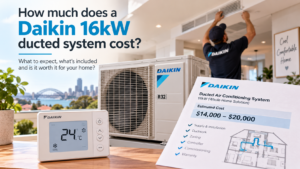
How Much Does a Daikin 16kW Ducted System Cost?
Short answer: in Sydney in 2026, a Daikin 16kW ducted system usually lands somewhere around $12,000–$18,000 fully installed — with a straightforward four-bedroom job sitting nearer the bottom of that range, and a tricky double-storey or heavily zoned install pushing past the top.
That’s the answer that’s actually useful.
Not “the unit costs $6,000.” And not “a ducted system costs $12,000.” Those two numbers describe completely different things, and mixing them up is how people end up shocked by a quote.
The Daikin outdoor and indoor equipment is only one slice of the project. A complete ducted install also brings in insulated ductwork, ceiling outlets, a return-air grille, zone motors, a zone controller, refrigerant pipework, drainage, electrical work, roof-space labour, mounting the outdoor unit, and commissioning at the end.
So when someone asks “how much is a 16 kW Daikin?”, the sharper question is: “how much will a properly designed 16 kW Daikin ducted system cost in my house?” That’s where the real number lives.
Quick answer: Daikin 16kW ducted system cost in 2026
For Sydney planning purposes:
| Project type | Approximate installed range |
|---|---|
| Straightforward 16 kW ducted install | Around $12,000–$14,000 |
| Typical 4-bedroom Sydney home | Around $12,000–$16,000 |
| More zones / premium controller | Around $14,000–$18,000 |
| Double-storey or difficult retrofit | Around $16,000–$20,000+ |
| Major electrical/building/access work | Can exceed $20,000 |
These are planning ranges, not fixed quotes. As a real-world benchmark, one current Sydney 2026 package lists a Daikin 16 kW inverter ducted system — 4 zones, 9 round outlets, installation included — at roughly $12,188. Handy as a reference point, but don’t paste it onto every house and assume it fits.
What exactly is a Daikin 16kW ducted system?
Daikin currently offers 16.0 kW capacity in its Premium Inverter residential ducted range. A ducted system is really a team of parts working together:
- One indoor unit — usually tucked away in the roof or ceiling space.
- One outdoor unit — mounted outside the home.
- Ductwork — carries the conditioned air to your rooms.
- Ceiling outlets — deliver the air into each space.
- Return-air grille — pulls indoor air back to the system.
- Controller — sets temperature and mode.
- Zoning — lets parts of the home run separately, where it’s designed to.
Daikin’s current Premium Inverter range includes 16.0 kW reverse-cycle systems running R32 refrigerant for the applicable capacity range. In plain terms, 16 kW sits firmly in whole-home territory — but that doesn’t mean every four-bedroom house automatically needs it.
Is 16kW enough for a four-bedroom house?
Often, yes — but you can’t size ducted air conditioning by bedroom count alone, and this is the trap most people fall into.
Take two houses.
House A: four bedrooms, single storey, good ceiling insulation, moderate glazing, a shaded western side.
House B: four bedrooms, two storeys, big western glass, open-plan living, high ceilings, poor insulation.
Both listings say “4 bedrooms.” Their heat loads are worlds apart. House B might need more capacity even though it looks identical on paper.
Proper sizing weighs floor area, ceiling height, windows, insulation, orientation, occupant numbers, roof exposure, room use and zoning. Which is why choosing 16 kW just because your neighbour with four bedrooms bought one is genuinely risky.
Why does a 16kW ducted system cost so much more than the unit?
Because you’re buying a system, not a box.
A current Sydney supply-only listing for a 16 kW Daikin ducted unit is around $5,957 — but a complete installation can be roughly double that or more. So where does the rest go? Into everything you can’t see in the product photo.
1. Ductwork
Flexible insulated duct carries the conditioned air through your roof. A bigger home can need long runs, multiple branches, larger main ducts, more fittings and careful routing. Skimp here and you get heat gain, airflow loss, noise and leakage. The hidden part of the system can matter every bit as much as the Daikin unit bolted to the wall.
2. Zones
A four-bedroom home might run zones like living, main bedroom, other bedrooms, and study or upstairs. More sophisticated zoning — motorised dampers, room sensors, smart controls, variable airflow — adds cost, but it also makes a big system far more practical to live with. Without zoning, you can end up cooling the whole house to keep one person comfortable in the lounge.
3. Number of outlets
That current 16 kW Sydney package with nine outlets is a useful reference, but one house might need eight and another eleven or twelve. More outlets mean more duct branches, more grilles, more labour and more balancing — and that moves the price.
4. Roof access
Easy to underestimate, this one. An installer working in a big, open roof cavity moves fast. An installer crawling through a tight, low-pitch roof full of beams, plumbing, wiring and insulation has a completely different day. Labour time climbs, and sometimes the ideal indoor-unit spot becomes impossible. Roof access alone explains why two near-identical Sydney houses can get very different quotes.
5. Single-storey vs double-storey
Single storey is usually simpler. A double-storey home can demand awkward duct routes, vertical risers, bulkheads, separate roof areas and extra access work. That’s why KYNEX’s current 2026 planning guide puts many double-storey ducted projects around $14,000–$18,000+, with the harder jobs going higher. Same Daikin unit, two totally different projects.
6. Electrical work
A 16 kW system needs the electrical side to suit the equipment — potentially a dedicated circuit, isolator, cable run, switchboard work, protection devices, and single-phase or three-phase requirements depending on the model. Don’t assume your existing setup is ready, and make sure the quote spells out what electrical work is included.
Daikin 16kW ducted system cost: example Sydney budget
An illustrative breakdown:
- Equipment (Daikin indoor + outdoor units): about $6,000
- Ductwork and outlets (depending on the home): $2,000–$4,000
- Zoning and controls (depending on spec): $1,000–$3,000
- Refrigeration and installation materials: roughly $1,000–$2,000
- Labour and commissioning: roughly $2,000–$4,000+
That lands the project in a broad range around $12,000–$18,000+. Again — a planning example, not a quote.
Ducted air conditioning cost, 4-bedroom house
This is probably the search closest to a 16 kW system. KYNEX’s current 2026 ducted planning figures put many typical four-bedroom Sydney installs around $12,000–$16,000, while another KYNEX cost page uses a wider $15,000–$22,000 range for 14–16 kW four-bedroom systems.
Why the gap? Because “four-bedroom home” still covers an enormous spread of projects. A simple single-storey four-bedder can sit near $12,000. A large, complex home with smart zoning, premium outlets, difficult access, long ducts and electrical upgrades can march toward $20,000 or beyond. A range is simply more honest than a single number.
What about a three-bedroom home?
A 16 kW system is oversized for many three-bedroom homes. KYNEX’s current planning guide puts typical three-bedroom ducted projects around $9,500–$13,500, often using lower-capacity systems.
That said, 16 kW isn’t automatically wrong for a three-bedder — a big one with oversized living areas, high ceilings, extensive glazing and a high heat load might still need serious capacity. But that call should come from a heat-load assessment, not the number of bedrooms.
Cheap ducted air conditioning in Sydney: should you chase the lowest quote?
Be careful here. There’s nothing wrong with a competitive price — but a cheap ducted air conditioning Sydney quote can turn expensive later if the saving comes from cutting duct size, insulation, outlets, return-air capacity, zoning quality or commissioning time.
Ask what’s included. A $12,000 quote with proper zoning, good duct insulation, suitable return air and electrical work bundled in may be far better value than an $11,000 quote that quietly leaves several of those out. Compare scope, not just the total.
What does a proper 16kW quote need to show?
Look for: the exact Daikin model; why 16 kW is suitable for your home; how many zones and how they operate; outlet number, type and location; return-air size and position; ductwork insulation and layout; whether electrical work is included or excluded; standard or upgraded controller; old-system removal if relevant; equipment and workmanship warranty; and a final price including GST.
If the quote just says “Daikin 16kW ducted — $15,000,” start asking questions.
Is a Daikin 16kW system expensive to run?
It can be — if you run the whole house constantly. But here’s the key point people miss: 16 kW is the cooling capacity, not the electrical draw. The unit does not constantly pull 16 kW from the wall.
Daikin’s Premium Inverter technical data shows a 16 kW-class configuration with rated cooling input in the mid-single-digit-kW range — nothing like a 16 kW electrical draw. And inverter systems constantly vary their output, so real running cost depends on zones, heat load, outdoor temperature, thermostat setting, runtime, insulation and your electricity tariff. KYNEX’s current ducted air conditioning running cost Sydney guide gives homeowners a much better way to think about hourly cost than simply multiplying 16 by an electricity rate.
A simple running-cost example
Say the system averages 4 kW of electrical draw at 33.14c/kWh:
4 × $0.3314 = about $1.33 an hour, or about $7.95 over six hours.
Actual use may run lower or higher. Fewer zones and a modulating inverter push it down; most zones open while fighting extreme Sydney heat pushes it up. That’s exactly why zoning matters.
Is 16kW too big?
Bigger isn’t automatically safer. An oversized air conditioner can cost more upfront, cycle differently, struggle with airflow on small zones, and simply hand you more capacity than the house will ever use.
The best capacity is the one that matches the load — not the largest system your switchboard can handle. Before you commit to 16 kW, ask one question: what calculation says my house needs 16 kW? A good installer should be able to walk you through the reasoning.
Daikin 14kW or 16kW?
This is a common fork for medium-to-large Sydney homes, and you shouldn’t pick 16 kW just because “it’s only a bit more expensive.” Capacity should follow the property.
A 14 kW system may suit a smaller home with good insulation, zoning that spreads out the load, and moderate glazing and heat gain. A 16 kW system makes more sense with larger floor area, several zones running together, big living areas and a higher heat load. Let the design justify the difference.
What about 18kW?
A current Sydney installed package lists an 18 kW Daikin ducted system — 10 outlets, 4 zones — at approximately $12,624, only modestly above the same supplier’s 16 kW package.
That reveals something important: equipment capacity isn’t the only thing driving price. Once you’re already installing ducts, zones, outlets, controls and electrical work, stepping up one capacity level may not move the total much. But that’s not a reason to oversize — choose the correct system, not the best dollar-per-kilowatt ratio.
What do 2026 Sydney customers say?
Recent KYNEX reviews give useful signals about what actually matters in a ducted install. In August 2026, Chris P described having a new Daikin ducted system installed and highlighted the professional workmanship. Also in August 2026, Emma-Charlotte Browne described the ducted team as punctual, polite and happy to explain the system. And on 13 September 2026, Michael Cohen described KYNEX finding a workable solution to an installation challenge that had tripped up other quotes — while calling the resulting quote competitive.
None of that tells you what your 16 kW system will cost. But it points at the things genuinely worth judging: problem-solving, quoting, workmanship, explanation and installation planning. Those matter far more than an online equipment price.
How KYNEX Air Conditioning can help with a 16kW Daikin quote
KYNEX Air Conditioning works with ducted systems across Sydney and publishes current 2026 pricing guidance for residential installs.
For a 16 kW Daikin, a proper site assessment should look at floor area, room-by-room heat load, roof access, duct routes, number of zones, outlet locations, return-air design, outdoor-unit position, electrical supply, insulation, and how many rooms tend to run at once.
For homeowners comparing Ducted Air Conditioning Services Sydney, the goal isn’t to force a 16 kW unit into the quote — it’s to find out whether 16 kW is actually the right capacity in the first place. And if you’re weighing up broader aircon sydney options, that same assessment helps decide whether ducted is genuinely better value than a set of split systems.
Daikin 16kW ducted system cost calculator
Start with the base system and installation: $12,000–$14,000.
Then add for possible extras — extra zones, extra outlets, a smart controller, difficult roof access, an electrical upgrade, a double-storey installation, removing the old system, or any building/access work.
Stack a few of those and your final number moves toward $15,000–$18,000+. Which is exactly why a site inspection matters more than a headline price.
Signs a 16kW quote is worth questioning
- The installer never measures anything. Bedroom count isn’t system sizing.
- There’s no explanation for 16 kW. Ask why that capacity was chosen.
- Zones aren’t clearly defined. You need to know what you can actually control.
- Outlet count is missing. It affects both comfort and cost.
- Electrical work is vague. Pin down what’s included.
- The price is extremely low. Check whether ductwork, controls, electrical and commissioning are all in there.
- The price is very high. Ask which installation complexities justify it.
The total should tell a story. If it doesn’t, keep asking.
Frequently asked questions
How much does a Daikin 16kW ducted system cost? For many Sydney homes in 2026, roughly $12,000–$18,000 fully installed is a realistic planning range.
How much is the Daikin 16kW unit by itself? One current Sydney supply-only listing is about $5,957 for the equipment package. Installation and ductwork are extra.
Is 16kW enough for a four-bedroom house? Often, but not always. Home size, insulation, glazing, orientation and heat load matter more than bedroom count alone.
Is 16kW too large for a three-bedroom home? It may be for many three-bedroom houses. A proper load assessment should justify the capacity.
How many outlets should a 16kW system have? There’s no fixed number. A current Sydney package uses nine, but the right count depends on room layout and airflow needs.
How many zones should a 16kW ducted system have? Many residential systems use around 4, but more or fewer can be appropriate. Zone design should maintain safe system airflow.
Why is installation almost as expensive as the unit? Because ductwork, zoning, outlets, electrical work, refrigerant pipework, roof labour and commissioning make up a large part of the project.
Is Daikin 16kW single phase? Daikin’s current Premium Inverter range offers configurations that can be single-phase or three-phase depending on model and capacity. Confirm the exact model in your quote.
How much does a 16kW Daikin cost to run? There’s no fixed hourly figure. Actual electrical input is far lower than the 16 kW cooling-capacity number and changes with inverter load, zones and conditions.
Does zoning reduce running costs? It can, by cutting unnecessary conditioning of unused areas — provided minimum airflow requirements are maintained.
Is a 16kW system worth it? It can be excellent value when the home’s heat load genuinely needs that capacity and multiple rooms are heated and cooled regularly.
Related Readings:
- Should You Leave Ducted Air Conditioning On All Day in a Sydney Heatwave?
- Fujitsu vs Daikin Ducted Air Conditioning: Which Is Better for Sydney Homes?
Final verdict: what should you budget for a Daikin 16kW ducted system?
For a realistic Sydney number, budget roughly $12,000–$18,000 fully installed.
A straightforward four-bedroom job may land near $12,000–$14,000. A more involved one — better zoning, more outlets, difficult roof access, electrical work — tends toward $15,000–$18,000+. Complex double-storey projects can go higher again.
The big mistake is fixating on the price of the Daikin equipment alone. A good ducted system is equipment plus ducts plus airflow plus zones plus electrical work plus installation design — all of it.
So the most important question isn’t “Can I get a 16 kW Daikin for $12,000?” It’s: “Does my house actually need 16 kW, and what exactly am I getting for the installed price?” Nail down those two answers and comparing ducted quotes suddenly gets a whole lot easier.