

Best Ducted Air Conditioning Brands: What Sydney Homeowners Should Actually Compare
Ask most people which ducted air conditioner is “the best,” and they’ll name a brand. Fair enough — that’s how we shop for most things. But with a ducted system, the badge on the outdoor unit is only a small part of the story, and it’s rarely the part that decides whether your bedrooms are comfortable in February.
The truth is that the best ducted air conditioning systems brands aren’t automatically the biggest, the priciest, or the ones with the longest feature list. What actually matters is whether the system is the right size for your home, how efficient it is in real conditions, how quiet it runs, what zoning and controls it offers, how it’s backed after the sale — and, above all, how well the whole thing is designed and installed.
That last point trips up more people than any other.
You can bolt a premium air conditioner onto poor ductwork and still end up with hot back bedrooms, whistling vents, weak airflow, ugly power bills, and rooms that never quite match each other. Meanwhile a sensibly sized unit on well-planned ducts and zones can feel like a completely different house.
So the more useful question isn’t “which ducted air conditioner brand is best?” It’s “which system actually suits my house — and who’s going to design and fit it properly?”
The short version
If you just want the checklist, here’s what to weigh up when you’re comparing ducted air conditioning brands:
- Correct capacity for your home (not the house next door)
- Inverter performance and rated efficiency
- Indoor and outdoor noise levels
- Zoning options and controller compatibility
- Smart/app control (if you’ll actually use it)
- Physical size of the indoor unit and whether it fits your roof
- Electrical requirements
- Warranty terms and long-term parts support
- The installer’s experience with that particular system
- Total installed price — not just the equipment
- Duct and return-air design
Don’t buy from the logo alone. Our current 2026 guidance at KYNEX Air Conditioning Sydney lands in the same place: the best system is usually the one that gets sizing, duct design and zoning right for the specific property in front of us.
“Best” means different things to different people
This is where online comparisons quietly mislead you.
To one homeowner, “best” means the lowest running cost. To another, it’s silent bedrooms at 2am. A family in a big two-storey place might care most about serious whole-home grunt and clever zoning. Someone replacing a tired old system might just want gear that plays nicely with the ducts they already have.
They’re all right. That’s exactly why there’s no single “best ducted AC brand” that wins in every house. The smarter move is to build a shortlist, then compare the specific models that match your home’s calculated heating and cooling load.
Start with size, not the brand
Sizing should come before you look at a single logo.
Ducted systems come in a range of capacities — think 10kW, 12.5kW, 14kW, 16kW, 18kW and so on. And here’s the bit people get wrong: a four-bedroom home doesn’t automatically need 16kW.
Picture two Sydney houses, both four-bed.
House A is single storey, well insulated in the ceiling, moderate glass, decent shade.
House B is two storeys, with a wall of west-facing glass, open-plan living, high ceilings, and brutal afternoon sun.
Same bedroom count. Wildly different cooling load.
Our current guidance stresses that proper sizing weighs up floor area, insulation, glazing, ceiling height, orientation and how many zones are realistically going to run at once. Which means a well-justified 14kW system can genuinely outperform a lazily specced 16kW one. Bigger isn’t better — right is better.
Compare the exact model, not just the name
This might be the single most useful tip in the whole guide, so it’s worth slowing down for.
Say two quotes both read: “Premium ducted system — 16kW.” They sound identical. They often aren’t. Within one brand you’ll find different model ranges, capacities, efficiency tiers, controllers, indoor-unit dimensions, electrical needs and features.
So write down the actual model numbers, then compare model against model. Otherwise you can end up pitting an entry-level unit from one range against a higher-spec unit from another and thinking you’re comparing apples with apples.
What about Daikin ducted air conditioning?
Daikin ducted air conditioning comes up constantly when Sydney homeowners are shopping for a whole-home system, and for good reason — it’s a well-established name. Our current 2026 material covers Daikin across a spread of residential capacities, including the 16kW-class gear that suits larger homes.
When a Daikin quote lands on your kitchen table, check the exact model, the rated cooling and heating capacity, the electrical input, the indoor-unit dimensions, the controller that’s actually included, the proposed zoning, the supply requirements, the warranty, and the installed price.
In other words, don’t ask “is Daikin any good?” Ask “is this Daikin model right for my house?” Much better question.
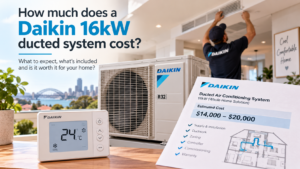
If you’re leaning towards a larger setup, we’ve put together a detailed breakdown of Daikin 16kW ducted system cost, including the gap between the price of the equipment and the cost of the finished project. As a planning figure, many 16kW Daikin installs in Sydney sit somewhere around $12,000–$18,000 installed in 2026 — though tricky roof access, more advanced zoning, extra electrical work and complicated homes can push that higher. Treat it as a ballpark for budgeting, not a quote.
And Mitsubishi ducted air conditioning?
Mitsubishi ducted air conditioning shows up just as regularly when Australians are weighing up premium systems. One thing worth flagging: always check the exact manufacturer and model number on the proposal rather than trusting the word “Mitsubishi” on its own. (It’s a name that appears on more than one company’s gear, which catches people out.)
From there, you’re checking the same things you’d check with any premium system — required capacity, rated efficiency, sound data, indoor-unit size, controller, zoning compatibility, electrical needs, warranty, serviceability and installed price.
You’ll notice I’m deliberately not crowning Daikin or Mitsubishi the universal winner. That would mean ignoring the actual house. One model might suit a particular roof cavity, electrical setup or capacity requirement better than the other. Let the installation design steer the brand — not the other way round.
Does efficiency tell you which brand is best?
It helps. It’s just not the whole story.
Your real electricity use depends on far more than the sticker on the outdoor unit — outdoor temperatures, insulation, glazing, where you set the thermostat, how many hours you run it, how many zones are going at once, duct leakage, airflow, system size and your electricity tariff all pull on the bill. That’s why two families with near-identical air conditioners can open very different power bills.
So use efficiency data as one input. Don’t let it become the entire decision.
Quick word on inverters
Almost every premium ducted system today uses inverter technology. In plain terms, an inverter lets the compressor dial its output up and down instead of only slamming between full power and off.
Think of driving. You don’t floor the accelerator everywhere and then cut the engine every time you need to slow — you feather the power. An inverter does something similar, adjusting as conditions change.
Just don’t read that as “it’ll barely sip electricity.” A big Sydney home on a 40-degree afternoon still needs serious cooling. The advantage is that the system modulates to the demand rather than behaving like a crude on/off machine.
How much does noise really matter?
A lot. Especially once the house goes quiet at night.
There are two sides to it.
Outdoors: ask exactly where the outdoor unit is going. Think about nearby bedrooms, the neighbours, courtyards, entertaining areas and boundaries. Don’t let it get parked somewhere purely because that spot is easy to plumb.
Indoors: the indoor unit usually hides in the roof or ceiling space, so it’s rarely the problem itself. The noise you hear — rushing air, whistling, vibration, clunks as zones change, an over-worked fan — tends to come from duct and outlet design, not the box in the ceiling. Which is one more reason the brand alone can’t guarantee comfort. A whisper-quiet unit can still feed a noisy duct run.
Will it actually fit your roof?
Easy to overlook, occasionally expensive to ignore.
Before you fall for the feature list, ask a blunt question: will this gear physically fit — and be serviceable — in my roof? Sydney housing stock is all over the place. A newer home might have a generous roof cavity with room to spare. An older terrace, a low-pitch roof or a mid-reno tangle might give you barely any.
A good installer plans for the indoor-unit dimensions, service clearances, access, duct connections, drainage and — crucially — future maintenance. Don’t accept a design that technically wedges in but can never be worked on again.
How much zoning do you really need?
Zoning is genuinely valuable for a lot of whole-home systems. It lets you split the house into separate areas — master, kids’ rooms, living, study, upstairs, downstairs — and condition them to suit how the place is actually being used.
But please don’t fall into the “more zones equals better system” trap. Zones have to work with the air conditioner’s airflow requirements. A poorly planned eight-zone job can perform worse than a well-thought-out four-zone one.
Good questions to ask: How many zones do you recommend, and why are the rooms grouped like that? What happens when only one small zone is running? Does the controller manage airflow? Are room sensors included? Can we adjust the zones down the track?
The controller is the bit you’ll live with
Everyone fixates on the outdoor unit during the buying process. But once it’s in, the thing you actually touch every day is the controller.
Check whether your proposed setup includes a wall controller, zone controls, temperature sensors, timers, scheduling, Wi-Fi, app control and room-by-room control.
Some people love a full smart-home rig. Others just want on, off, temperature, zone — and there’s nothing wrong with either. Don’t pay for tech you’ll never open. But don’t settle for a bare-bones controller and then discover six months later that you really wanted room-level control after all.
Read the warranty properly
“It comes with a warranty” isn’t an answer. Read the actual terms.
How long is the equipment covered? Which parts? What labour? Who handles a claim if something fails? What servicing is expected, and do you need proof of it to stay covered?
And keep two things separate in your head: the manufacturer’s warranty on the equipment, and the installer’s obligation for their own workmanship. They’re not the same thing, and it pays to know who you’ll be calling.
Parts and support — think ten years out
Most of us focus on the day we buy. Try to picture year ten instead.
Ask about replacement controls, sensors, circuit boards, fan components, zone motors and general service support. Nobody can promise what a part will cost a decade from now, or that every component will still be on the shelf — but a brand with established support channels absolutely belongs in your comparison. A great system isn’t much use if a minor fault turns into a hunt for parts.
What should a premium ducted system cost?
This is where brand comparisons get slippery, because the equipment is only one line on the invoice.
A complete install can also cover insulated ducts, ceiling outlets, return air, dampers, zoning, controls, refrigerant pipe, drainage, electrical work, mounting the outdoor unit, labour and commissioning. Which is exactly why two quotes on the same brand can differ by thousands.
One home might have easy roof access, eight outlets and simple zoning. Another might have awkward access, eleven outlets, sophisticated zoning, an electrical upgrade and two storeys to service. Don’t write an installer off as “expensive” until you’ve compared the whole scope of works, line for line.
A comparison table worth using
Print this, or paste it into your notes, and fill it in as quotes come through:
| Feature | System A | System B |
|---|---|---|
| Exact model | ||
| Cooling capacity | ||
| Heating capacity | ||
| Inverter system | ||
| Rated efficiency | ||
| Indoor noise data | ||
| Outdoor noise data | ||
| Indoor-unit dimensions | ||
| Controller | ||
| Number of zones | ||
| Room sensors | ||
| Wi-Fi / app option | ||
| Electrical requirements | ||
| Equipment warranty | ||
| Installed price | ||
| Duct specification | ||
| Return-air design |
It quietly changes the question from “which brand sounds nicer?” to “which complete system gives my house what it needs?”
Brand or installation — which matters more?
Honestly, you need both. But a premium brand won’t rescue you from a poor install.
Connect a good air conditioner to undersized ducts, leaky joints, badly placed outlets, choked return air and rushed zoning, and it may never perform the way the brochure promised. That’s precisely why our guide to the best ducted air conditioning system leans so hard on sizing, duct design and zoning rather than declaring one logo the winner. The hidden half of a ducted system deserves as much attention as the shiny half.
The mistakes we see most often
Going too big. More capacity isn’t a safety margin — match the heat load.
Buying on equipment price alone. The unit is one piece of a much bigger project.
Ignoring duct design. Those hidden ducts carry the air you’ve paid to heat and cool. Skimp there and you’ll feel it.
Over-zoning. More controls don’t automatically mean more comfort.
Forgetting return air. The air has to get back to the unit. It’s the step people never think about.
Comparing brand names instead of exact models. Different models under one brand can vary hugely.
Underestimating roof access. Roof conditions shape both the design and the final price.
A real-world Sydney example
Picture a family weighing up two premium 16kW systems. System A is a bit cheaper. System B is $1,500 more. On price alone, System A looks like the better deal.
Then you read the quotes properly.
System A: eight outlets, four basic zones, a standard controller.
System B: ten outlets, five zones, better room control, the electrical work included, and removal of the old system.
You’re not comparing two air conditioner brands anymore — you’re comparing two different installations. That’s why brand rankings on their own so rarely answer the question the homeowner is actually asking.
What 2026 customers tell us afterwards
Feedback we’ve published through 2026 is a decent window into what people notice once the dust settles. The themes that come up are professional workmanship, turning up on time, clear explanations, sorting out tricky installs, and fair quoting.
To give a sense of it: our September 2026 material describes a customer praising the team for finding a workable fix to a difficult installation, while August feedback focused on the workmanship on a new ducted system and the team taking the time to explain how it all worked.
Notice what’s not in there. Almost nobody rings up afterwards to talk about the badge on the outdoor unit. They talk about whether the system works, whether the house is comfortable, whether the install looks neat, whether the controls make sense, and whether the installer solved the problems. That’s the thing you’re really paying for.
How KYNEX can help
We handle whole-home ducted installations right across Sydney, and we don’t spec gear off the bedroom count. A proper assessment looks at the home’s size and floor plan, insulation, windows, sun exposure, roof space, electrical supply, duct routes, zoning needs, return air, where the outdoor unit can sensibly live, and how your household actually uses each room.
Our published 2026 material also reflects more than ten years in the trade and thousands of systems serviced or installed around Sydney. The goal was never to jam one favourite brand into every house — it’s to choose and fit ducted air conditioning systems that genuinely suit the building and the people living in it.
15 questions to ask before you sign
- Why is this capacity right for my house?
- What exact model are you quoting?
- What makes this model suitable for my roof space?
- How efficient is it at its rated capacity?
- How noisy is the indoor unit?
- How noisy is the outdoor unit?
- How many outlets are included?
- How many zones are included?
- How will airflow be managed when zones close?
- What controller comes standard?
- Can I add app or Wi-Fi control later?
- What electrical work is required?
- What does the warranty actually cover?
- What parts of the installation are excluded?
- Why this exact model over the alternatives, for my house specifically?
That last one is gold. A good installer should be able to answer it without blinking.
Related reading
Before you pick between premium ducted air conditioner brands, these two guides will help you compare the whole installation instead of just the box:
- Ducted Air Conditioning Replacement: Repair or Replace Your Existing System?
- Daikin vs Mitsubishi Ducted Air Conditioning: Which System Suits Your Home?
The verdict
There’s no single best ducted air conditioning brand for every Sydney home. Not the most thrilling answer, I know — but it’s the honest one.
Daikin ducted air conditioning, Mitsubishi ducted air conditioning and the other premium options are all worth considering, provided you compare the exact model rather than the logo. Start with the fundamentals: correct capacity, efficiency, noise, physical size, zoning, controller, smart features, electrical requirements, warranty, parts support and installed cost.
Then look at the thing most brand-comparison articles skate right past — the installation design. A premium outdoor unit won’t fix undersized ducts. A fancy controller won’t fix poor airflow. And a bigger air conditioner won’t fix bad sizing.
So the question to carry into every quote isn’t “which brand wins?” It’s “which exact system gives my Sydney home the right capacity, airflow, controls and long-term support — and who’s going to install it properly?”
Answer that, and choosing between the best ducted air conditioning brands gets a whole lot easier.