

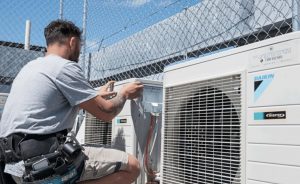
Where Do You Actually Put the Outdoor Unit on a Heritage Terrace in Sydney’s Inner West?
Planning air conditioning Sydney Inner West installation on an old terrace and wondering where the condenser can legally and sensibly go? The short version: for most heritage terraces, the outdoor unit belongs at or behind the rear building line — tucked away from the street façade and well clear of the neighbour’s bedroom windows. And if your terrace is an actual listed heritage item, current NSW exempt-development standards go a step further: the unit has to be ground-mounted.
Simple enough on paper.
On a skinny Newtown, Balmain, Leichhardt, Marrickville or Petersham terrace, it’s rarely that tidy.
Your rear courtyard might be barely a few metres across. The neighbour’s bedroom could be sitting almost on the boundary. Add in a narrow side passage, century-old brickwork, a balcony overhead, awkward drainage and nowhere obvious to hide a condenser without choking its airflow — and suddenly “just stick it out the back” stops being a plan.
Which is exactly why placement should be sorted before anyone buys the system, not after the installer turns up with the gear in the van. If you’re researching air conditioning sydney inner west, this is one of the most important calls you’ll make in the whole assessment.
A quick note on the rules and figures: The measurements, operating hours and planning standards in this article reflect current NSW exempt-development and noise rules at the time of writing, and they can change. Heritage status varies property by property. Always confirm the specific requirements for your home with your council, a licensed installer, or the relevant NSW planning and EPA guidance before committing to a location or design.
The Short Answer: Where’s the Best Spot?
For a lot of Inner West heritage terraces, the first place worth looking is a discreet rear courtyard or service area — positioned at or behind the rear building line, with enough breathing room for airflow and servicing, and as far as you can practically get it from the neighbour’s bedroom windows.
But before you call that spot “sorted,” run through this checklist:
- Is the house individually heritage listed, or just inside a conservation area?
- Can you see the unit from the street?
- Is ground-mounting required?
- How close is the boundary?
- Is there a neighbouring bedroom nearby?
- Can the condenser actually breathe?
- Where does the condensate drain to?
- Can a technician reach it in five years’ time?
- Will vibration travel into the old masonry?
- Will the hum bother anyone next door?
A good installation answers all of those at once, not one at a time.
First Thing to Check: Heritage Item, or Just a Conservation Area?
This trips people up constantly.
Plenty of homeowners say “my house is heritage” when what they really mean is “my street is inside a heritage conservation area.” Those aren’t the same thing, and the difference changes what you’re allowed to do.
Your terrace might be:
- an individually listed heritage item
- a contributing building within a conservation area
- a non-contributory building inside one, or
- outside the heritage controls entirely
The Inner West is packed with heritage conservation areas. The Enmore-Newtown area, for instance, is recognised for its Victorian and Federation-era terrace housing and the way that built form tells the story of how the neighbourhood grew. Which is precisely why a chunky condenser bolted to an ornate street façade tends to cause grief.
So before you design anything, confirm your property’s actual heritage status — not what the real-estate listing claimed or the previous owner reckoned.
What the NSW Rules Actually Say
Here’s where it gets refreshingly clear.
Under the current NSW exempt-development standards for residential air-conditioning units, the unit generally has to:
- not sit on the wall or roof facing the primary road
- not sit forward of the primary-road building line
- be at least 450 mm from each lot boundary
- be at least 1 metre from bedrooms of adjoining homes
- not reduce the building’s structural integrity
- meet the applicable noise requirements
For a heritage item, the unit must be ground-mounted. And for a heritage item, draft heritage item, heritage conservation area or draft conservation area, it needs to sit at or behind the rear building line if you want the job to fall within the relevant exempt-development standard.
The takeaway for Inner West homeowners: think rearward, discreet and neighbour-aware. Don’t start your design at the front balcony just because it’s the handiest spot.
Can the Condenser Go on the Front of the Terrace?
Almost always, that’s the one place to avoid.
The front façade is usually the most important heritage feature the terrace has. Picture a classic Inner West streetscape — iron lacework, rendered parapets, brickwork, verandahs, tiled paths, timber doors, and that repeating rhythm of terrace fronts down the whole street. Stick a condenser above the front door or off a decorative balcony and you’ve broken it.
The rules back this up: current NSW exempt-development provisions say a residential air-conditioning unit can’t go on the wall or roof facing the primary road, or forward of the building line to that road. So the front wall shouldn’t be anywhere near the top of your list.
What About the Rear Courtyard?
Often, yes — that’s the logical first place to investigate. It usually offers less visual impact from the street, easier compliance with the heritage-positioning principles, shorter runs of exposed pipework, the possibility of ground-mounting, and better access for future maintenance.
But “rear courtyard” on its own doesn’t guarantee a good install.
Picture a courtyard 2.5 metres wide. The installer pushes the condenser hard against one side, and directly behind that fence is the neighbour’s bedroom. The unit looks beautifully hidden from your place — while creating a genuine noise problem for the person next door. Placement has to work for both properties, not just yours.
How Far From the Boundary?
For a unit relying on the NSW exempt-development provisions, the current standard is at least 450 mm from each lot boundary. There’s a second measurement Inner West owners really need to know: the unit must also be at least 1 metre from bedrooms of adjoining residences.
On a big suburban block, easy. On a terrace only a few metres wide, those two numbers can instantly rule out the “obvious” spot. That’s the whole reason an installer should look at your wall and the neighbour’s layout before locking anything in.
Let’s Talk About Noise (Because Everyone Underestimates It)
An outdoor unit can seem perfectly quiet when you’re standing next to it on a busy afternoon. At midnight, on a silent street, with the neighbour’s window open, that same mechanical hum reads very differently.
And the rules here are brand new. The Protection of the Environment Operations (Noise Control) Regulation 2026 commenced on 28 August 2026. For domestic air conditioners, the noise generally shouldn’t be audible inside a neighbour’s residential room:
- before 8 am or after 11 pm on weekends and public holidays
- before 7 am or after 11 pm on other days
There’s an exception to those time limits during a Bureau of Meteorology-declared severe or extreme heatwave. But that doesn’t mean noise is a free-for-all the rest of the time — NSW EPA guidance makes clear that offensive noise can still be dealt with outside those restricted hours.
The lesson? Don’t design an installation that only works as long as your neighbour never complains. Design it to be considerate from day one.
What If the Neighbour’s Bedroom Is at the Rear Too?
Classic Inner West dilemma. You walk into the courtyard, spot the perfect corner — then clock the window across the boundary, and realise it’s their bedroom.
Options worth exploring: the opposite side of the courtyard, a rear service area, a ground position further from that window, a better-screened spot that still allows unrestricted airflow, or even rethinking where the indoor unit goes so a different condenser route opens up.
What you shouldn’t do is cram the condenser into a tight little box just to hide it. Outdoor units dump heat into the surrounding air — restrict that airflow and you’ll hurt performance and make servicing a nightmare.
Can I Wall-Mount It?
Sometimes — but heritage status is the deciding factor. If the building itself is a heritage item, the current NSW exempt-development provision requires the unit to be ground-mounted. That’s different from a house merely sitting inside a conservation area.
So don’t fall for “everyone down the street has theirs on brackets, so mine’s fine.” Their building might have a different heritage status. Their system might have been approved a different way. Or their setup might simply pre-date the current rules. Check your property.
Why Old Terrace Walls Deserve Extra Care
Some Inner West terraces have brick walls that have been standing well over a century. That masonry shouldn’t be treated like a fresh concrete slab. A condenser brings weight and vibration, and the pipe penetrations have to go somewhere.
Current NSW exempt-development standards say the work must not reduce the building’s structural integrity or an existing wall’s fire resistance level. On a heritage property, that’s a strong argument for a careful site inspection — and sometimes the best install is the one that touches the old fabric as little as possible.
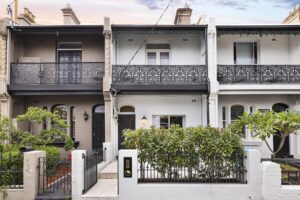
Air Conditioning Balmain: Why Narrow Terraces Make It Fiddly
Balmain is a textbook example of why condenser placement has to be designed around the actual house rather than copied from someone else’s job. For anyone researching air conditioning balmain, the usual terrace constraints stack up fast: narrow lots, close neighbours, small courtyards, tight side passages, older masonry, and street façades that genuinely matter.
Say you’ve got a two-storey terrace and the upstairs front bedroom needs cooling. The shortest pipe run looks like straight through the front wall to a unit on the balcony. Visually and from a planning point of view, that’s very likely the wrong answer. A slightly longer, well-planned route toward the rear can preserve the façade and give you a more appropriate condenser position. That’s the gap between “installing an air conditioner” and designing an installation around the property.
What If I Want Ducted in a Heritage Terrace?
A heritage terrace doesn’t automatically rule out ducted — but the building needs a proper look first. A ducted system needs room for an indoor fan-coil, ductwork, a return-air path, supply outlets, electrical components, and the outdoor condenser.
Terrace roof space is often squeezed by low pitches, existing structural members, past renovations, skylights, old wiring, ceiling details and limited access. And even if the indoor ductwork fits, you still have the condenser question to solve outside. That’s why central air conditioning Inner West Sydney searches keep circling back to the same practical question: where’s all of this physically going to fit? The answer comes from measuring the real property — not picking a system off a website.
Split or Ducted — Which Is Easier for a Heritage House?
Neither wins by default.
A split system tends to suit the property when only one or two rooms need conditioning, roof space is poor, a discreet pipe route can be found, or independent room control matters.
Ducted tends to suit when several rooms need regular heating and cooling, there’s enough ceiling or roof space, you’d prefer discreet internal outlets, and a workable outdoor condenser position can actually be designed.
There’s a third possibility too: sometimes the physical limits of the house mean the smartest move is rethinking the “ideal” system altogether. That’s not a failure — that’s good design.
What Does Installation Cost Out Here?
The air conditioning Inner West Sydney cost is driven by far more than the price of the box. On an older or heritage terrace, the figure moves because of difficult access, longer pipe routes, concealed pipework, electrical work, drainage requirements, ground-mounting, vibration control, heritage-sensitive positioning, tricky roof access, and the system type and capacity.
Which means the cheapest quote isn’t automatically the best value. A quote that includes the extra work to shift the condenser from a highly visible or noisy spot to a more sensible rear position may well be the smarter long-term buy. The same logic applies when you’re weighing up an air conditioner service cost Sydney figure — find out what’s actually included before you compare prices.
Can I Just Hide It Behind a Screen?
Maybe — but don’t create an airflow problem to fix a looks problem. Screens can genuinely reduce the visual impact of mechanical gear, but an outdoor condenser still needs proper air intake, discharge space, the manufacturer’s clearances, and maintenance access. Sit a screen too close and you’ll get hot discharged air recirculating, which drags down performance. If screening is part of a heritage-sensitive design, treat the condenser and screen as one system — don’t design the screen as an afterthought.
Do I Need Council Approval?
Possibly. Air-conditioning installs can qualify as exempt development in NSW when every applicable standard is met, and exempt development doesn’t need planning or construction approval.
But there are big qualifications. Exempt development generally can’t be carried out on land containing an item on the State Heritage Register or subject to an interim heritage order, unless the relevant heritage exemption applies. And if your proposed install doesn’t meet the exempt-development standards, don’t just assume you can go ahead anyway. Heritage status, the location and the exact property all matter — so verify your status and confirm the correct approval pathway before anyone drills a single hole.
Five Condenser Spots I’d Treat With Real Caution
- The street-facing balcony — hits the heritage streetscape and likely clashes with exempt-development positioning rules.
- Right beside the neighbour’s bedroom — even a quiet unit gets noticeable late at night.
- A narrow sealed enclosure — the unit needs to breathe.
- Fragile old masonry — a century-old wall isn’t automatically a great mounting structure.
- Somewhere inaccessible — a cleverly hidden spot stops being clever the moment a technician can’t reach it.
A Better Order to Choose the Position
Step 1 — Check heritage status. Listed item, or just inside a conservation area?
Step 2 — Rule out the obvious conflicts. Don’t start at the street façade.
Step 3 — Check the rear building line. Especially important for heritage items and conservation areas under the exempt-development standards.
Step 4 — Look at your neighbours. Find those bedroom windows.
Step 5 — Check airflow. The condenser needs room to reject heat.
Step 6 — Check pipe and drainage routes. The outdoor spot has to connect practically to the indoor system.
Step 7 — Think about servicing. Someone has to reach it again one day.
Step 8 — Consider noise before you install. Moving a condenser afterwards is far more painful than getting it right first time.
How KYNEX Can Help With a Heritage Terrace
On an Inner West heritage property, the genuinely useful part of a consultation isn’t picking a brand or a capacity — it’s working out where the system can physically go.
KYNEX Air Conditioning can assess the home before installation and weigh up the practical stuff: available condenser locations, rear-building-line positioning, neighbour proximity, pipework routes, drainage, roof and ceiling space, electrical requirements, split-versus-ducted options, and ongoing service access. On a narrow terrace, it’s often worth mapping two or three possible condenser positions rather than defaulting to the shortest pipe run.
KYNEX’s current site says the business provides installation, repair, servicing and maintenance across Sydney, and starts installation enquiries with an assessment and written quote — which is exactly what you want on an older property, where the obvious position often isn’t the best one.
And Afterwards — Servicing in the Inner West
Where you put the condenser affects servicing long after installation day. A unit wedged behind a fixed structure or crammed into an inaccessible gap might look neat now, but it becomes a real headache when maintenance rolls around. For air conditioning service Inner West Sydney, a technician needs physical access to the electrical components, refrigerant connections, coils, fan assembly, drainage and controls. Design for the person coming back in a few years — not just the person installing it today. That one thought saves a lot of expensive access grief down the line.
Frequently Asked Questions
Can an outdoor air conditioner go on the front of a heritage terrace?
Generally it shouldn’t be your first choice. Current NSW exempt-development standards prevent installation on a wall or roof facing the primary road, or forward of the building line. Heritage properties and conservation areas carry extra positioning requirements on top.
Where should a condenser go in a heritage conservation area?
For relevant exempt development, a unit on a heritage item or within a conservation area must be positioned at or behind the rear building line.
Does a condenser on a heritage-listed house need to be ground-mounted?
Under the current NSW exempt-development standard, if the unit is on or in a heritage item or draft heritage item, it must be ground-mounted.
How far should it be from the neighbour?
The current NSW residential exempt-development standards specify at least 450 mm from each lot boundary and at least 1 metre from bedrooms of adjoining residences. Noise requirements still apply on top of that.
Can my neighbour complain about noise during the day?
Yes. The restricted operating hours aren’t the whole story — the NSW EPA notes that councils and police may still respond where equipment is causing offensive noise outside those restricted periods.
What is Inner West Sydney?
It covers the suburbs immediately west and south-west of Sydney’s CBD, characterised by Victorian, Federation and later residential development. For air conditioning, the dense housing, terraces, conservation areas and close neighbours make outdoor-unit placement especially important.
Related Readings
- Best Air Conditioning Installer In Marrickville / Newtown / Leichhardt?
- How Do I Hide An aircon condenser in a tiny Inner West courtyard?
The Bottom Line
For most heritage terraces in Inner West Sydney, start by investigating a discreet spot at or behind the rear building line — away from the street façade and the neighbours’ bedrooms, with enough room for airflow and maintenance. If the building itself is a heritage item and you’re relying on the NSW exempt-development pathway, the condenser must be ground-mounted under the current standard.
But there’s no universal “back-left corner” answer. A good position has to balance heritage appearance, planning rules, noise, airflow, neighbour impact, pipework, drainage and servicing all at once. Which is exactly why the placement call belongs in the site assessment — not halfway through the install.
On an Inner West terrace, the best-looking installation is usually the one you barely notice. The best-performing one still has room to breathe. And the best long-term installation manages both — without becoming the neighbour’s problem next door.