
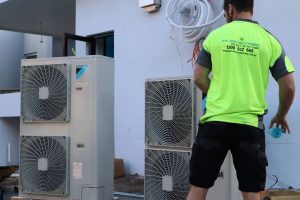
Short version: for most Sydney homes, reverse-cycle inverter is the technology you want. The real decision is how you get that air into your rooms — a split system if you’re really only cooling one or two spaces, or zoned ducted if you want the whole house comfortable.
That’s the ten-second answer. The honest answer is that nobody can tell you what’s best for your place without looking at it.
A one-bedder in Randwick and a five-bedroom home out west are two completely different jobs. A Surry Hills terrace with barely any ceiling cavity has different constraints again. So rather than crowning a winner, this guide walks through how to make the call yourself, without drowning in jargon.
The quick cheat sheet
- One room or an apartment: reverse-cycle split system
- Two separate rooms: two splits, or a multi-split
- Three or more rooms you use daily: price up both splits and ducted before deciding
- Whole-home comfort: zoned ducted reverse cycle
- Tightest budget: a single split, sized properly, in the room you actually live in
- Cleanest look: ducted, hands down
- Best all-round technology: reverse-cycle inverter
One thing worth burning into your memory before you read any further: Australian energy guidance recommends matching capacity to the space you’re conditioning. Buying the biggest unit on the shelf is not a safety net.
Sydney isn’t one climate, and that changes the brief
People talk about “Sydney weather” like it’s a single thing. It isn’t. You can get a 35-degree westerly afternoon, a sticky night where the humidity is the real problem, and a July morning cold enough that you’re hunting for a heater — sometimes in the same fortnight.
Where you live matters just as much. Western Sydney cops serious heat. Coastal and apartment properties bring their own installation headaches, from salt exposure to strata rules to nowhere sensible to put a condenser. And built-up areas hold heat: NSW climate guidance notes that large urban areas can sit roughly 1°C to 3°C warmer than surrounding rural land, because roads, roofs and hard surfaces soak up heat all day and let it go overnight.
Recent conditions make the point. During autumn 2026, Observatory Hill still managed a 30.7°C day on 17 March. Then July 2026 delivered above-average minimums across much of Greater Sydney, with some spots hitting record or equal-record July mean minimums.
Which is why I’d never shop for “good cooling” alone. For the vast majority of households, you want a system that heats properly too.
That’s the case for reverse cycle.
Reverse cycle air conditioning Sydney homeowners can actually use year-round
Reverse cycle just means the unit works in both directions. In summer it pulls heat out of the house and dumps it outside. In winter it runs the other way and brings heat in. One system, two jobs, one install.
Australian Government energy information describes reverse-cycle air conditioners as an efficient heating and cooling option because they move heat around rather than generating it all from scratch with electricity. That’s the whole trick — it’s closer to a pump than a heater.
There’s a second thing to look for, and plenty of buyers skip past it.
Inverter technology
An older fixed-speed compressor is basically on or off. It blasts, hits the temperature, shuts down, drifts, blasts again. An inverter varies its output instead.
Think about driving. Fixed speed is flooring it, braking hard, flooring it again. An inverter eases off as you approach the limit and holds it there. You feel that as steadier comfort rather than the hot-cold-hot cycle people complain about with older units.
Every option below can be reverse cycle and inverter. The choice that’s left is how the air gets distributed: split, multi-split, or ducted. And that depends far more on how much of your home you actually want conditioned than on which system sounds fancier.
Split system air conditioning Sydney: when it’s the right call
A split is an indoor head connected to an outdoor unit. That’s it. For a bedroom, a living room, an apartment or a small house, Sydney air conditioning installers put in every day is very hard to beat on simplicity and value.
Splits make the most sense for apartments, small houses, bedrooms, home offices, granny flats and single living zones — basically any household that doesn’t use every room, or anyone whose upfront budget has a firm ceiling.
Picture a couple in a two-bedroom apartment. Weeknights are spent in the living room. The bedroom only really needs cooling on the handful of nights when it’s still 26 degrees at 11pm. Spending big on a whole-home ducted system there would be money doing very little. One properly sized split in the living zone, and a second head in the bedroom if the summer justifies it, will serve them better. (That’s an illustration, not a case study — but it’s a scenario that comes up constantly.)
What splits do well:
The upfront cost is lower, usually by a wide margin. You only run the room you’re in, so you’re not paying to condition empty bedrooms. Installation is far less invasive than pulling ductwork through a house. Modern inverter models throttle back as the room settles rather than running flat out. And they’re often the practical answer in older homes where the roof space just isn’t there.
Where they fall down:
Scale. One indoor head and one outdoor unit is tidy. Four or five of them is not. You end up with wall units in every room, multiple condensers stacked along the side of the house, and a remote for each one. That’s the point where people start asking about ducted.
Ducted air conditioning Sydney families choose for whole-home comfort
If you want most of the house comfortable, ducted air conditioning Sydney homeowners install is usually the better long game. Instead of a unit on every wall, one concealed indoor fan coil feeds ductwork, and the air comes out through discreet ceiling or wall outlets.
The real advantage isn’t raw grunt. It’s zoning.
A zone is just a group of rooms you can control separately. A typical layout:
- Zone 1: living and dining
- Zone 2: main bedroom
- Zone 3: kids’ bedrooms
- Zone 4: study
So you can run the living areas all Saturday afternoon without pumping cold air into four empty bedrooms.
Ducted tends to suit three and four-bedroom houses, larger family homes, renovations and new builds, and anyone who wants one controller instead of five remotes and nothing visible on the walls.
Ask people who’ve made the switch what they like and they rarely lead with performance. They lead with convenience. You walk in, tap the zones you want, and it handles the rest.
The catch is price. KYNEX’s published 2026 Sydney guides put many ducted installations in the $9,500 to $18,000 range, with bigger or more awkward jobs pushing toward $22,000 and beyond. Treat those as planning numbers, not quotes. Roof access, switchboard work, zone count, duct runs and general site difficulty move that figure around a lot.
What about multi-split?
A multi-split sits between the two. Several indoor heads run off a single outdoor unit.
It’s a good fit when you want independent control in a few rooms but ductwork isn’t realistic — apartments, townhouses, places with a shallow ceiling cavity, or properties where you simply can’t have three condensers lined up outside.
Just don’t assume it automatically wins on cost. Once you’re up to three or four heads, get the fully installed price next to a zoned ducted quote before you commit. The cheaper-looking equipment doesn’t always produce the cheaper finished job.
Split vs ducted: side by side
| Feature | Split system | Ducted system |
|---|---|---|
| One room | Excellent | Usually overkill |
| Apartment | Excellent | Depends on the building |
| Small home | Excellent | Sometimes |
| Large family home | Can work | Excellent |
| Whole-home comfort | Limited with one unit | Excellent |
| Individual room control | Excellent | Excellent with zoning |
| Hidden indoor appearance | No | Yes |
| Installation complexity | Lower | Higher |
| Upfront cost | Usually lower | Usually higher |
| Three or more rooms in daily use | Worth comparing | Often the stronger option |
The operative word is comparing. Three splits can be the smart answer in one house and the wrong answer in the one next door.
How big does your air conditioner need to be?
This is the part where guessing costs you money.
Capacity is measured in kilowatts. A bigger number is not a better system — an oversized unit reaches temperature too quickly, short-cycles, and does a poor job of pulling humidity out of the air. You end up with a room that’s cold and clammy. Government guidance is explicit about choosing capacity that suits the space.
Floor area alone doesn’t get you there. A proper assessment looks at room size, ceiling height, how much glass you have and which way it faces, insulation, afternoon sun, roof construction, how many people are usually in there, what the room is used for, and any appliances throwing off heat.
Two bedrooms with identical floor plans can need different units. One has a shaded south-facing window. The other has west-facing glass doors that turn it into a greenhouse from 3pm. Any “square metres times X” rule of thumb flattens that difference completely.
Comparing efficiency without the headache
Look at the Zoned Energy Rating Label. In 2026, Australian Government guidance still uses it to help buyers compare air conditioners on climate-specific performance rather than a single generic star count.
More stars generally means more efficient within that comparison — but only if the unit is correctly sized in the first place. An efficient system doing the wrong job is still doing the wrong job.
The label also covers cooling and heating efficiency, estimated energy use, performance by climate zone, and indoor and outdoor noise.
Noise deserves more attention than it usually gets. Government energy-rating guidance specifically flags outdoor noise where the condenser sits near a bedroom, a window, or the fence line. On a standard Sydney block, where houses can be a few metres apart, that’s not a minor detail — it’s the difference between a happy neighbour and an awkward conversation.
Five questions that’ll narrow it down
1. How many rooms do you regularly want conditioned? One: start with a split. Two: compare two splits against a multi-split. Three or more: get both splits and ducted priced. Most of the house: start with zoned ducted.
2. Have you got usable ceiling space? If yes, ducted is on the table. If not, split or multi-split is likely your answer regardless of preference.
3. Do visible wall units bother you? If you barely notice them, splits stay strong. If they’d irritate you every day for fifteen years, that’s worth paying to avoid.
4. Is upfront budget the main constraint? If yes, start with the rooms you actually live in and expand later. If not, compare on lifetime comfort and running cost, not just the invoice.
5. Does the household spread out at different times? If everyone’s in different rooms on a Sunday, zoning or independent control should be near the top of your list.
What suits which type of Sydney home
Apartments. A split, almost always. Space is limited, condenser locations are limited, and you’ll need to check strata rules before anything goes on an external wall or balcony. Do that first, not after you’ve paid a deposit.
Two-bedroom homes. Split or multi-split. If only the living area needs daily conditioning, one good unit may genuinely be enough. If both bedrooms need real cooling and heating too, price both approaches.
Three-bedroom family homes. This is the interesting one. If your family tends to be in the living room and one bedroom at a time, splits work fine. If the bedrooms, study and living areas are all in use through the day, zoned ducted starts pulling ahead — not just on comfort, but on how annoying the alternative becomes.
Four and five-bedroom homes. Compare ducted first. Five wall units and five outdoor condensers is a lot of hardware and a lot of clutter for a result a well-designed ducted system handles more elegantly.
Renovations. Think about ducted early. If ceilings and walls are already open, running duct is dramatically easier than retrofitting it in two years’ time. This is the single most common “I wish we’d done it then” I hear.
What does it cost in Sydney in 2026?
There’s no single Sydney price, because site conditions swing the number so much.
KYNEX’s published 2026 guidance gives useful planning ranges: split-system installations commonly land around $2,800 to $5,500 depending on equipment and scope, and ducted projects commonly fall around $9,500 to $18,000, with harder or larger installs moving past $20,000.
Budget with those. Don’t treat them as a quote. Your house needs to be looked at.
Where people go wrong
Shopping on brand alone. A premium unit installed badly still performs badly. Selection, sizing and installation quality do more for your comfort than the badge on the wall.
Going bigger “to be safe.” Covered above, but it’s worth repeating, because it’s the most common and most expensive mistake.
Comparing quotes on the bottom line only. Ask what’s actually included. On a ducted quote, that means zone count, outlet count, return-air design, controller, electrical work, installation, commissioning and warranty. Two quotes $3,000 apart are often two different jobs.
Ignoring where the outdoor unit goes. Airflow, service access, appearance, noise, and how it affects the neighbours. Sort this before installation day.
Conditioning rooms nobody’s in. Sensible zoning is the fix.
What 2026 customer feedback suggests
I’m not going to claim first-hand testing that didn’t happen. What I did do is read through publicly available KYNEX material published during 2026.
The recurring themes in that feedback are professionalism, quick turnaround from quote to completed job, tidy workmanship and clear communication. One January 2026 snippet described the service as “helpful, affordable” with a fast turnaround, and other feedback from around the same time mentions prompt, thorough work and installations kept within budget.
Testimonials are a reasonable trust signal. They’re not a substitute for your own due diligence. Ask for a written scope, and satisfy yourself that the system proposed was chosen for your house rather than copied from the last job.
How KYNEX can help
Choosing between splits, multi-splits and ducted gets much easier once someone has actually walked through the property.
KYNEX Air Conditioning states that its team supplies, installs, services and repairs systems across Sydney, and reports more than 10 years in the industry with over 2,000 systems installed or serviced.
If you’re weighing up options, KYNEX can assess the things that actually drive the decision: your layout, the rooms you genuinely use, required capacity, zoning, and what your property will physically allow. Homeowners planning residential air conditioning Sydney wide can compare individual splits, multi-room setups and a full ducted solution on the same footing.
The recommendation should start with the house. Not with the air conditioner.
Best for: 2026 recommendations
Go split if you mainly use one or two rooms, you’re in an apartment, upfront budget is the constraint, ductwork isn’t practical, or you want each room controlled on its own.
Go multi-split if you need independent units in several rooms, outdoor space for multiple condensers is tight, and ducted isn’t feasible.
Go ducted if you use most of the house, you’ve got three or more rooms in daily use, you want outlets you barely notice, central control appeals, zoning matters, and the property can take the ductwork.
Go reverse cycle if you want heating as well as cooling — which, in Sydney, is most people.
Frequently asked questions
What’s the most efficient air conditioning for a Sydney home? There’s no universally most-efficient unit. Look for a correctly sized reverse-cycle inverter with strong Zoned Energy Rating Label performance. How you run it matters nearly as much as what you buy.
Is ducted better than split? Not automatically. Ducted is excellent for whole-home comfort. Splits are often more sensible when you only need one or two rooms done well.
Is reverse cycle good for Sydney? Yes. Hot summers and genuinely cold winter mornings make one system that does both a practical fit.
Is ducted worth it in a three-bedroom home? It can be. If most rooms are occupied most days, get a ducted quote and compare it against the total cost of the equivalent number of splits, installed.
Should I go a size up just in case? No. Capacity should match the load. Oversizing costs more, cycles more, and dehumidifies worse.
Does zoning cut your running costs? It lets you stop conditioning rooms nobody’s in, which helps. Actual savings depend on system design, settings, insulation, weather and how the household behaves.
Related Blogs
- Split System vs Ducted Air Conditioning in Sydney: How to Actually Choose
- How Much Does It Cost to Run Air Conditioning in Sydney?
Final verdict
9.3/10 for a correctly sized reverse-cycle inverter system.
For most Sydney households, that’s the starting point. Then you decide how to distribute it.
One or two rooms that matter? Split system. Several rooms but no ceiling space to speak of? Compare multi-split. Whole home, several rooms in constant use? Zoned ducted.
The mistake is asking “what’s the best air conditioner?” The better question is “what suits the way we actually live in this house?” Answer that, and choosing between the main air conditioning systems Sydney homeowners install stops being complicated.