
What Is The Cost to Run Air Conditioning in Sydney
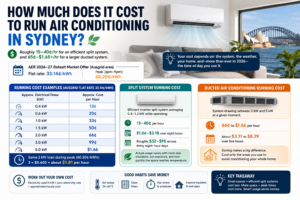
Roughly 15–40 cents an hour for an efficient split system, and anywhere from about 65 cents to $1.65 or more an hour for a larger ducted system, based on a typical flat-rate electricity example.
That’s the short answer, and it comes with a catch worth understanding.
Your air conditioner doesn’t sit at its maximum rated power the whole time it’s switched on. Modern inverter systems throttle back once the room hits the set temperature, so your real air conditioner running cost in Sydney depends on the system, the weather outside, the house itself and — more than ever in 2026 — what time of day you’re using it.
That last factor has become the big one. The Australian Energy Regulator’s 2026–27 Default Market Offer took effect on 1 July 2026. For residential customers in the Ausgrid distribution area, the published DMO caps include a flat usage rate of 33.14 cents per kWh. The time-of-use benchmark tells a different story: 60.20 cents per kWh between 3pm and 9pm.
Those aren’t necessarily the rates on your bill. The AER is clear that the DMO is a safety-net and comparison price, and your retailer’s plan may be cheaper or structured completely differently.
It does give us a solid 2026 benchmark, though, for the question people actually want answered: if I switch the aircon on tonight, what’s it going to cost me?
Air conditioning running costs Sydney: the quick numbers
The arithmetic is simple enough:
Electricity used in kW × your electricity rate = approximate hourly cost
Using the AER’s 33.14c/kWh Ausgrid flat-rate benchmark:
| Approximate electrical draw | Approximate cost per hour |
|---|---|
| 0.4 kW | 13 cents |
| 0.6 kW | 20 cents |
| 1.0 kW | 33 cents |
| 1.5 kW | 50 cents |
| 2.0 kW | 66 cents |
| 3.0 kW | 99 cents |
| 5.0 kW | $1.66 |
Read those as worked examples, not as running costs for any particular air conditioner.
Now run the same 3 kW load during the Ausgrid peak time-of-use benchmark of 60.20c/kWh:
3 × $0.602 = about $1.81 per hour
Which is how two Sydney households with identical air conditioners end up with very different bills.
Working out your own running cost
You need two numbers: how much electricity the unit is actually drawing, and what you pay per kilowatt-hour.
Say your system is pulling around 0.8 kW while it runs. At 33.14c/kWh:
- 0.8 × $0.3314 = about 27 cents an hour
- Six hours: about $1.60
- Six hours a day for a month: about $48
Real inverter systems are messier than that. The compressor ramps up and down, so the unit may draw noticeably more power in the first stretch after you turn it on, then settle to much less once the room is at temperature.
So resist the obvious mistake: “my air conditioner is 2 kW, therefore it uses 2 kWh every hour.” Often it doesn’t.
How much does a split system cost to run in Sydney?
For bedrooms, home offices, apartments and single living areas, a split system is usually the cheapest way to cool the space you’re actually sitting in.
Take an efficient inverter split system averaging somewhere between 0.4 and 1.2 kW while it operates. At 33.14c/kWh, that works out to roughly:
- 13–40 cents per hour
- $1.06–$3.18 over eight hours
- roughly $32–$95 across thirty eight-hour days
Not a promise — a range. A small bedroom that reaches temperature in ten minutes will use a fraction of what a west-facing living room with big windows chews through on a 38-degree afternoon.
Which is really an argument about sizing. Australian Government energy guidance warns that an incorrectly sized air conditioner can run inefficiently, and recommends choosing a system suited to the local climate and to the specific house and room.
Ducted air conditioning running cost
Harder to pin to one number, because “ducted” covers a lot of ground. You might be conditioning one zone, three bedrooms, an open-plan kitchen and lounge, or an entire two-storey home.
Suppose the system is drawing between 2 kW and 5 kW at a given moment. At 33.14c/kWh:
- 66 cents to $1.66 per hour
- about $3.31 to $8.29 over five hours
This is where zoning changes everything. Cooling the one section of the house you’re using is a completely different proposition from pushing conditioned air through every room, occupied or not. A well-designed zoned system can cut out a lot of pointless conditioning — though system design and minimum airflow requirements still put limits on how far you can take that.
So the useful question isn’t “are ducted systems expensive to run?” It’s: how much of my house am I conditioning, for how long, and how efficiently is the system doing it?
Is a split system cheaper to run than ducted?
Usually, when you only need one room or a small part of the home. That’s not a surprise — you’re conditioning less space.
Ducted starts to make more sense when several rooms need heating or cooling at once and whole-home comfort actually matters.
Picture two Sydney households.
The apartment. Two people in the living room on a warm evening. They need that one room comfortable. One appropriately sized split system beats conditioning several empty rooms, every time.
The family home. Four bedrooms, a living room and a kitchen all occupied at 7pm in February. Running five or six separate systems changes the maths considerably, and a properly designed ducted setup with sensible zoning may well be the more practical answer.
There’s no universal winner. The cheapest system to run is the one that delivers the comfort you need without conditioning space you’re not using.
Why 3pm to 9pm can cost so much more
This is the thing most worth understanding about Sydney electricity in 2026: some households are on time-of-use plans, which means power doesn’t cost the same all day.
For the 2026–27 Ausgrid DMO benchmark, the AER lists:
- 24.04c/kWh from 9pm to 3pm
- 60.20c/kWh from 3pm to 9pm
under the relevant time-of-use standing-offer structure.
Take a system drawing 2 kW. Off-peak, that’s about 48 cents an hour. In the peak window, it’s about $1.20 an hour.
Same air conditioner. Same power draw. Two and a half times the cost.
Check your actual bill before you rearrange your habits, because your retailer’s tariff may look nothing like the DMO example.
Why the number on the unit doesn’t tell you the running cost
The single biggest source of confusion is the gap between cooling capacity and electrical input power.
A system advertised as “5 kW” is not necessarily drawing 5 kW of electricity. That figure usually describes how much heating or cooling it can deliver.
Reverse-cycle air conditioners are heat pumps — they move heat rather than generate it. NSW Government energy information explains that reverse-cycle systems can deliver several units of heating or cooling energy for every unit of electricity they consume. That’s the whole point of the technology, and it’s why the capacity figure and the consumption figure are nowhere near each other.
Look at the energy label and the technical data instead of assuming. The Australian Government’s Energy Rating program also runs a calculator built specifically for comparing estimated energy consumption and running costs between models.
What pushes running costs up
The wrong system size. Undersized and it labours for hours on end. Oversized and you’ve paid for capacity you didn’t need, then paid again to run it.
Extreme heat. The bigger the gap between inside and outside, the harder the system works. A 42-degree day is not a 28-degree day with a bit extra.
Poor insulation. Cooling a room while heat pours in through the roof, windows and walls is filling a bucket with a hole in it.
Dirty filters. Restricted airflow drags performance down. Australian Government energy guidance recommends cleaning household air-conditioner filters and having servicing done where appropriate.
Open doors and windows. The system can’t win against a steady supply of warm outside air.
A thermostat set absurdly low. Setting it to 16°C doesn’t cool the room faster. It mostly means the system runs longer before it’s allowed to ease off.
Cooling rooms nobody’s in. Especially relevant on larger ducted systems, and largely solvable with decent zoning.
Cutting costs without sitting in the heat
You don’t have to pick between comfort and a frightening bill. Start with the easy stuff.
Set a sensible temperature rather than dropping the thermostat to an extreme because the room feels hot right now. Give the system time to do its job.
Close the room off — doors and windows shut while refrigerated cooling is running.
Block the sun. Blinds and curtains make a real difference on exposed windows, and they cost nothing to close.
Don’t wait until the house is unbearable. Letting a building bake all afternoon before switching on means the air conditioner inherits a much bigger heat load to shift.
Use your zoning. If the system allows it, stop conditioning rooms nobody’s in.
Clean the filters. Easily the highest-value ten minutes of maintenance most homeowners can do themselves.
Get it looked at when something changes. If airflow has dropped off, the unit can’t reach temperature, or consumption has jumped for no obvious reason, that’s worth investigating. For professional help, see air conditioning maintenance Sydney.
Does a more efficient unit actually save money?
Potentially, yes — and the numbers behind that are significant. Australia’s Energy Rating program says heating and cooling can account for around 40% of household energy use nationally. When something is that large a share of your bill, equipment efficiency matters.
But don’t buy on star ratings alone. Weigh up:
- room size and system capacity
- performance in the Sydney climate zone
- annual energy-use estimates
- zoning requirements
- insulation
- expected hours of use
- installation quality
The Zoned Energy Rating Label is genuinely useful here, because it’s designed to show efficiency under different Australian climate conditions rather than one national average.
Is there NSW help for upgrading an old system?
There may be. In 2026 the NSW Government continues to promote incentives for eligible energy-efficiency upgrades under the Energy Savings Scheme, including discounts for installing a new efficient air conditioner or replacing an older, thirstier one.
Eligibility, eligible products and discount amounts all vary, and none of it is guaranteed. Check before you commit to a purchase — not after.
Where KYNEX Air Conditioning fits in
Sometimes a high bill isn’t an electricity-price problem at all. It’s an air-conditioning problem.
The usual suspects:
- the system is the wrong size for the space
- airflow is restricted somewhere
- filters need attention
- ductwork is leaking conditioned air into the roof
- zoning doesn’t match how the house is actually used
- the equipment is old and no longer efficient
- the thermostat is in a spot that gives it poor information
- the house needs a different strategy altogether
KYNEX Air Conditioning handles installation, servicing, repairs and maintenance for Sydney homes and businesses, with published experience across both residential and commercial projects.
And the more useful conversation isn’t “what’s the cheapest air conditioner?” It’s “what system gives me the comfort I need without conditioning more space than I have to?”
You can read more about KYNEX’s air conditioning services in Sydney.
A worked Sydney example
A family runs a system averaging 1.5 kW for five hours each evening.
At the Ausgrid flat-rate benchmark of 33.14c/kWh:
- about 50 cents an hour
- about $2.49 for the evening
- about $74.57 over thirty days
Now charge that same consumption entirely at the 60.20c/kWh time-of-use peak benchmark:
- about 90 cents an hour
- about $4.52 for the evening
- about $135.45 over thirty days
Roughly $61 difference in a single month, from identical usage. Which is why checking your tariff can matter as much as checking your air conditioner.
Frequently asked questions
How much does air conditioning cost per hour in Sydney? A small or efficient split system might be a few tens of cents an hour in moderate conditions. A large ducted system working hard can be $1 an hour or considerably more. It comes down to actual electrical consumption and your tariff.
What does a split system cost to run overnight? If it averaged 0.6 kW across eight hours at 33.14c/kWh, the simple calculation is about $1.59. Real inverter consumption may land either side of that.
How much does ducted air conditioning cost per day? There’s no honest single figure. A zoned system serving two occupied rooms behaves nothing like a whole-house system running ten hours straight.
Does 24°C cost less than 18°C? In cooling mode, a moderate set point generally gives the system less work to do than holding the house at a very cold temperature. How much less depends on the conditions and the equipment.
Is leaving it on all day cheaper? Not automatically. There are cases where holding a stable temperature avoids a big recovery load, and cases where you’re just paying to cool an empty house. It depends on the building, the insulation, the weather and your tariff.
Does servicing reduce electricity costs? Servicing won’t turn an inefficient system into an efficient one. But dirty filters, restricted airflow and unresolved faults all make things worse than they need to be, and keeping the equipment working properly is part of not wasting energy.
Related reading
- What Type of Air Conditioning Is Best for Sydney Homes?
- When Is the Best Time of Year to Install Air Conditioning in Sydney?
The bottom line
For most households there isn’t an honest single-dollar answer.
A modest split system might cost 15–40 cents an hour in a simplified flat-rate example. Larger ducted systems drawing several kilowatts move toward $1 an hour and beyond. During peak time-of-use windows, the same equipment can cost substantially more than that.
What actually drives the number:
- your electricity tariff
- actual electrical consumption
- system size
- inverter efficiency
- how many rooms you’re conditioning
- thermostat setting
- insulation and solar heat gain
- maintenance
- how long the thing runs
So before you accept that air conditioning is simply expensive, check the figures that apply to your house. Find your electricity rate. Look at the system’s energy information. Be honest about how much of the home you really need to condition.
And if it’s running non-stop, never quite reaching temperature, or costing well beyond what you’d expect, get the installation, airflow and equipment checked. That will tell you far more than any generic cost-per-hour figure ever could.