
Every summer, somewhere around the third day of a heatwave, a lot of Sydney households have the same conversation. Someone says “we should just get ducted,” someone else says “that’s ten grand,” and the discussion dies until the next February.
So let’s settle it properly.
The honest answer is that neither system wins on paper. What wins is the system that matches your floor plan, your budget and — this is the part people skip — the way your household actually moves through the house during the day. A beautifully designed ducted system in a home where two people only ever use the lounge and one bedroom is money spent on air you’re never in. Five wall units bolted around a four-bedroom home is a different kind of mistake.
Here’s how to work out which one you are.
The basic difference, without the sales pitch
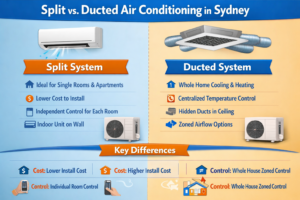
A split system is two boxes. One sits on your wall inside, one sits outside on a bracket or a slab, and a small line of refrigerant pipe runs between them. It cools the room it’s mounted in. That’s the whole concept.
Ducted is one bigger unit hidden in your roof space, connected to insulated flexible ductwork that fans out to vents in the ceilings of individual rooms. You see the vents and a wall controller. Everything else is out of sight.
Both heat and cool — modern systems are reverse cycle, so you’re buying your winter heating at the same time. They just solve different problems:
- Split system — comfort where you are
- Ducted — comfort everywhere, managed from one place
Quick comparison
| Split system | Ducted | |
|---|---|---|
| Suits | One to three rooms | Whole home |
| Upfront cost | Lower | Higher |
| What you see indoors | Wall unit in each room | Ceiling vents only |
| Room-by-room control | Yes, naturally | Yes, via zoning |
| Retrofitting | Usually straightforward | Depends on roof access |
| Install time | Often a day | Typically several days |
| Controls | A remote per unit | One controller, or an app |
The thing worth remembering: dearer doesn’t mean better suited. It just means dearer.
When a split system is the smarter buy
Picture a two-bedroom apartment in Ashfield. The occupants are in the living room and the main bedroom, and that’s about it. The second bedroom is a study that gets used twice a week. Cooling the hallway, the kitchen and the bathroom all day would be pointless.
Two well-chosen split systems handle that home properly, for a fraction of what a ducted install would cost — and there’s no roof space to run ductwork through anyway, which is the reality in most Sydney units.
Go the split system route if:
- You only need one or two rooms comfortable
- You’re renting the place out, or living in it short-term
- You’re in an apartment (ducted is rarely even an option)
- The budget is tight now and you’d rather add a second unit next year
- Your ceiling cavity is shallow, or the roof is a skillion with nowhere to hide a fan coil
- You’re only renovating part of the house
One thing apartment owners underestimate: strata. Getting a condenser mounted on a balcony or an external wall usually needs owners corporation approval, and some buildings have rules about where the outdoor unit can go and how it looks from the street. Sort that out before you book an installer, not after.
The other quiet advantage of splits is that you can do them one at a time. Bedroom this Christmas, living room next year. Ducted is all or nothing.
When ducted earns its price
Now picture a four-bedroom home in Baulkham Hills. Four bedrooms, an open-plan kitchen and living area, and a second lounge or media room. Doing that with splits means five indoor units, possibly three or four outdoor units clustered along the side of the house, five remotes floating around the place, and a wall unit in every single room.
That’s when ducted stops being a luxury and starts being the sensible engineering answer. One outdoor unit. One controller. Vents you barely notice.
And then there’s zoning, which is the feature that changes how people actually live with air conditioning Sydney. You split the house into controllable areas — commonly bedrooms in one zone, living areas in another, and maybe the kids’ end of the house or a guest wing separately. At 10pm you shut the living zone and cool the bedrooms only. On a Sunday afternoon it’s the reverse.
Ducted makes sense if:
- You want the whole house comfortable, not just the rooms you’re standing in
- You’re building, or you’re mid-renovation with the ceilings open
- You care about how the interior looks and don’t want boxes on the walls
- You’ve got several bedrooms plus more than one living space
- You’ve got a decent tiled or Colorbond roof with room to work in
That last point matters more than most people realise. Roof access is the make-or-break question for a Sydney ducted install, and it’s the first thing a good installer will go and look at.
What does air conditioning installation cost in Sydney?
There’s no fixed price, and any installer who quotes over the phone without seeing the place is guessing.
What moves the number: system capacity, how many rooms, how hard the roof is to move around in, whether your switchboard needs work, where the outdoor unit has to go, how far the pipe run is, ductwork layout, how many zones, and what brand of equipment you pick.
For a rough sense of scale, NSW Government material puts installation somewhere between about $1,500 for a single split system and north of $10,000 for a full ducted job, depending on the property.
KYNEX Air Conditioning quotes indicative Sydney ranges of roughly $1,000–$3,000 supply-and-install for split systems, and around $3,000–$7,000+ for ducted reverse cycle.
Treat both as ballpark. The gap between the bottom and top of those ranges is mostly install difficulty, and install difficulty is invisible until someone’s had a look in your roof.
Is ducted more expensive than split?
For one room against one room, obviously yes. More equipment, more labour, more days on site.
But that’s not the comparison most people should be running. If whole-home comfort is the actual goal, the honest sum is five split systems versus one ducted system — and once you add up five units, five installs, five sets of pipework and possibly extra outdoor units, the gap narrows a lot. Sometimes it closes.
The useful question isn’t “which is cheaper.” It’s “what am I getting for the money, and will I still be happy with it in five years.”
Which one uses less electricity?
Depends entirely on how you run it, which is an unsatisfying answer but a true one.
A split system cooling one bedroom overnight is very hard to beat on efficiency. You’re conditioning maybe 12 square metres. Nothing else is running.
A ducted system that’s correctly sized and properly zoned can be just as sensible — you’re only opening the zones you’re in. Where ducted gets expensive to run is when it’s oversized, when the ductwork is badly laid out, or when people leave every zone open out of habit because it’s easier than thinking about it.
Things that genuinely move your bill: the star rating of the equipment, insulation and ceiling batts, how much west-facing glass you have, whether the house is single or double brick, the thermostat setting, and how many hours the thing runs.
On that last point — NSW guidance suggests around 24–26°C in summer and 18–20°C in winter. Setting it to 18 on a 38-degree day doesn’t cool the room faster. It just makes the compressor work harder for longer, and you pay for it.
Sizing is where installs go wrong
The most common mistake in this industry isn’t picking the wrong type of system. It’s picking one that’s too big.
Oversized air conditioners cool the room quickly, hit the set temperature, and shut down before they’ve pulled any real moisture out of the air. In a Sydney February, that leaves you with a room that’s technically 24 degrees and still feels clammy. The unit then short-cycles on and off, which is hard on the equipment and inefficient.
Undersized units have the opposite problem — they run flat out and never quite get there on the worst days of the year.
Proper sizing means someone looking at room dimensions, ceiling height, how much glass you have and which way it faces, insulation, construction type, whether the space is open-plan, and how many people are usually in it. A west-facing living room in Penrith with a wall of windows needs meaningfully more capacity than the same-sized south-facing room in Manly. That’s a calculation, not a guess.
Can you put ducted in an older Sydney home?
Usually yes — it just needs more thought.
Sydney’s housing stock is all over the place: Federation homes, inner-west terraces, fibro in the south, 1970s brick veneer, new builds in the north-west. Each has its own quirks.
Terraces are the hardest. Narrow roof spaces, party walls, heritage controls on street-facing elevations, and often nowhere sensible for a condenser except a tiny courtyard. It’s often doable, but it’s a design job rather than a standard install.
Older detached homes are generally fine. The installer needs to check roof access and cavity depth, where the vents can sit given the ceiling joists, whether the switchboard can carry the load, condensate drainage, and where the outdoor unit can live without being a nuisance.
None of that rules ducted out. It just means the site inspection is doing real work, not going through the motions.
If you’re near the water
Salt air is corrosive, and coastal suburbs — anywhere from Cronulla up through the eastern beaches to the northern beaches — are harder on outdoor units than inland Sydney.
Two things help. First, placement: sheltered from direct salt spray where possible, but still with clear airflow around it, because a unit crammed into a tight alcove can’t reject heat properly. Second, maintenance. A regular rinse of the outdoor coil and an eye on the casing and fasteners goes a long way. Some manufacturers also offer coastal-treated coils, which are worth asking about if you’re within a few streets of the beach.
Looks and noise
If interior appearance matters to you, ducted wins and it isn’t close. Modern split systems are slimmer and less ugly than they used to be, but a white box above the doorway is still a white box above the doorway. Ducted hides everything except discreet ceiling vents. In a house that’s just been renovated, that’s often the deciding factor on its own.
Noise is more even than people assume. Both are quiet when properly specified. The difference is where the sound comes from: with a split, the fan is in the room with you, so you hear airflow directly. With ducted, the fan coil is in the roof and you hear air arriving at the vents, which is usually softer but depends heavily on duct sizing and how well the ductwork is run. Badly designed ductwork whistles.
The one thing that catches people out either way is outdoor unit placement. A condenser directly under a bedroom window will annoy you at 2am, and it’ll annoy your neighbour too. There’s almost always a better spot.
Two households, two answers
The apartment. Couple in a two-bedder, mostly in the lounge and main bedroom. Two split systems, sized properly, strata approval sorted. Ducted would cost several times as much to condition rooms they don’t sit in.
The family home. Four bedrooms, open-plan living, second lounge, kids at different bedtimes. Ducted with zoning — bedrooms on one zone, living on another. The system gets designed around the household’s actual timetable rather than the floor plan alone.
Three questions that get you to an answer
How many rooms do you genuinely need comfortable? One or two, splits. Four or more, start pricing ducted.
Do you mind seeing the equipment? If a wall unit doesn’t bother you, that’s a lot of money saved. If it’d irritate you every time you walked in, ducted.
Are you building or renovating right now? If yes, price ducted while the ceilings are open — retrofitting later costs more and involves more patching. If no, splits are the easier retrofit.
That’ll get you 80% of the way. The last 20% is someone standing in your roof space with a torch.
How KYNEX Air Conditioning can help
The starting point should always be the house itself, not a brochure.
KYNEX Air Conditioning says it has more than 10 years in the industry and has serviced or installed air conditioning in over 2,000 Sydney homes, and provides a free measure and written quote.
That measure is the part that matters. Capacity calculations, equipment placement, electrical requirements and how your household uses each room are what determine whether a system performs — not the brand sticker on the box.
If ducted is the direction you’re leaning, KYNEX handles ducted air conditioning installation Sydney, including planning the layout and zoning around the property rather than dropping a standard design into it.
What to ask before you sign anything
Good installers welcome these questions. Anyone who gets vague is telling you something.
- What capacity does this house actually need, and how did you work that out?
- Why this system over the alternatives?
- What’s included in the price, and what’s extra?
- Is the electrical work covered, and does my switchboard need upgrading?
- Where exactly is the outdoor unit going, and where’s the indoor equipment?
- For ducted — how many zones, and what’s in each one?
- How is condensate drained?
- What warranty applies to the equipment, and separately, to your workmanship?
- Who services it in two years’ time?
- Can I have that in writing?
Pros and cons, briefly
Split systems are good because they’re cheap to get started with, quick to install, give you dead-simple per-room control, work in apartments, and can be added to over time.
They’re not great because the indoor units are visible, every room you add means another unit and another remote, and a house full of them can mean multiple condensers cluttering the side of the property.
Ducted is good because it conditions the whole house, hides almost everything, runs from one controller, and zones well. In a large home it’s simply the cleaner solution.
Ducted isn’t great because it costs more upfront, takes longer to install, needs usable roof space, and lives or dies on the quality of the duct design. If the ductwork’s rubbish, the best equipment in the world won’t save it.
Related Blog
FAQ
Is ducted better than split in Sydney? Not inherently. It’s better for larger homes and whole-house comfort. Splits are better for targeted cooling and lower upfront spend. The house decides, not the category.
Is a split system cheaper? One split versus one ducted system, yes, substantially. But compare like for like — if you’d need four or five splits to get the same coverage, the totals get much closer than people expect.
Does ducted use more power? It can, because it’s often conditioning far more space. Zoning is how you control that. A zoned ducted system running two bedrooms overnight isn’t using dramatically more than two splits doing the same job.
Can ducted go into an existing home? Usually. It depends on roof access, ceiling cavity depth, where the ductwork can run, the switchboard, drainage and outdoor unit placement. Terraces are the tricky ones.
How many zones should I have? As many as reflects how you live, which is commonly three or four in a typical family home. Zoning by how the house is used beats zoning by how it’s drawn.
What’s the best air conditioning for Sydney homes? The correctly sized one, installed properly. That’s not a dodge — sizing and install quality affect your comfort and your bills more than the choice between ducted and split ever will.
The verdict
If you want lower upfront cost and comfort in the rooms you actually use, get split systems and don’t feel like you’ve compromised.
If you want the whole house comfortable, the equipment out of sight, and one controller running the lot, ducted is worth the money — provided your roof can take it and someone designs it properly.
And if you’re stuck between them, stop comparing systems for a minute and answer a different question: where is everyone in this house at 3pm, and where is everyone at 10pm?
Once you can answer that honestly, the system picks itself.