

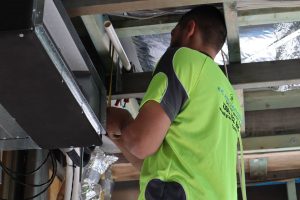
The most common ducted air conditioning problems are weak cooling, water leaks, strange noises, uneven room temperatures, and a system that won’t switch on — and most are fixed by cleaning a filter, clearing a blocked drain, topping up refrigerant, or replacing a worn part.
A well-installed ducted air conditioning Sydney system should run quietly for years. But when it plays up, the warning signs are usually easy to read. This guide explains each fault in plain English — what causes it, what you can safely check yourself, and what needs a licensed technician.
9 min read · Written by the KYNEX Air Conditioning Sydney team · Reviewed for 2026
The short answer (TL;DR)
- Not cooling? Usually a dirty filter, blocked return air, or low refrigerant.
- Leaking water? Nearly always a blocked condensate drain or a full drain pan.
- Noisy? Loose ceiling grilles, a worn fan bearing, or ducting flexing as it heats and cools.
- Some rooms hot, others cold? A zoning, damper, or duct problem in the roof.
- Won’t turn on? Power, thermostat, a blown capacitor, or a control-board fault.
- Rule of thumb: filters and vents are safe to check yourself — anything involving refrigerant or wiring needs a licensed pro.
What are the most common ducted air conditioning problems?
A ducted system is simple in principle. One indoor fan coil sits in your roof space. It pushes cooled air through a web of ducts to vents in each room, then pulls warm air back through a large return-air grille to do it all again. The outdoor unit does the heavy lifting of moving heat out of your home.
Because the design is simple, the faults are predictable too. When a ducted system misbehaves, the problem almost always sits in one of a handful of parts: the filter, the condensate drain, the fan, the refrigerant, the zoning, or the controls. Here are the common ducted aircon faults we see most across Sydney homes:
- Weak or no cooling — air flows but the house stays warm (the most reported ducted AC airflow problem).
- Water leaking — a damp patch on the ceiling, usually near a vent.
- Noise — rattles, whistles or grinding the system didn’t used to make.
- Uneven rooms — one room freezing, another stuffy.
- Won’t start or keeps stopping — no response at the controller, or it cuts out after a few minutes.
- Musty smell — a damp, “dirty sock” odour when it first kicks on.
Why is my ducted air conditioning not cooling?
If the fan runs and air comes out of the vents but the rooms never get cool, you’ve got the single most common complaint we hear. Nine times out of ten the cause is airflow, not a broken compressor — and that’s good news, because airflow problems are usually cheap to fix.
The usual suspects, roughly in order:
- A clogged return-air filter. That big grille (often in a hallway ceiling) hides a filter. When it’s choked with dust and pet hair, the system can’t pull enough air to cool. A Randwick call-out in January often ends here — a two-minute filter clean and the house is cold again.
- Blocked or closed vents. Furniture over a return grille, or too many zones shut off, starves the system of air.
- Dirty coils. Over the years the indoor and outdoor coils cake up with grime, so they can’t shed heat. This is a service job.
- Low refrigerant (gas). If the refrigerant has leaked, the system runs flat out but barely cools. This needs a licensed technician to find the leak, repair it, and recharge — it is not a “just top it up” fix.
- A struggling outdoor unit. On Sydney’s 40°C western-suburbs days, an outdoor unit boxed in against a hot wall, or packed with leaves, simply can’t dump heat fast enough.
Try this first: Clean or replace the return-air filter, make sure the outdoor unit has clear space around it, and check the controller is set to Cool (not Fan) at a sensible temperature. If it’s still weak after that, book a tech. We go deeper on this in our guide to ducted air conditioning not cooling.
Why is my ducted air conditioner leaking water?
As your system cools, it pulls moisture out of the air. That water collects in a tray under the indoor unit and drains away through a thin pipe. When you see a brown stain spreading on the ceiling near a vent, that drainage path has failed somewhere.
The main causes of a ducted air conditioner leaking are:
- A blocked condensate drain. Dust and algae build up inside the drain line and clog it. The tray overflows into the roof and down onto your ceiling. This is the most common leak by far.
- A full or rusted drain pan. Older trays crack or corrode, so water escapes before it reaches the drain.
- Poor duct insulation. In a hot, humid Sydney roof space, cold ducts “sweat”. That condensation drips and looks exactly like a leak.
- A frozen coil that melts. If the coil ices up, it dumps a flood of water when it thaws.
The fix depends on the cause: flushing and clearing the drain line, re-levelling or replacing the tray, or wrapping bare ducts in proper insulation. Our full write-up on air conditioner water leak causes and fixes walks through each one.
Don’t ignore a ceiling leak: Water pooling in a roof space can damage plaster, insulation and wiring. Switch the system off and get it looked at before the stain spreads.
Why is my ducted AC making noise?
Every ducted system makes a gentle “whoosh” — that’s normal. It’s the new noises you want to pay attention to. The sound itself is a strong clue to the fault:
- Rattling or buzzing at a vent — a loose grille or a bit of debris. Easy fix.
- Whistling — air being forced through a restriction. Usually too many zones are closed, or the filter is blocked.
- Banging or clicking in the roof — ducts and metal expanding and contracting. Often harmless, sometimes a sign of poorly supported ducting.
- Grinding or squealing from the roof unit — a worn fan bearing or motor. This needs attention before it seizes.
- A loud, rattly outdoor unit — a loose panel, a failing fan motor, or a labouring compressor.
A sudden grinding or metal-on-metal sound is your cue to switch off and call someone, before a small part failure turns into a big one.
Why is one room hotter than the rest?
Ducted systems are built to cool the whole house evenly. When one room lags behind, the fault is usually in how the air is divided up:
- A stuck or broken zone damper. Zones use motorised flaps to send air where it’s needed. If a damper jams shut, that zone never gets cold.
- A disconnected or crushed duct. Flexible ducting in the roof can pop off a vent or get squashed by stored boxes or a tradesperson’s foot. All the air meant for that room escapes into the roof.
- Trying to cool too many zones at once. A system sized for part of the house can’t cool every room on full at the same time.
- Upstairs heat. In two-storey Sydney homes, heat rises, so the top floor always works harder.
Fixes range from freeing a damper to re-securing ducting in the roof, or adjusting how your zones are set up so the air goes where you actually spend time.
Why won’t my ducted system turn on — or why does it keep stopping?
It won’t start at all
Before assuming the worst, check the simple things: a tripped safety switch in the meter box, the isolator switch near the outdoor unit turned off, flat batteries in a wall controller, or the thermostat set to the wrong mode. Plenty of “dead” systems come back to life with a reset.
If power is fine and it still won’t fire up, the fault is usually a blown run capacitor (a cheap, common part), a faulty control board, or a dead fan motor — all technician territory.
It starts, then cuts out after a few minutes
This stop-start behaviour is called short cycling. Common causes are a dirty coil, low refrigerant, a faulty sensor, or a system that’s simply too big for the space and satisfies the thermostat too quickly. Short cycling wears parts out fast, so it’s worth sorting early.
Electrical safety: A capacitor can hold a dangerous charge even with the power off, and opening the unit can void your warranty. In NSW, electrical and refrigerant work must be done by a licensed technician.
Why does my ducted AC smell musty?
That damp, “dirty sock” smell when the system first switches on is moisture plus mould or bacteria growing on a dirty coil or inside the ducts. Sydney’s humid summers make roof spaces a perfect home for it. Beyond the smell, it can push dust and spores into rooms, which matters if anyone in the house has asthma or allergies.
The fix is a proper clean: sanitising the coil and drain, replacing the filter, and sorting out any moisture source feeding the growth. A regular service keeps it from coming back.
Quick symptom finder
Not sure where to start? Match the symptom to the likely cause and the first thing to check.
- Air is blowing, but the house won’t get cool → Most likely: clogged filter, dirty coils, or low refrigerant. Check first: clean the filter and clear the outdoor unit; still weak means a service call.
- A brown stain or dripping near a ceiling vent → Most likely: a blocked condensate drain or overflowing tray. Check first: turn the system off and have the drain cleared.
- New rattles, whistles or grinding sounds → Most likely: loose grille (rattle), restricted airflow (whistle), or a worn fan bearing (grinding). Check first: a grinding sound means switch off and call a tech.
- One room never reaches temperature → Most likely: a stuck zone damper or a duct knocked loose. Check first: confirm the vent is open, then have the roof ducting inspected.
- Nothing happens when I turn it on → Most likely: tripped safety switch, isolator off, flat batteries, or a blown capacitor. Check first: reset the safety switch and check the isolator.
How do you prevent common ducted aircon faults?
Most ducted breakdowns don’t come out of nowhere — they build up slowly from dust, damp and wear. A little upkeep prevents the big call-outs:
- Clean the return-air filter every few months through the cooling season — this one habit prevents the most problems.
- Keep the outdoor unit clear. Trim plants back and sweep away leaves so it can breathe.
- Watch for early signs. A new noise, a weak vent, or a faint musty smell is easier (and cheaper) to fix early.
- Book an annual service. A professional clean of the coils and drain, plus a refrigerant and electrical check, keeps the system efficient and catches small faults first.
A yearly check-up is the cheapest insurance against a mid-heatwave breakdown. Regular air conditioning maintenance Sydney homeowners book before summer is the simplest way to keep a ducted system reliable — and to protect the manufacturer’s warranty, which often requires it.
When should you call a pro — and how can KYNEX Air Conditioning Sydney help?
Filters, vents and resets are safe to handle yourself. But anything involving refrigerant, electrical parts, or climbing into the roof is a job for a licensed technician — both for your safety and to keep your warranty intact. If your system is leaking, making grinding noises, tripping the power, or just not cooling after a filter clean, that’s the point to get help.
That’s where our team comes in. KYNEX Air Conditioning Sydney diagnoses and repairs ducted systems right across the city — from a blocked drain or a blown capacitor to a refrigerant leak or a zoning fault. We explain what’s wrong in plain language, quote before we start, and stand behind the work. If you need ducted air conditioning repairs Sydney wide, we can usually get a technician to you quickly.
Why Sydney homeowners trust KYNEX (based in Randwick, servicing homes and businesses across Sydney):
- 10+ years industry experience
- 2,000+ systems installed & serviced
- 5-year workmanship guarantee
- Licensed technicians, with full strata support
[ Paste 2–3 of your genuine 2026 Google / Trustindex reviews here. ] I’ve left this as a note rather than inventing testimonials — real customer words build trust; fabricated ones breach Australian Consumer Law. Delete this line once your reviews are in.
Got a ducted system playing up? Call 0484 595 959 for a free, no-obligation quote.
Ducted air conditioning troubleshooting: FAQs
Can I fix ducted air conditioning problems myself?
You can safely clean or replace the return-air filter, open blocked vents, reset the safety switch, and clear leaves from the outdoor unit. Anything involving refrigerant, electrical parts, or working in the roof should be left to a licensed technician.
How do I know if my ducted system needs regassing?
Signs include weak cooling despite a clean filter, ice forming on the pipes or coil, and the system running non-stop without reaching temperature. Low gas means there’s a leak somewhere — a good technician finds and repairs the leak rather than just refilling it.
Is it worth repairing an old ducted system?
It depends on the system’s age, the cost of the repair, and how efficient it still is. A one-off fix like a capacitor or a drain clear is usually worth it. If an older system needs major parts or keeps failing, a technician can help you weigh repair against replacement.
How often should a ducted system be serviced?
Once a year is the standard recommendation, ideally before summer. Clean the filters yourself every few months through the cooling season in between professional services.
Why does my ducted AC struggle on very hot Sydney days?
On 38–40°C days an outdoor unit has to work much harder to shed heat. If it’s dirty, boxed in, or the system is undersized for the home, it can fall behind. A service and good airflow around the outdoor unit help a lot.
Related reading
Guide by the KYNEX Air Conditioning Sydney team · Reviewed for 2026. General guidance only — for a diagnosis specific to your system, book a licensed technician.