
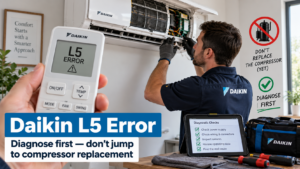
Daikin L5 Error Code: What It Means and Why “Replace the Compressor” Is the Wrong First Move
If your Daikin is flashing L5, the outdoor unit has caught something it doesn’t like: an abnormal overcurrent condition in the inverter or compressor circuit. Put plainly, more electrical current is flowing through the inverter power electronics than the system considers safe — so it shuts down to protect the compressor and control gear before anything gets cooked.
That puts L5 in a completely different league from a dirty filter or a low-refrigerant warning. This is an electrical protection fault on the outdoor side, and it deserves respect.
The causes can range from a compressor that’s mechanically seized, to damaged compressor windings, an electrical short or insulation fault, a failed inverter power module, an outdoor control-board fault, abnormal supply voltage, wiring problems, a closed refrigerant stop valve on some systems, or an installation issue. The exact path depends on the model.
So when L5 shows up, the right response isn’t “replace the compressor.” It’s “find out why the inverter circuit saw excessive current.” That one distinction can save you a genuinely painful bill.
Quick answer: what does Daikin L5 mean?
Daikin’s residential documentation commonly lists L5 as output overcurrent. The technical service documentation gets more specific: inverter compressor instantaneous overcurrent. On some newer model families, the L5 section describes an IPM abnormality — IPM being the Intelligent Power Module, part of the electronics that control power going to the inverter-driven compressor.
The fault fires when current through the inverter power transistor or module gets excessive. When that happens, the air conditioner stops or throttles itself to avoid damage. It’s the unit protecting itself, not the unit giving up.
The main possible causes of a Daikin L5 error
The exact list shifts by model, but Daikin’s documentation points at a handful of areas:
| Possible cause | What it means |
|---|---|
| Compressor mechanical lock | The compressor can’t rotate normally |
| Compressor winding fault | The motor’s coils may be damaged or shorted |
| Compressor insulation failure | Electricity is leaking where it shouldn’t |
| Inverter/IPM fault | The power electronics driving the compressor have failed |
| Outdoor PCB problem | The outdoor control board is defective |
| Power-supply problem | Voltage is abnormal or unstable |
| Wiring/connection fault | Compressor or inverter connections are loose or damaged |
| Closed stop valve | Refrigerant flow is restricted on applicable systems |
| Installation issue | Commissioning, wiring, or refrigerant-side conditions are off |
Notice what’s not on that list: a dirty indoor filter. L5 is fundamentally an outdoor inverter/compressor-side electrical fault, and treating it like routine maintenance is how people end up throwing money at the wrong thing.
Cause 1: The compressor is drawing too much current
The compressor is the main mechanical component in the refrigeration circuit — its job is to compress and circulate refrigerant. In an inverter air conditioner, its speed varies with demand, which is efficient, but it also means sophisticated power electronics are riding herd on it the whole time.
If the compressor becomes hard to start or turn, it demands more current. Picture an electric motor straining to spin something that’s jammed — it pulls harder and harder. The inverter spots that abnormal demand and shuts things down to protect itself. Daikin’s service documentation lists defective compressor startup or a mechanical lock as a possible L5 cause on applicable systems. It’s one of the clearest reasons L5 deserves a proper diagnosis instead of being reset on repeat.
Cause 2: Damaged compressor windings
Inside the compressor sits an electric motor, and that motor has electrical windings. If those windings become disconnected, shorted, damaged, or poorly insulated, the compressor’s electrical behaviour changes.
Daikin’s service manuals build compressor coil and insulation testing right into the L5 diagnostic process. A technician will typically measure winding resistance, continuity, and insulation resistance to earth — those numbers reveal whether the compressor has failed electrically. This is emphatically not something to test with the unit powered up, and definitely not by cracking open the outdoor unit yourself.
Cause 3: Inverter or IPM failure
This is another big one. The inverter converts and controls electrical power so the compressor can run at variable speed, and the IPM is one of the key power-electronic components in that job.
If the inverter transistor or IPM develops a fault, it can drive the compressor incorrectly or misread current. Daikin’s newer service documentation lists causes like a defective power transistor, inverter board problems, IPM-related faults, and poor connections between electronic boards.
The takeaway matters: L5 doesn’t always prove the compressor is bad. Sometimes the electronics driving the compressor are the problem — and that’s a completely different (and often cheaper) repair.
Cause 4: Outdoor PCB fault
PCB means printed circuit board. The outdoor one manages inverter control, compressor operation, sensor inputs, fan operation, and communication. If it develops a fault, the inverter can behave incorrectly or register an overcurrent that isn’t really the compressor’s doing.
Daikin’s service logic usually has technicians check the compressor and power transistor before deciding the outdoor PCB needs replacing. That sequence isn’t bureaucratic box-ticking — swapping an expensive control board without first checking the compressor is a great way to spend a lot of money and still have a broken air conditioner.
Cause 5: Power-supply problems
Some model-specific L5 procedures ask the technician to check the incoming supply voltage, and for good reason. An inverter expects power within an acceptable range. Too high, too low, or unstable, and it may not operate correctly.
An abnormal power event can occasionally throw a fault that never comes back after a restart — Daikin’s documentation acknowledges that a momentary disturbance can sometimes be behind an L5 that doesn’t reappear. But if the code keeps returning, that theory’s out, and it needs investigating properly.
Cause 6: Wiring or connection problems
An inverter compressor has multiple electrical connections between the outdoor PCB/inverter module and the compressor itself. Loose, damaged, or wrongly connected wiring can all mess with current flow.
So Daikin’s procedures often call for checks of the compressor harnesses, board connectors, general wiring condition, and the connections between inverter and control boards. A single damaged cable can throw symptoms that look exactly like a failed electronic component — which is precisely why visual inspection and electrical testing come before anyone orders expensive parts.
Cause 7: Closed stop valve or installation problem
Some L5 procedures also list a closed refrigerant stop valve or an installation fault as possible causes. That seems odd for an electrical overcurrent code — until you remember that the compressor’s electrical demand depends on the refrigeration conditions it’s working against.
If refrigerant can’t circulate because a valve is shut or system conditions are abnormal, the compressor’s load can climb too high. This is especially worth checking when the system is newly installed, the fault started right after installation, or refrigerant-side work was recently done. A new system throwing L5 should never just be reset and ignored.
What symptoms come with a Daikin L5 fault?
You might see the air conditioner start and then stop, no cooling or heating at all, the outdoor unit refusing to stay running, the compressor trying to start and cutting out, a flashing operation light, L5 through the diagnostic function, repeated breaker or protection behaviour, unusual noises from the outdoor unit, or the fault returning the instant you reset it.
One thing that catches people out: the indoor fan may keep running briefly, so it can look like the aircon is working normally even though the outdoor refrigeration circuit has actually stopped.
Can you fix a Daikin L5 error yourself?
For most L5 faults, honestly, no. The likely causes involve high-voltage inverter electronics, compressor electrical testing, outdoor PCB diagnosis, power-supply measurements, and refrigeration operating conditions — all firmly technician-level. But there are a few safe things you can do before you call.
Confirm the code. Don’t assume L5 from a flashing light alone. Daikin residential remotes can usually retrieve stored fault codes — the exact steps vary, but many use a diagnostic mode where you cycle through codes until the matching fault gives a confirmation tone. If you confirm L5, write it down, along with the indoor and outdoor model numbers, serial number, when the fault began, whether it happens immediately or after a few minutes, and whether there was a recent power outage or electrical event. Daikin itself asks customers for the model number, serial number, and fault code when seeking support.
Check whether there was a recent power problem. Did the power drop? A storm roll through? Lights flicker? A breaker trip? Did the fault appear right after? None of this proves the power supply caused L5, but it’s genuinely useful for the technician.
Make sure the outdoor unit isn’t obviously obstructed. Check it isn’t buried in leaves, blocked by stored items, tightly boxed in, or physically damaged. Don’t open covers or touch wiring — you’re just eyeballing the outside.
Try one normal restart. If your manual permits it, switch the system off and back on once. If L5 vanishes and stays gone, a one-off electrical disturbance may have been the culprit. If it returns, stop resetting it — a recurring overcurrent fault is telling you something abnormal is still happening.
What you should NOT do with an L5 fault
- Don’t open the outdoor electrical panel. The inverter section can hold dangerous voltages. This is nothing like cleaning an indoor filter.
- Don’t test the compressor yourself. Proper testing needs electrical knowledge and the right equipment.
- Don’t replace the PCB based on the code alone. L5 can involve the compressor, inverter, wiring, power supply, or refrigerant-side conditions.
- Don’t assume the compressor is dead. It’s one possible cause, not the only one.
- Don’t keep resetting the system. A protection fault exists to prevent damage. Forcing restarts isn’t a repair.
Is L5 the same as a compressor error?
Not exactly. Calling it a “compressor error” is understandable, because the compressor is heavily involved — but it’s too broad. A more accurate label is an inverter/compressor output overcurrent fault: the system has detected excessive current associated with the compressor drive circuit.
That could trace back to the compressor, the inverter electronics, the wiring, the power supply, or abnormal compressor operating conditions. The code tells you which electrical protection was triggered. It does not name the failed component with certainty.
How does L5 compare with other Daikin fault codes?
Daikin uses different codes for different abnormal conditions. For context:
- U0 — refrigerant shortage
- U2 — voltage-related abnormality
- U4 — indoor/outdoor communication failure
- A5 — high-pressure control or freeze-up protector
- A6 — indoor fan motor fault
- E6 — compressor startup fault
- E7 — outdoor DC fan motor fault
- E8 — input overcurrent
- L4 — inverter heat-sink high temperature
- L5 — output/inverter compressor overcurrent
Those distinctions matter — a code is a diagnostic clue about where to look, not a verdict.
L5 vs E6: aren’t they both compressor faults?
Both can involve the compressor, but they describe different detected conditions. E6 generally relates to abnormal compressor startup on applicable residential models. L5 relates to output overcurrent, or instantaneous inverter-compressor overcurrent. A compressor that can’t start correctly can throw various electrical symptoms depending on the model, timing, failure type, and control logic — which is exactly why technicians look at far more than two characters on a controller.
L5 vs E8: what’s the difference?
Daikin commonly lists E8 as input overcurrent and L5 as output overcurrent. The wording is nearly identical, but they refer to different parts of the power-control process — L5 focuses more directly on the inverter output/compressor circuit. As always, the specific service manual for your model beats any generic chart.
Can Daikin L5 be caused by heat?
High outdoor temperature does increase workload, but L5 shouldn’t be waved away as “it’s just hot outside.” Daikin has separate protection systems and codes for several heat-related conditions — L4, for instance, can relate to excessive inverter heat-sink temperature on applicable models. L5 specifically means overcurrent. If it keeps appearing in hot weather, a technician still has to work out why the current is exceeding the expected limit.
What about Daikin ducted systems?
L5 shows up in larger product families too. The broad concept — inverter-compressor overcurrent — stays the same, but the diagnosis gets more involved. Ducted systems can mean larger compressors, different outdoor boards, extra sensors, three-phase power on some units, and more complex control systems. So if a ducted Daikin throws L5, give the technician the exact model number rather than leaning on a generic online chart.
What will a technician check?
The process depends on the model, but an L5 investigation typically covers the power supply (is the voltage correct and stable?), the compressor wiring (secure and undamaged?), the compressor windings (are resistance readings normal?), compressor insulation (any leakage to earth?), the mechanical compressor condition (can it start and run normally?), the inverter/IPM (are the power transistor and electronics working?), the outdoor PCB (operating properly?), the stop valves (correctly open, where applicable?), and the refrigeration operating conditions (is the compressor fighting abnormal pressure or flow?).
Only after all that does it become fair to say “the compressor needs replacing” or “the inverter PCB has failed.” Anything sooner is guesswork with a price tag.
A simple L5 decision tool for homeowners
- Is L5 confirmed? No → retrieve the code properly first. Yes → continue.
- Did the fault follow a power interruption? Yes → note it and try one permitted restart.
- Does L5 return? No → monitor the system. Yes → continue.
- Does the outdoor unit start and stop? Yes → stop restarting it.
- Any obvious external damage or obstruction? Yes → report it.
- Is L5 still present? Yes → arrange a professional diagnosis.
By that point you’re into compressor testing, inverter testing, and electrical measurements — genuinely not useful DIY territory, and not safe either.
What if L5 appears on a brand-new Daikin?
Take it seriously. The areas to check include the wiring, commissioning, power supply, stop-valve position, compressor connections, and general installation conditions. A brand-new air conditioner should not be repeatedly throwing an inverter overcurrent fault.
If L5 shows up soon after installation, contact the installer and give them the fault code, model number, when it happens, and whether the system ever worked normally. Don’t start pulling a new system apart yourself — beyond the safety risk, it can tangle up your warranty.
What if L5 appears on an older Daikin?
On an ageing system, component wear moves up the list. A technician will look hard at the compressor condition, inverter board, electrical insulation, previous fault history, and parts availability. This is where repair-versus-replace becomes a real conversation — a small wiring fix on an otherwise healthy unit is a world away from replacing a major compressor or inverter assembly in an old one.
Does maintenance prevent L5?
Maintenance can ease some of the stress on a system, but it can’t guarantee an inverter module or compressor winding will never fail. What regular servicing can do is flag unusual compressor behaviour, damaged wiring, dirty outdoor coils, electrical deterioration, and abnormal operating conditions early — and it builds a service history, which becomes genuinely valuable when a major fault does eventually appear, because the technician can compare current behaviour against how the system used to run.
Should you keep running a Daikin showing L5?
If L5 keeps returning, no. It’s an electrical protection event, and forcing the compressor to restart over and over is asking for trouble. The sensible approach: confirm the code, record the model and serial number, note whether a power interruption happened, try one restart if the manual allows, and if L5 comes back, stop using the system and get it diagnosed.
Repair vs replacement: when does L5 tip over?
An L5 code by itself doesn’t tell you to replace anything. Repair often makes sense when the system is relatively young, wiring or connections are the issue, the inverter component is repairable or replaceable, parts are available, and the rest of the unit is in good shape.
Replacement earns more thought when the system is old, the compressor has failed, both the inverter PCB and compressor show problems, repairs are expensive relative to a new unit, several faults have cropped up lately, or parts are hard to source. The diagnosis should drive that call — never the fault code alone.
Why diagnosis matters: two L5 scenarios
Picture two Sydney homes.
Home A: a Daikin throws L5 after a brief electrical interruption. It’s restarted once, the code doesn’t come back, and a technician later finds no recurring problem.
Home B: the Daikin starts, the outdoor unit tries to run, then stops almost instantly. L5 returns every single time. Electrical testing shows abnormal compressor insulation resistance.
Same code. Completely different outcomes — one a non-event, the other a major repair. That’s exactly why no honest error-code article should promise a single universal fix.
What do 2026 KYNEX customers say about repairs?
Recent 2026 KYNEX reviews offer real evidence of repair and maintenance work — without pretending every reviewer had an L5. In June 2026, Mike Morgan described having an ageing AC unit serviced and cleaned, with a pump replaced during the visit. In March 2026, Andrew Barlow noted it was the second time he’d used KYNEX for install, maintenance, or repairs, and praised their responsiveness and knowledge.
Neither review proves a Daikin L5 repair — that would be a stretch. What they do show is recent, real customer experience with actual servicing and fault work, which is a far more credible trust signal than inventing a compressor-repair case study.
How KYNEX can help with a Daikin L5 error
KYNEX Air Conditioning provides repair and maintenance across Sydney and works with Daikin equipment. Its current site reports more than 10 years of experience diagnosing, repairing, and maintaining air conditioners, plus more than 2,000 homes and systems serviced and installed across Sydney.
With an L5 fault, the useful objective isn’t to reset the error — it’s to work out whether the overcurrent is coming from compressor failure, inverter/IPM electronics, wiring, the outdoor PCB, the incoming power, installation conditions, or an abnormal refrigerant-side load.
If you’re looking for air conditioning repairs near Bondi, tell the technician you’ve got a Daikin L5 fault and hand over the indoor and outdoor model numbers if you can. That gives them far more to work with before they even arrive. And for anyone weighing up options more broadly, comparing air conditioning repairs near me on the basis of proper diagnosis — not just who can “reset it” cheapest — tends to save money in the long run.
Signs you should book a technician quickly
Get a professional diagnosis if L5 immediately returns after a restart, the compressor keeps trying to start, the outdoor unit makes abnormal electrical or mechanical noises, a breaker trips, there’s a burning smell, the outdoor unit has visible electrical damage, the system is newly installed and has never run right, or cooling and heating have stopped entirely.
If you smell burning or see electrical damage, stop using the system and don’t keep restoring power. That’s not a “wait and see” situation.
Frequently asked questions
What does L5 mean on a Daikin air conditioner? Generally, output overcurrent. Daikin service manuals describe it as inverter compressor instantaneous overcurrent, or an IPM abnormality on applicable models.
Is Daikin L5 a compressor fault? It can be, but not always. Possible causes also include inverter electronics, outdoor PCB problems, wiring, power-supply issues, and installation-related conditions.
Can a Daikin L5 fault be reset? A one-off power disturbance may clear after an appropriate restart, but if L5 returns, the underlying fault needs diagnosis.
Does L5 mean the compressor is dead? No. The compressor is one possible cause. Electrical testing is required before condemning it.
Can low refrigerant cause L5? L5 isn’t Daikin’s primary refrigerant-shortage code — U0 covers that on many residential systems. But abnormal refrigeration conditions can affect compressor load on some models, so a full-system view still matters.
Is L5 caused by a dirty filter? No, not typically. L5 is mainly about outdoor inverter/compressor overcurrent protection.
Can bad power cause L5? Yes. Abnormal or unstable supply can be part of the diagnostic path on some models.
Can a faulty inverter board cause L5? Yes. Daikin service documentation includes defective inverter power electronics and outdoor PCB faults among possible causes.
Can I test the compressor myself? No. Compressor winding, insulation, and inverter testing involve hazardous electrical systems and should be done by trained personnel.
Should I keep running the air conditioner if L5 returns? No. A recurring L5 is a protection fault and should be professionally diagnosed, not repeatedly reset.
Does L5 occur on Daikin ducted systems? It can. The broad meaning stays the same, but the diagnostic process varies by model family.
Related readings:
- Daikin A5 Error Code: Causes, Symptoms and Solutions
- Daikin E7 Error Code: Outdoor Fan Fault Explained
The bottom line
Treat L5 as an inverter/compressor overcurrent protection fault — not a simple maintenance warning. Daikin’s own technical material points at possible causes including compressor mechanical problems, damaged windings, inverter/IPM failure, outdoor PCB faults, wiring problems, abnormal power supply, and model-specific installation conditions.
So: confirm the code, record the model and serial number, note any recent power outage, and try one normal restart if the manual permits. If L5 returns, stop guessing and have the compressor, inverter, and power circuit properly tested.
The one thing to hold onto: L5 tells you excessive current was detected. It does not tell you which expensive part to replace. That answer only ever comes from diagnosis — and the money you save is the money you don’t spend replacing a healthy compressor because a cable was loose.