

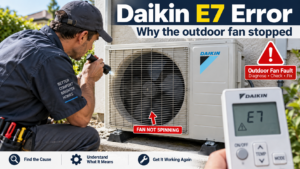
Daikin E7 Error Code: Why Your Outdoor Fan Stopped (And What It Actually Means)
If your Daikin has thrown an E7 and the fan on the outdoor unit has gone quiet, here’s the short version: the system has noticed the outdoor fan isn’t spinning the way it’s supposed to, so it’s shut things down to protect itself.
That’s it. That’s the whole message in plain language — your outdoor fan is not doing what the air conditioner expects it to do.
And here’s the part most people get wrong online: E7 does not automatically mean the fan motor is dead.
Search the code and you’ll find a hundred forum posts confidently telling you to “just replace the fan motor.” Daikin’s own troubleshooting process is a lot more patient than that — and for good reason. The fan, the connector, the wiring and the control board all have to be ruled out before anyone condemns an expensive part. Swap the motor first and you might still have the same fault an hour later.
Let’s walk through what E7 really means, what you can safely check yourself, and where the DIY part sensibly stops.
What Does the Daikin E7 Error Code Actually Mean?
Daikin’s service documentation describes E7 as an outdoor fan motor abnormality — and on some residential models, an outdoor fan motor lock.
The logic behind it is simple. The system constantly watches how fast the outdoor fan is rotating. If the fan is meant to be running but its detected speed stays stubbornly below where it should be, the controller flags E7. On many Daikin units, if it keeps happening, the system stops altogether.
That shutdown isn’t the air conditioner being dramatic. It’s the air conditioner protecting itself.
Your outdoor fan pushes air across the outdoor heat exchanger, and that airflow is how the refrigeration cycle dumps or absorbs heat. Take the airflow away and pressures climb, cooling collapses, and the compressor starts working in conditions it was never designed for. So instead of letting the compressor grind on under stress, the system pulls the plug.
The Real Causes Behind an E7 Fault
Here are the causes Daikin actually points technicians toward:
| Possible Cause | What It Means |
|---|---|
| Something blocking the fan | Leaves, a twig, debris or an object jamming rotation |
| Fan motor connector disconnected | The motor isn’t sending or receiving the expected signal |
| Damaged wiring or harness | The electrical link between fan and control board is compromised |
| Fan motor failure | The motor can’t rotate normally or hold its speed |
| Fan mechanically stiff or seized | Worn bearings or damaged components |
| Rotation feedback fault | The board can’t correctly read the fan’s speed |
| Outdoor PCB fault | The control board isn’t driving or reading the fan properly |
The exact path through that list depends on your model — which is exactly why the model number matters so much when you call for help.
Why the Outdoor Fan Punches Above Its Weight
It’s easy to write the outdoor fan off as “just a big fan behind a grille.” It does a lot more than that.
When you’re cooling, heat pulled from inside your home travels through the refrigeration system out to the condenser. The outdoor fan drags air across the heat exchanger so that heat can escape outside. Stop that fan and the heat has nowhere to go — pressures rise, cooling gets weak, the compressor takes a beating, and protection kicks in.
In reverse-cycle heating the flow runs the other way, but outdoor airflow is still just as critical. So an E7 isn’t really a comfort complaint. It’s the system refusing to run without the airflow it depends on.
Cause 1: Something Is Jamming the Fan
This is the best-case scenario, and it’s more common than you’d think.
Daikin’s own E7 flow tells technicians to check for foreign matter around the fan first. And around Sydney, outdoor units quietly collect all sorts of things — leaves, twigs, seed pods, plastic bags, garden clippings, windblown rubbish. Units tucked in beside a garden bed cop the worst of it.
Sometimes a stick lodges between the blade and the housing. The motor tries to spin, the fan can’t move, the controller sees the speed is wrong, and up pops E7. Nothing’s actually broken.
What you can safely do: with the system switched off, take a look around the outside of the unit. Don’t put your hands through the grille, and never try to spin the fan by hand while power is connected. If there’s loose debris sitting around the outside that lifts away easily, clear it. If something’s wedged inside the fan area, leave that for a technician.
Cause 2: A Connector or Wiring Problem
The fan doesn’t operate on its own — it’s wired into the outdoor control system, and Daikin specifically lists a disconnected fan motor connector as an E7 cause.
Connections can work loose, corrode, get knocked out of place, or simply sit poorly. Harnesses can develop faults over years of heat, vibration and weather. If the motor isn’t getting the right drive signal, it won’t spin properly. And if the board isn’t getting the right speed feedback back, it’ll assume the fan has failed even when the motor is perfectly healthy.
This is exactly why nobody should be buying a motor the moment E7 shows up. Check the connection first.
Cause 3: The Fan Motor Really Has Failed
Sometimes, yeah — the motor’s cooked.
Daikin directs technicians to check whether the fan turns smoothly and, depending on the model, to test electrical resistance or rotation feedback. A dying fan motor tends to give itself away. It might:
- refuse to start
- start slowly or struggle up to speed
- stop after a few minutes
- make grinding or buzzing noises
- act up worse in hot weather
- trip E7 over and over
Worn bearings can also leave a motor mechanically stiff — the board tells it to spin, but it physically can’t hit the speed it’s supposed to.
Cause 4: The Outdoor PCB (Control Board)
If there’s no obstruction, the connectors are solid, the fan spins freely and the motor tests fine — attention turns to the outdoor PCB (printed circuit board).
The board runs a big chunk of what happens inside the outdoor unit. For the fan alone, it sends the control signals, monitors rotation, reads the speed feedback, and decides when the fan should run. If it can’t correctly drive or read the fan, you’ll get E7 even though the blade itself looks perfectly fine.
Daikin’s diagnostic flow can genuinely end at “replace the PCB” — but only after the motor and connections have been cleared. That order isn’t bureaucracy. It’s what stops you paying for the wrong part.
Symptoms That Show Up Alongside E7
You might notice any mix of these:
- the aircon stops cooling
- it starts, then shuts down
- the outdoor fan won’t spin
- the fan starts and stops
- the fan turns unusually slowly
- buzzing or grinding from outside
- the indoor unit keeps blowing, but the air turns warm
- the operation light flashing
- E7 on the controller
- the fault coming straight back after a reset
One observation is worth more than all the others: watch the outdoor fan. From a safe distance, does it try to start? Sit dead still? Twitch and stop? That single detail can point a technician toward the answer before they’ve even opened the unit.
Can You Fix a Daikin E7 Yourself?
There are a handful of safe homeowner checks. But most E7 repairs mean electrical or mechanical work inside the outdoor unit, so DIY runs out of road fairly quickly. Here’s how far you can safely go.
Check 1: Confirm It’s Actually E7
Don’t diagnose off a blinking light. Most Daikin controllers let you pull the stored fault code, though the steps vary by controller. Once you’ve confirmed it, jot down:
- indoor model number
- outdoor model number
- serial number
- the E7 code
- when it started
- whether the outdoor fan moves at all
Daikin itself asks customers for the model number, serial number and fault code when you request support — so having these ready saves everyone time.
Check 2: Look Around the Outdoor Unit
Switch it off, then check for leaves, branches, rubbish, plants creeping in, or anything shoved up against the grille. The unit needs breathing room. Don’t remove any covers, don’t reach through the grille, and don’t touch internal wiring.
Check 3: Listen for Odd Noises
Think back to when it first faulted. Grinding? Rattling? Buzzing? Clicking? Scraping? A scrape hints at a physical obstruction; a buzz with no spin can mean the motor’s trying and failing to turn. Sound alone won’t diagnose it — just make a mental note and pass it on.
Check 4: One Restart. Just One.
If your model’s instructions allow it, switch off and restart once. If E7 clears and the unit runs normally, keep an eye on it. If it comes back — stop resetting. Cycling the power won’t fix a jammed fan, a failed motor, a loose harness or a faulty board. It just tells the system to attempt the same failed move again.
What You Should NOT Do
- Don’t push the fan blade with power connected. It can start without warning.
- Don’t pull the outdoor electrical cover. There are hazardous components in there.
- Don’t hose down the electrical section. Cleaning a condenser doesn’t mean flooding it.
- Don’t replace the motor off the code alone. The connector, wiring or PCB may be the real culprit.
- Don’t keep running it. If the fan genuinely isn’t working, forcing operation stresses the whole refrigeration system.
Can Leaves Really Trigger an E7?
Yes — and it’s a genuinely useful thing to remember, because not every fault code means a part has died.
Picture a unit beside a garden. A strong Sydney gust drops a small branch into the grille, the blade catches it, and the fan can’t turn. The motor’s fine. The PCB’s fine. The compressor’s fine. But the system sees an abnormal fan speed and stops. Clear the branch and the immediate problem’s gone — which is a world away from replacing a motor.
Can a Dirty Coil Cause E7?
A clogged outdoor coil will absolutely hurt performance and pile stress on the system — but E7 points specifically at the fan motor system, not the coil. So if the coil’s filthy and you’re seeing E7, don’t jump to “dirty condenser = E7.” The real E7 path runs through fan rotation, obstruction, the motor, the connections and the board. Keep the coil clean as part of normal maintenance, sure — just don’t assume it’s the cause here.
E7 vs A6 vs L5: Telling the Fans Apart
These get muddled because a couple of them involve fans.
- E7 — outdoor fan motor abnormality or lock.
- A6 — generally the indoor fan motor.
- L5 — inverter/compressor output overcurrent (outdoor area, but a different system entirely).
That’s why vague advice like “your outdoor unit is broken” is useless. The code gives a technician a real starting point. If you want the bigger picture, a broader guide to Daikin aircon error codes helps you see exactly where E7 sits among the other common faults.
Split System vs Ducted: Does E7 Behave Differently?
On a standard wall-mounted split, E7 sends attention straight to the outdoor fan system — obstruction, connector, wiring, free movement, motor characteristics, rotation feedback, then the PCB, in that sensible order.
On ducted and larger systems, the broad meaning is the same, but bigger outdoor units can run two fan motors, use different motor types, and carry more complex boards with extra monitoring. Daikin’s documentation for some outdoor units specifically notes the technician has to work out which fan is faulty. So don’t assume the process for a bedroom split matches a big ducted setup — another reason your model number earns its keep.
Why Does E7 Sometimes Only Appear on Scorching Days?
Because heat exposes weakness that was already brewing.
Imagine a motor that copes fine on a mild 24°C afternoon. Then Sydney turns on a proper stinker, the outdoor unit has to reject far more heat, and fan performance suddenly matters a lot more. A weak motor, a marginal connection or a developing fault finally buckles under the extra load. The heat didn’t cause the fault — it just dragged an existing weakness into the open.
Can E7 Be Intermittent?
Absolutely, and it’s maddening. A loose connector might make contact some of the time. A bearing might only stiffen once it’s hot. A board can fail on and off. So you get the classic pattern: works, stops, works again, then E7 returns.
Intermittent faults are exactly why you should record what happened instead of hammering the reset button. Note the outside temperature, how long it ran, whether the fan moved, any noises, and whether E7 appeared immediately or crept in later. Those details are gold for a technician chasing a ghost.
Does Maintenance Prevent E7?
Maintenance can’t guarantee an electronic motor or PCB will never fail — electronics do what electronics do. But it heads off the avoidable stuff. A good service picks up debris around the unit, abnormal fan noise, restricted airflow, damaged wiring, deteriorating connections and early mechanical wear.
You can help too: keep the outdoor area clear. Don’t build storage around the condenser, don’t let plants grow into it, and don’t let leaves pile against it. The unit needs airflow to live.
A Quick E7 Decision Tool (Run This Before You Book)
- Is E7 confirmed? No → confirm the code first. Yes → keep going.
- Obvious debris around the fan? Yes → power off and clear external loose debris only. No → keep going.
- Does the fan look physically damaged? Yes → stop using it and book service. No → keep going.
- Did one permitted restart clear it? Yes → monitor. No → keep going.
- Does the fan fail to start or keep stopping? Yes → you need a professional.
At that last step, the likely checks are electrical connections, the fan motor, rotation feedback and the outdoor PCB — squarely beyond normal DIY.
When Should You Stop Using It Altogether?
Stop and get it assessed if:
- E7 keeps coming back
- the fan won’t rotate
- the outdoor unit is grinding
- the blade looks damaged
- there’s a burning smell
- the breaker trips
- there’s visible electrical damage
- it starts and shuts down on repeat
A protection code exists because the system has spotted something it considers abnormal. Don’t turn that safety logic into a staring contest with the reset button.
What a Technician Will Actually Check
A proper E7 diagnosis usually runs through:
- Physical inspection — is anything stopping the blade?
- Fan motor connector — is it secure?
- Wiring harness — damaged or poorly connected?
- Mechanical rotation — does the fan turn freely when safely tested with power isolated?
- Motor electrical testing — does it meet Daikin’s expected values?
- Rotation feedback — is the board getting the fan-speed pulse it expects?
- Outdoor PCB — is the board correctly controlling and reading the fan?
The outcome decides whether the fix is clearing an obstruction, repairing a connection, replacing the motor, or replacing the board. That’s the whole point of diagnosing before spending.
Same Code, Three Different Repairs
Why guessing is a bad idea — three Sydney homes, all showing E7:
Home A — the unit sits beside a tree, a branch is trapped in the fan, and the motor tests perfectly. Clear the obstruction, verify, done.
Home B — no blockage, connector secure, fan mechanically free. But the motor isn’t producing the expected rotation-feedback signal. The motor needs replacing.
Home C — motor tests fine, wiring’s sound, but the control board can’t correctly read or drive it. Now it’s the PCB.
Same fault code. Three completely different repairs. That’s why E7 means check the outdoor fan system — not replace the fan motor without testing anything.
What 2026 KYNEX Feedback Actually Tells Us
It’d be easy to invent a tidy E7 case study to make this article more convincing. We’re not going to do that. Instead, here’s real, verified 2026 feedback about actual service work.
In June 2026, customer Mike Morgan described having an ageing AC system serviced and cleaned, including replacement of a failed pump. In March 2026, Andrew Barlow said it was the second time he’d used KYNEX for installation, maintenance or repairs, and singled out responsiveness and technical knowledge. In February 2026, another customer described reliable air-conditioning installation and servicing for both home and workplace.
None of those reviews claims an E7 repair — and that honesty matters. They show recent, real repair and maintenance experience without pretending to prove a specific fan-motor outcome.
How KYNEX Can Help With a Daikin E7
KYNEX Air Conditioning handles repair, servicing and maintenance across Sydney. Its current website states the team has more than 10 years of industry experience and has serviced or installed more than 2,000 systems around Sydney.
With E7, the goal isn’t just to make the code vanish — it’s to work out whether the fault is coming from obstruction, wiring, a connector, the motor, the rotation-feedback circuit or the PCB.
So if you’re searching for aircon repairs near me, give the technician something to work with. Compare these two:
“Daikin split system, E7 code. Outdoor fan tries to turn and stops after a few seconds.”
versus:
“My aircon doesn’t work.”
The first one is genuinely useful. The second one has the technician starting from zero.
Repair or Replace? Is E7 a Reason to Buy New?
Usually not on its own. A failed fan motor can very often be repaired without replacing the whole system.
Repair makes sense when the system’s relatively young, only the fan motor’s gone, parts are available, the PCB and compressor are healthy, and everything else runs well.
Replacement is worth weighing when the system’s old, several major faults are stacking up, both the PCB and fan need expensive work, the compressor’s in poor shape, parts are hard to source, or repair bills keep repeating.
The E7 code alone can’t make that call. The diagnosis can.
Frequently Asked Questions
What does E7 mean on a Daikin air conditioner? Daikin uses E7 for an outdoor fan motor abnormality — or an outdoor fan motor lock on applicable systems.
Does E7 mean the fan motor is broken? Not always. It can also be foreign matter blocking the fan, a disconnected connector, wiring problems or a faulty outdoor PCB.
Can leaves cause a Daikin E7 fault? Yes. Daikin specifically lists foreign matter preventing fan rotation as a possible cause.
Can I reset an E7 error? You can do one normal restart if your model’s instructions allow it. If E7 returns, arrange diagnosis rather than resetting repeatedly.
Can a dirty filter cause E7? E7 relates to the outdoor fan system. A dirty indoor filter isn’t a typical direct cause.
Can the outdoor PCB cause E7? Yes — after the motor, obstruction and connection issues have been checked.
Is E7 the same as A6? No. A6 generally relates to the indoor fan motor; E7 relates to the outdoor fan.
Can E7 occur on ducted Daikin systems? Yes. Larger systems use E7 for outdoor fan abnormalities too, and some outdoor units have more than one fan motor.
Should the outdoor fan always spin when the aircon runs? Not every second under every condition — fan speed changes with demand. But if the system reports E7, it has detected fan behaviour outside the expected range.
Can I replace a Daikin outdoor fan motor myself? No. Diagnosis and replacement involve electrical components and should be done by trained personnel.
Should I keep running the aircon with E7? If it keeps returning, stop normal operation and have it checked.
How urgent is an E7 error? It deserves timely attention. The outdoor fan is central to heat transfer and healthy compressor conditions, so a repeating E7 shouldn’t be ignored.
Related Readings
The Bottom Line on Daikin E7
Treat E7 as an outdoor fan system fault — not proof the fan motor is dead. Daikin’s own troubleshooting points to four main areas:
- Foreign matter blocking the fan
- A connector or wiring problem
- A defective fan motor
- A defective outdoor PCB
Start with what you can safely see. Confirm the code, record the model number, check around the unit, clear any obvious external debris, listen for odd noises, and try one restart if your instructions allow it. If E7 comes back, stop resetting and have the fan motor, wiring, rotation feedback and PCB properly tested.
Because with E7, the smartest repair isn’t swapping out the first part whose name happens to sit next to the fault code. It’s figuring out why the outdoor fan didn’t spin the way the Daikin controller expected it to.