

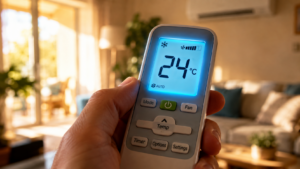
What is the best air conditioner temperature in summer?
Sydney guide · Reviewed for the 2026 summer season
THE SHORT ANSWER: The best air conditioner temperature in summer is around 25–27°C. That range keeps most Sydney homes comfortable, cuts the workload on your system, and trims your power bill. Every degree colder can add roughly 10% to your running cost, so 21°C isn’t “a bit cooler” — it’s a noticeably bigger bill for comfort you often won’t even notice.
Most of us do the same thing on a scorching afternoon. We walk in the door, we’re sticky and cranky, and we jab the remote down to 19°C or 18°C because we want the room cold right now. It feels logical. It’s also the single most expensive habit in Australian cooling, and it doesn’t even work the way people think.
So let’s settle the number, explain why it’s the number, and cover the handful of times it’s fair to break the rule.
Who’s actually telling you this?
Fair question — you should be skeptical of any random figure on the internet. The 25–27°C range isn’t something we made up. It lines up with Australian Government energy guidance for summer cooling, and it’s the same advice you’ll hear from qualified installers across the country.
For the Sydney context, this guide draws on the field experience of the team at KYNEX, an air conditioning sydney company that has serviced and installed thousands of systems across the city. When you spend years walking into homes with sky-high summer bills, a pattern shows up fast: the thermostat is almost always set too low. Fixing that one habit tends to do more than any gadget.
Why 25–27°C, and not just crank it to 20?
Your air conditioner isn’t cooling the air so much as it’s removing heat and dumping it outside. The bigger the gap between your target temperature and the temperature outdoors, the more heat it has to shift, and the harder it works to get there.
On a mild 27°C day, holding the living room at 25°C is an easy job. On a brutal 39°C afternoon, that same 25°C target is already a big ask. Drop the target to 20°C and you’ve widened the gap enormously — the system runs longer, draws more power, and often struggles to reach a number you didn’t really need in the first place.
Think of it like a car. Cruising at a steady speed sips fuel. Flooring it to overtake burns it. Setting 18°C on a hot day is the flooring-it option — except you’ve told the car to keep flooring it all afternoon.
What does each degree actually cost? (The running-cost bit)
This is where it stops being abstract. Australian energy advice puts the cost of extra cooling at roughly 10% more energy for each degree cooler you set. So the move from a sensible 25°C down to 21°C isn’t a small tweak — it can lift the cooling portion of your bill by a meaningful chunk, every hot day, all summer.
You can sanity-check your own numbers with a simple air conditioner running cost calculator — no app required. Use:
Average draw (kW) × your electricity rate ($/kWh) × hours run = cost
Say your unit averages 1.2 kW while it’s working, your rate is $0.35/kWh, and you run it six hours:
| Setting | Rough relative effort | Six-hour cost (illustrative) |
|---|---|---|
| 26°C | Comfortable, easy load | ~$2.10 |
| 24°C | Noticeably more work | ~$2.55 |
| 21°C | System pushing hard | ~$3.35+ |
Those figures are illustrations, not price promises — your real air conditioner running cost per hour depends on your own tariff and how hard the unit is working at that moment. But the shape is the point: a few degrees is real money over a Sydney summer.
Does a colder setting cool the room faster? (No.)
This is the myth that costs people the most. Setting 18°C does not make the room cool faster than setting 25°C. Your air conditioner has one maximum cooling output, and it runs at roughly that flat-out pace until the room hits the target either way.
All 18°C does is tell the system to keep going long past the point you were already comfortable — so it overshoots, runs longer, and costs more. Set the temperature you actually want and let it get there. It arrives at the same speed.
Why the “right” number shifts between Sydney homes
Here’s where a single national figure needs local nuance. Two Sydney homes can behave completely differently.
A ground-floor apartment facing east, with decent curtains and morning-only sun, might feel perfect at 26°C. A west-facing townhouse with big glass doors taking the full afternoon sun can feel stuffy at the same 26°C, because the building itself is radiating heat back at you. Same setting, different experience.
That’s why the honest answer is a range, not a magic digit. Start at 26°C, sit with it for fifteen minutes, and nudge down a degree only if you genuinely need to. Most people find they settle a degree or two higher than they’d have guessed — especially once a fan is moving the air around, which makes a room feel a couple of degrees cooler for almost no power.
Day, night, and sleeping through a heatwave
Daytime, 25–27°C is the sweet spot for comfort versus cost. For sleeping, many people are comfortable somewhere around 24–26°C with light bedding and some airflow — cooler than that is usually the bedding or the airflow talking, not the thermostat.
A timer earns its keep here. Rather than running cold all night, set the system to ease off after you’ve fallen asleep, or to switch on shortly before you wake. You get the comfort where it counts without paying to over-cool a sleeping household at 3am.
How KYNEX Air Conditioning can help you land on the right number
If you’ve set a sensible 25–26°C and the house still won’t get comfortable, the thermostat usually isn’t the villain. Something else is making your system work overtime, and that’s worth diagnosing rather than solving by cranking the dial.
Common culprits the KYNEX team sees across Sydney:
- Clogged filters choking airflow, so the unit runs long and cools poorly.
- Wrong sizing — a system too small for the room can never comfortably reach target on a hot day.
- Poor zoning on ducted systems, cooling rooms nobody’s in.
- An ageing or under-serviced unit that’s quietly lost efficiency.
Regular air conditioning maintenance Sydney homeowners schedule before summer is the cheapest fix on that list — a clean filter and a proper check-up often restore comfort at a higher, cheaper thermostat setting. KYNEX supplies, installs, services and repairs residential systems across Sydney, and the useful first question is never “which unit is coldest?” It’s “why is my current setup working so hard?” Answer that, and the right temperature usually looks after itself.
Five common summer thermostat mistakes
| Mistake | What to do instead |
|---|---|
| Setting 18°C to “cool faster” | Set the real target — it arrives just as fast |
| Ignoring ceiling and pedestal fans | Run a fan; it makes a room feel ~2–3°C cooler cheaply |
| Leaving blinds open in the afternoon | Close them before the sun hits the glass |
| Cooling the whole house for one room | Use zoning or shut internal doors |
| Never cleaning the filter | Clean per the manual; book a service before summer |
Frequently asked questions
What is the best air conditioner temperature in summer in Australia?
Around 25–27°C for daytime cooling. It keeps most homes comfortable while keeping running costs down. Going colder adds roughly 10% more energy per degree.
What temperature should I set my air conditioner in summer in Sydney?
Start at 26°C and adjust by a degree if needed. West-facing and poorly shaded homes may feel warmer at the same setting, so use fans and shading before dropping the thermostat.
Does a lower temperature cool the room faster?
No. The system cools at the same rate regardless of the target; a lower setting just makes it run longer and cost more.
What’s the best air conditioner temperature in summer in Celsius for sleeping?
Many people sleep well around 24–26°C with light bedding and airflow. A timer to ease off overnight saves power without hurting comfort.
How much does each degree cost?
Roughly 10% more energy for each degree cooler. Multiply your unit’s average kW draw by your electricity rate and hours run to estimate your own cost per hour.