
Residential Air Conditioning Sydney / Strata & apartments / Updated 28 July 2026
By the KYC Air Conditioning installation team — Sydney-based since 1993
The short answer
If your Sydney apartment has no drain point, there are five drainage solutions that work, listed here from best to last resort:
- Gravity drain to an existing waste point — pipe the water to a bathroom or laundry drain through a tundish (a small open funnel that creates an air gap so dirty water can never siphon back into your unit).
- Condensate pump — a small pump lifts the water up and over to a drain the pipe can’t reach by gravity.
- Heated evaporation tray — the water boils off as vapour. No drain needed at all.
- Self-evaporating split or window unit — the system re-uses most of its own water.
- New building drain line — a shared riser designed by a hydraulic engineer, for whole-building upgrades.
All five need owners corporation approval if they touch common property, and any connection to a waste pipe must be done by a licensed plumber to AS/NZS 3500.2.
Almost every apartment we quote in Sydney hides the same problem. The wall is fine. The power is fine. Then someone asks where the water goes, and the room goes quiet.
This guide comes from our own residential air conditioning Sydney work in strata buildings across the Inner West, Eastern Suburbs, North Sydney and the CBD. We have installed and repaired these systems since 1993, and drainage is still the most common reason an apartment install stalls.
Why do so many Sydney apartments have no drain for air conditioning?
Because nobody built one. A 1960s walk-up in Randwick, a 1930s Art Deco block in Neutral Bay, a 1990s infill development in Zetland — none were designed with a spare waste pipe next to your living room wall. Newer towers often have a dedicated condensate riser. Older buildings almost never do. And the drains that are nearby usually belong to somebody else:
- The balcony floor waste — normally goes to stormwater, not sewer, and is common property.
- The stormwater downpipe — collects rain only. Tying condensate into it in NSW is often knocked back.
- The bathroom or laundry drain — the right target, but frequently on the wrong side of the apartment.
How much water does an air conditioner actually produce?
Far more than people expect. This is the number that changes the conversation.
When your air conditioner cools, it pulls moisture out of the air. That moisture — called condensate — has to go somewhere. A small split system can produce two litres an hour or more in humid weather, and published figures for larger capacities run as high as around 4.7 litres an hour.
Sydney in February is exactly the wrong climate to be casual about this. High humidity plus long run times means a single bedroom unit can shed a full bucket in an afternoon.
Rough guide to daily condensate volume
| Cooling capacity | Litres per hour | Over an 8-hour day |
|---|---|---|
| 2.5 kW (bedroom) | 0.9 – 1.8 L | 7 – 14 L |
| 3.5 kW (large bedroom) | 1.2 – 2.5 L | 10 – 20 L |
| 5.0 kW (living area) | 1.8 – 3.5 L | 14 – 28 L |
| 7.1 kW (open plan) | 2.5 – 5.0 L | 20 – 40 L |
Based on roughly 0.35–0.7 litres per hour for each kW of cooling in humid Sydney conditions. Check your unit’s data sheet for its rated figure.
Interactive estimator
How much water will your unit make?
1.2–2.4litres / hour10–19litres / day1–210L buckets / dayRough guide only, based on roughly 0.35–0.7 L per hour for each kW of cooling in humid Sydney conditions. Check your unit’s data sheet for its rated figure.
What are the residential air conditioning Sydney drainage rules?
Two separate rule sets apply, and people usually only find out about the second one after the first one is finished.
1. Plumbing rules
All plumbing and drainage work in NSW must comply with the Plumbing Code of Australia, and the “deemed to satisfy” path is to do the work in line with AS/NZS 3500. For condensate, the code sets out the approved discharge points. Condensate drains from cooling equipment must discharge to an approved point such as a sanitary drainage system by way of a tundish or self-sealing device, or an absorption pit only where no sanitary or surface water system is available.
A tundish is a small open funnel. The gap of air above it means dirty water from the drain can never be sucked back up into your air conditioner. NSW is specific about how it is fitted: pipes discharging over a tundish need an air gap at least twice the internal diameter of the discharging pipe, and tundishes must be accessible. Building Commission NSW audits of apartment buildings keep finding them sealed inside waterproofed, tiled walls with no access panel — which means any future access damages the waterproofing and fire rating, at the owner’s cost.
Watch this one
Ask your installer where the tundish will go, and whether you will be able to reach it in five years. A tundish behind new bathroom tiles is a future repair bill, not a solution.
2. Strata rules
Under section 110 of the Strata Schemes Management Act 2015, minor renovations to common property need owners corporation approval by resolution at a general meeting. Clause 28 of the Strata Schemes Management Regulation 2016 includes installing a reverse cycle split system air conditioner in the definition of minor renovation works. That approval may carry reasonable conditions, but it cannot be unreasonably withheld.
Two catches worth knowing. Owners must give at least 14 days’ written notice before the meeting, and work that alters the external appearance of a lot falls outside minor renovations — so a new pipe running down an outside wall may need a special resolution and a by-law instead.
The five drainage solutions, explained
1. Gravity drain to an existing waste point
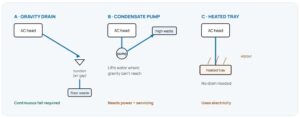
The best solution when it is possible. A drain line runs from the indoor unit, hidden in a duct or wall cavity, to a tundish above an existing bathroom floor waste or laundry tub trap. No moving parts, no power, nothing to fail. The catch is fall: water only moves downhill, so the whole run must drop continuously. If your unit sits three rooms from the bathroom, gravity may simply run out.
2. Condensate pump
A pump the size of a paperback sits near the indoor unit. A float switch detects water, the pump lifts it several metres, and gravity takes it from there. This is what makes drainage possible where the only drain is above the air conditioner. It needs power and occasional cleaning. Ask for one with a safety switch that shuts the system down if water backs up — that switch is the difference between a service call and a damaged ceiling.
3. Heated evaporation tray
Condensate drains into an insulated tray with a heating element and leaves as vapour. No pipe, no connection to common property. It is the honest fallback for high-rise lots where no drain can be reached. The trade-off is running cost: you pay electricity to boil water while you pay electricity to cool the room. The tray needs cleaning too, because minerals stay behind when water leaves.
4. Self-evaporating split or window unit
Some units re-use most of their own condensate, passing it over the hot outdoor coil so it leaves as vapour. Useful for renters and lots where no pipework is allowed. But “self-evaporating” usually means “mostly”. On a 30°C, 80%-humidity February night most will still weep a little, so plan a drip tray as backup.
5. A new building drain line
Where a whole block wants air conditioning, the durable answer is a dedicated condensate riser designed by a hydraulic engineer. Expensive and slow, but it solves the problem for every lot permanently.
Which drainage solution fits your apartment?
Work through these in order and stop at the first match.
- You rent and can’t alter pipework → self-evaporating or portable unit. Plan a drip tray.
- There is no drain within about 8 metres → heated evaporation tray. Budget for the electricity.
- You’re not sure of the distance or the fall → get a site inspection. This decision is measurements, not guesswork.
- Heritage controls or strict by-laws → internal gravity drain, or push the committee for a building-wide riser.
- A drain is nearby and lower than the unit → gravity drain. Your best case.
- A drain is nearby but level with or above the unit → condensate pump with a safety switch.
Side-by-side: which drainage option should you choose?
| Solution | Needs a plumber? | Uses power? | Strata friction | Best for |
|---|---|---|---|---|
| Gravity drain | Yes | No | Low | Units near a bathroom or laundry with fall available |
| Condensate pump | Yes | Yes, small | Low | Drain exists but sits too high or too far |
| Heated evaporation tray | No connection needed | Yes, notable | Low | High-rise lots with no reachable drain |
| Self-evaporating unit | No | Included | Low | Renters and no-alteration by-laws |
| New building riser | Yes, plus engineer | No | High | Whole-of-building upgrades |
| Dripping off the balcony | — | — | Breach | Nothing. See below. |
Four things not to do with air conditioner water
Every one of these turns up on Sydney balconies, and every one of them creates a bigger problem than the one it solved.
- Letting it drip over the balcony edge. The classic. It stains the render, it lands on the balcony below, and it generates complaints that end up in front of the strata committee. Owners have been told to rectify exactly this.
- Cutting into the stormwater downpipe. Tempting, because it is right there. In NSW this is often refused, on the basis that a stormwater line is for rain and not for other discharges. Do not assume — have your installer confirm with a licensed plumber and the water authority first.
- Draining into a bucket or pot plant. Mosquito breeding, overflow onto a membrane never designed for standing water, and someone has to empty it every day in February.
- Hiding the tundish inside a wall. Cheap on the day, expensive later. It must stay accessible.
Gentle reality check
Nobody has ever been fined for asking a question. Plenty of owners have been ordered to remove non-compliant work. If you are being quoted a drainage solution that sounds like “we’ll just run it out the wall”, ask where the water goes after that.
How do you get strata approval for a drainage change?
Faster than most people fear, if the paperwork is right the first time. Committees usually reject applications for missing information, not for the air conditioner itself.
Include all of this in one notice:
- Make, model and cooling capacity of the system
- Where the indoor and outdoor units go, with a photo or sketch
- The full drainage path — where the water goes, and to which existing waste point
- Licence numbers for your installer and plumber
- Certificate of currency for public liability insurance
- Your written undertaking to repair any damage to common property
- Proposed work hours and access arrangements
Strata notice template
Dear Strata Committee / Strata Manager,
Re: Lot [NUMBER], [BUILDING ADDRESS] — notice of proposed minor renovation under section 110, Strata Schemes Management Act 2015
I propose to install a reverse cycle split system air conditioner in my lot. Clause 28 of the Strata Schemes Management Regulation 2016 lists this as a minor renovation.
Details: [MAKE/MODEL], [CAPACITY] kW. Indoor unit on the [LOCATION] wall; outdoor unit at [LOCATION].
Condensate drainage: the drain line will discharge to [EXISTING WASTE POINT] via a tundish with the required air gap, installed by a licensed plumber in accordance with AS/NZS 3500.2. No new penetration of common property waterproofing is proposed. The tundish will remain accessible.
Attached: installer and plumber licence details, certificate of currency for public liability insurance, and a sketch of the unit and drain locations.
I undertake to repair any damage caused to common property and to have all work carried out in a competent and proper manner. I am happy to accept reasonable conditions.
Kind regards,
[NAME], Lot [NUMBER]
Three Sydney scenarios we see most
These are composite examples drawn from the pattern of jobs we quote, not individual customer accounts.
The 1970s walk-up in Marrickville
Living room on an internal wall, bathroom eleven metres away and slightly uphill. Gravity is out. Solution: a condensate pump lifting to a tundish above the laundry tub trap, with a safety switch. Strata approved it once the drainage path was drawn on the plan.
The 22nd floor in the CBD
No riser, no balcony waste, and a by-law forbidding new external pipework. Solution: heated evaporation tray — the only compliant option that never touches common property. We are upfront that it is a trade-off, not a free lunch.
The Art Deco block in Cremorne
Heritage controls mean nothing changes outside. Here the answer starts with the building, not the lot: the committee is better off pricing a shared riser once than fielding twelve applications over five years.
How KYC Air Conditioning can help with no-drain apartments
Drainage in strata is a design problem before it is an installation problem. That is where we spend our time.
On a no-drain apartment, our process is:
- Site inspection first. We find every possible discharge point and measure the fall before recommending anything. If gravity works, we use gravity — it is cheaper for you and there is nothing to break.
- Written drainage path in the quote. Not “drain to waste”. The actual route, the actual waste point, and the tundish location. This is the document your strata committee needs.
- Licensed plumbing for the connection. Any tie-in to a sanitary drain is done to AS/NZS 3500.2, with the tundish left accessible.
- Strata paperwork support. Licences, insurance certificates and drawings supplied in the format committees actually accept.
- Honest no. If the only compliant option is an evaporation tray with real running costs, we say so before you commit.
We handle air conditioning installation Sydney wide, including the awkward apartments other installers walk away from. If a system is already in and leaking, our residential air conditioning repairs team clears blocked drain lines and pumps. And because a blocked condensate line is the single most common cause of an indoor unit dripping onto a wall, annual residential air con servicing is genuinely the cheapest insurance you can buy in a strata building.
[Fabulous job. From the very beginning to the very end, KYC have been professional and exceeded all expectations. Competitive pricing and the only company who came out to quote us who asked reasonable and logistical questions. They have been solution orientated and friendly to work with. Thanks KYC.
—Utopia Art Sydney]
Questions Sydney apartment owners ask us
Can I install air conditioning in an apartment with no drain at all?
Yes. A heated evaporation tray or a self-evaporating unit needs no drain connection. Both work, and both have trade-offs — the tray uses electricity, and self-evaporating units can still weep in high humidity.
Can air conditioner condensate go into the balcony drain?
Sometimes, but never assume it. Most balcony drains run to stormwater, and connecting condensate to stormwater in NSW is frequently refused. The balcony drain is also usually common property. Have a licensed plumber confirm the correct discharge point before any work starts.
Do I need strata approval just for the drainage?
If the drain line touches common property — a wall, a slab, a shared pipe — yes. Installing a reverse cycle split system is a minor renovation needing owners corporation approval, and that approval cannot be unreasonably withheld.
How long does a condensate pump last?
Expect several years with cleaning, less without. Pumps fail from sludge, not age. A yearly clean during servicing is the whole maintenance story.
My air conditioner is dripping inside the room. Is that a drainage fault?
Almost always. The usual causes are a blocked drain line, a drain line without enough fall, or a failed pump. It rarely fixes itself and it can damage plasterboard quickly, so turn the unit off and book a service.
Is a portable unit an easier answer?
Easier to buy, harder to live with. Portables still make condensate, most need a tank emptied or a hose run somewhere, and they are noisier and less efficient than a fixed split. They suit short leases more than long-term comfort.
Our verdict
No drain is not a dead end. It is a design constraint, and it has five workable answers.
Chase gravity first, because a pipe that runs downhill will still be working in fifteen years. Reach for a pump when geometry defeats gravity. Use a heated tray when there is genuinely nowhere for water to go, with your eyes open about the electricity. Treat self-evaporating units as a rental compromise, not a Sydney-summer solution. And if you sit on a committee, price the shared riser once instead of arguing about drips for a decade.
The only option with no upside is letting water drip off the balcony: cheapest on the day, most expensive to undo.
If you remember one thing
Get the drainage path written into your quote before you approve the job. That single sentence protects your ceiling, your strata approval and your relationship with the neighbour below.
About the authors
KYC Air Conditioning has been designing and installing residential and commercial systems across Sydney since 1993, including strata apartments, terraces, heritage blocks and high-rise lots. Our team works daily with owners corporations on drainage design, approval documentation and compliant condensate discharge.
More on our approach: residential air conditioning services.
Not sure where your water can go?
Send us a photo of the wall and the nearest drain. We will tell you which of the five options applies to your apartment, and what your strata committee will need to see.
→ Talk to our residential team
Related reading
- Where can I legally drain AC condensate on a balcony in NSW strata?
- Where does air conditioning condensate water go in Sydney strata apartments?
- Managing portable air conditioner drainage on an apartment balcony