
Can a damaged ducted air conditioning supply duct be repaired without replacing the entire duct network?
Yes. A technician can often reconnect a loose supply duct or replace one damaged branch while keeping the rest of the network. If you’re searching for “ducted air conditioning duct repair Sydney” because one room has lost its breeze, start with a simple question. Where along the path to that room does the air stop flowing properly?
Prepared for KYNEX Air Conditioning & Trades · Sydney homeowner guide · November 2026
What can ducted air conditioning duct repair in Sydney fix?
A supply duct takes heated or cooled air from the indoor unit to a room. In many homes a main duct feeds smaller branches. Follow one branch to its end and you’ll find the fitting behind the ceiling grille. A loose joint at that fitting can leave the room short of air even when the fan runs and the next bedroom feels fine.
Flexible duct has layers. The inner tube carries the air. Insulation wraps around it to slow heat transfer. An outer jacket protects that insulation and helps keep moist air out. A photo of torn silver foil tells you which layer you can see. It takes a closer look to tell whether the air tube underneath has split as well.
What if just the outer jacket has torn?
If the inner tube is sound and the insulation is dry and in place, the technician may be able to restore the jacket with a repair suited to that duct. Ask them to check the underside as well as the visible face. Wet or missing insulation changes the job, even if the hole in the foil looks small.
What if the inner tube is torn or has come loose?
A sound end that has slipped off a fitting may be fit to reconnect. A tear through the air tube needs a sound joint or a replacement length, in line with the duct maker’s instructions. Wrapping the outside can hide a split while air still spills into the insulation. Ask which layer the proposed work will repair and how the insulation will be closed afterwards.
What can you tell from inside the room?
Leave the ceiling space to the technician. From the floor, note which zones are on, the fan setting and which outlets feel weak. Compare rooms during the same run. If someone opens a second zone or the fan changes speed halfway through, that comparison becomes hard to use. Open the description that matches your home.
One outlet is weak and another in the same zone feels normal
Tell the technician which two outlets you compared. Ask them to trace the weak outlet back to the point where the paths divide. A loose fitting, a squashed bend or a local obstruction could explain the difference. The healthy outlet gives them a useful comparison.
Every outlet in one zone feels weak
Check that the controller shows that zone as open. A damper is a flap that controls air to a zone. The screen can show a request to open even if the flap sticks. Ask for a check of the damper and the duct that feeds those rooms before agreeing to replace separate branches.
Air comes out strongly, but the room stays warm
Note when the problem starts. A west-facing room that warms up late in the day raises a different question from a room that loses its breeze as soon as cooling starts. Ask about supply temperature, sun through the glass and airflow for the size of the room.
All rooms have lost airflow
Tell the technician whether this happens with your usual zones open. The return-air path, filter, fan or main supply duct may need attention. One damaged bedroom branch is a weak explanation for a change you can feel at every outlet.
One detail worth writing down is what changed just before you noticed the fault. Did the bedroom work well until a ceiling repair? Has it felt that way since you moved in? The first answer gives the technician a place to look. The second makes it worth checking the original layout and the amount of air the room was meant to receive.
Should you repair the joint, replace a branch or renew the network?
Choose a local repair when the surrounding duct can hold a joint
Take an illustrative example. A Randwick household finds the back bedroom barely cools after work near the ceiling hatch. The front bedroom on the same zone still feels comfortable. If an inspection finds a loose collar feeding the back room, a reasonable quote would cover checking the fitting, securing the connection, restoring the wrap and testing that outlet. Sound branches elsewhere have no reason to come out for that fault.
Choose a new branch when a patch would depend on weak material
Picture a different finding in the same bedroom. The inner tube has split in two places and the end crumbles when handled. A new length between sound fittings gives the technician solid ends to join. Ask what pushed the old duct out of shape. If a tight turn or a poor support caused the damage, a new branch laid along the same path could develop the same fault.
Consider wider replacement when the evidence reaches other branches
If several runs have brittle liners, repeated splits or soaked insulation, paying for a series of small visits may make little sense. Ask to see an example from each affected part of the home. Find out which sections the technician could inspect and which remain hidden. A quote that labels those gaps gives you a fair basis for deciding how much work to approve.
Also check what “replacement” means on the paperwork. One quote may cover a bedroom branch. Another may include the main duct, zone fittings and grilles. A third may include new indoor and outdoor equipment. Ask for those items on separate lines. A failed duct connection alone tells you little about the condition of the air conditioner itself.
Why can the same duct fault need different work in Sydney homes?
In a single-storey house with a clear route from the hatch, a technician may be able to reach both ends of a branch. In a terrace with a room built into the roof, the last metre of that same branch may sit behind a finished wall. When you call, say where the hatch is and whether the home has had an extension. You can share an existing floor plan without having to climb up for photos.
In a strata flat, the duct may sit above your hallway ceiling, while the best route to it crosses a shared space. Before agreeing to an opening, ask who will confirm access with the strata manager, protect the room and make good the ceiling. If paint or plaster work falls outside the quote, it helps to know that while you can still compare options.
Water marks deserve a separate look. A gap in a duct’s outer wrap can allow moisture to reach a cold surface, but several faults can leave a similar mark. Show the technician where the stain first appeared and say whether it follows rain or a long cooling run. Ask them to identify the moisture source before fitting fresh insulation around a wet section.
How do you know the repair has restored airflow?
Ask for a reading at the affected outlet before and after the work. Air volume is often recorded in litres per second, written as L/s. It tells you how much air reaches the room. Two grilles can feel breezy at the centre yet deliver different volumes, especially if their sizes differ. A hand held under a vent is useful for spotting a change. It gives you no reliable design target.
For example, suppose a bedroom measures 18 L/s before a repair and 32 L/s afterwards. That is a gain of 14 L/s. These are example figures. Whether 32 L/s suits that bedroom depends on the design and the conditions of the test. Ask the technician to write down the fan speed, open zones and target, if known, alongside both readings.
Then repeat the check in the way you actually use the house. If you sleep with the bedroom door shut and the hall zone off, mention that. A room also needs a path for air to get back to the unit. A result taken with every door open can miss a comfort problem that only shows up at bedtime.
What does a ducted installation look like?
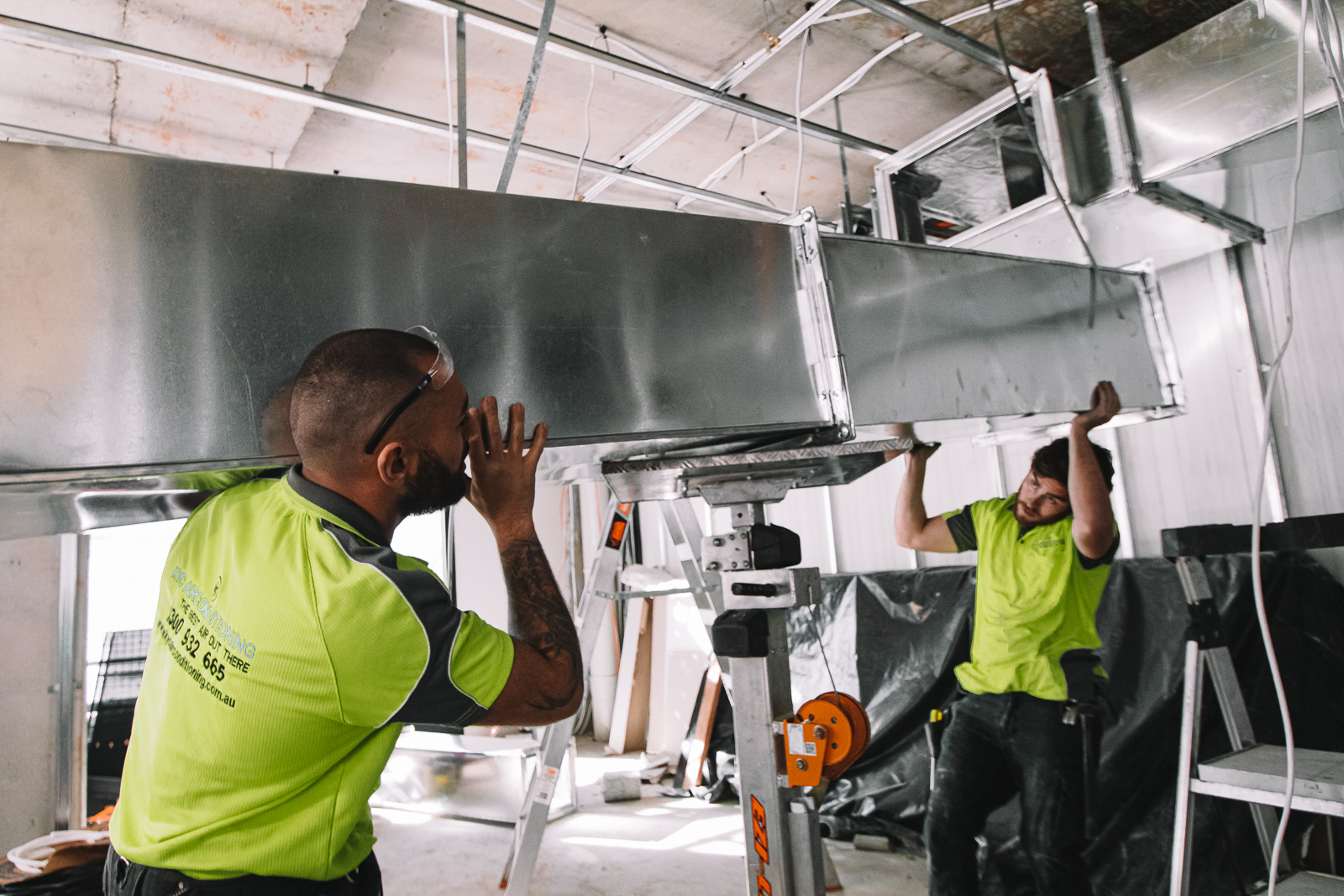
This KYNEX installation showcase gives you a visual reference when discussing your own layout. On your home’s photos, ask the technician to point out three things you can recognise later on a plan or invoice. Where does the branch start? Which grille does it feed? Where is the damaged section between them?
View a still from the project video

What should you ask KYNEX before approving a quote?
KYNEX Air Conditioning & Trades describes an on-site assessment, diagnostic checks and final testing in its service profile for ducted air conditioning repairs Sydney. When booking, name the room and describe what you can feel at the grille. “The back bedroom has lost its breeze, but the study on the same zone feels fine” gives the team more to work with than “the air con is broken”.
Ask for the smallest lasting repair the inspection supports. The written scope should identify the branch, the fittings or duct length involved, any work needed for access, and how the result will be checked. If the recommendation includes a redesign, the ducted air conditioning Sydney installation page gives you background for that discussion.
One Sydney homeowner, Carol Cook, described having ducting installed at her house. In its 2026 after-sales guide, KYNEX publishes her account of a courteous crew who cleaned up when the work was finished. Her experience concerns an installation. For your repair, agree on the details that matter to you, including who will protect furniture beneath the hatch and clear away the old wrap.
For a site-specific cost, call KYNEX Air Conditioning & Trades on 0484 59 59 59. Suite 206 Level 2/71 Belmore Rd, Randwick NSW 2031. Have your room notes, the zone settings and any photos taken safely from the floor to hand.
What is the bottom line?
If a single branch has failed and the duct around it is sound, ask for a local repair or branch replacement first. If several branches have failed, ask to see where and why. The most useful handover is one you can explain in your own words. You know which duct was damaged, what changed and how much air now reaches the room that brought you to the phone.
Related reading
- Why Does My Ducted Air Conditioner Stop When I Turn On a Second Zone?
- Why Does My Ducted Air Conditioner Keep Running After Every Zone Is Switched Off?