

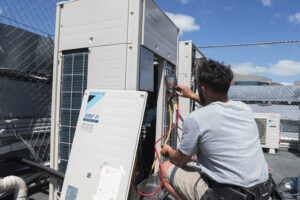
Can My Old Switchboard Handle New Aircon in Sydney? What to Check Before Installation
Your old switchboard might handle a new air conditioner — but you can’t tell that safely from its age or how it looks. Before booking an aircon Sydney installation, the electrical supply, your existing household loads, the circuit protection, the wiring, and the new system’s electrical demand all need checking.
That doesn’t mean every older Sydney house needs a switchboard upgrade. A small split system in one bedroom asks very little of your electrics compared with a large ducted system cooling a two-storey home. So the useful question isn’t “How old is my switchboard?” — it’s “Can my existing electrical installation safely supply the air conditioner I actually want?” That’s something the installer, and where required a licensed electrician, need to establish before anything gets mounted.
Quick answer: do I need a switchboard upgrade?
You may be looking at an aircon switchboard upgrade Sydney homeowners commonly run into when:
- the property still has an old fuse box,
- there’s no suitable spare circuit,
- the switchboard lacks the required protection,
- the existing wiring isn’t up to it,
- the home is already near its available electrical capacity,
- you’re installing a large ducted system,
- the new install changes the electrical loading significantly, or
- the board shows signs of damage, overheating or deterioration.
But an old board doesn’t automatically mean replacement. The NSW Government’s current switchboard guidance notes that upgrades may be needed when replacing outdated fuse boxes, increasing capacity or adding major appliances, and it recommends a professional assessment of the home’s current and future electrical needs. So before you bolt the price of a new board onto your aircon budget, get the existing installation properly assessed.
Why does new aircon put pressure on an old switchboard?
Think of your switchboard as the traffic controller for the home’s electricity. Power comes into the property and the board distributes it across the circuits — lighting, power points, the oven, hot water, pool gear, induction cooking, EV chargers, air conditioning.
A new air conditioner is simply another load added to that mix. Sometimes it’s a modest one; sometimes it’s substantial. Which is exactly why someone after a small aircon Sydney install can have a completely different electrical requirement from someone putting in a large multi-zone ducted system. The NSW Government says a switchboard upgrade can become necessary when adding major appliances, particularly where an older property still runs an original or low-capacity board. What matters is the complete electrical picture, not any single part of it.
Does an old switchboard automatically need replacing?
No — and this is one of the most important points here. A switchboard being old doesn’t prove it can’t support air conditioning. Just as importantly, a board that looks modern isn’t guaranteed to have spare capacity.
A proper assessment weighs up the incoming supply, the main-switch rating, existing household demand, available circuit space, the circuit-protection equipment, the size and condition of the wiring, the air conditioner’s rated electrical demand, and the equipment’s installation instructions. That’s why a blanket rule like “any switchboard over 20 years old must be replaced before installing aircon” would be misleading. There’s no sensible one-size-fits-all answer.
What are the aircon electrical requirements in Sydney?
Electrical work in NSW is regulated. The NSW Government states that electrical wiring work must be done by, or under the supervision of, a licensed electrician, and that the work requires compliance documentation once it’s been tested. Air-conditioning and refrigeration work is itself licensed work in NSW — guidance updated 23 June 2026 confirms a licence or certificate is required for regulated aircon and refrigeration work.
Current NSW energy-efficiency guidance also states that installing or replacing qualifying air-conditioning equipment carries electrical requirements including appropriate RCD protection, a local isolator, and installation wiring suited to the specific system.
In plain English: your new aircon can’t just be wired into wherever there happens to be power. The electrical side has to be designed around that particular system and your existing home.
Does a new air conditioner need a dedicated circuit?
Many permanently installed systems need an appropriately designed circuit, but the exact arrangement follows the appliance’s requirements and the electrical design. This is where you’ll hear the phrase air conditioner dedicated circuit — a circuit provided specifically for the equipment rather than casually sharing power with a pile of other appliances.
Why does that matter? Picture running your aircon, microwave, kettle, toaster and a portable heater through an unsuitable shared arrangement — the demand on that circuit can climb out of range fast. A properly planned installation takes the guesswork out of it.
What will the installer check first?
Before completing an air-conditioning installation, the property and the proposed system get considered together. A useful pre-installation assessment tends to look at:
The size of the system. A small bedroom split doesn’t draw what a large ducted system does.
The switchboard. Is there suitable protection? Is there room? Is there an existing circuit that fits?
Existing household demand. The electrician needs to know what else pulls serious current.
The wiring. Existing cables have to suit the intended load and installation.
Supply capacity. Sometimes the limitation is bigger than the board itself. NSW guidance notes that where a property needs increased supply capacity for significant new loads, an Accredited Service Provider may be required for certain network-side changes. That doesn’t happen with every install — but it’s a good illustration of why the answer can never come from the switchboard cover alone.
7 signs your switchboard deserves a closer look
Raise these before your new aircon goes in.
1. You still have old-style fuses. Ceramic or rewireable fuse setups are a world away from a modern board with contemporary protective devices. Their presence doesn’t answer every capacity question, but it’s a strong reason to get the install assessed.
2. There’s no room for another circuit. A packed board can make extra work necessary — don’t assume another breaker can just be squeezed in.
3. Your lights regularly flicker. The odd flicker has many causes, but repeated flickering alongside other symptoms is worth investigating. The NSW Government lists flickering lights and buzzing switchboards among the signs that can justify a professional assessment.
4. You hear buzzing from the board. Don’t pull the cover to investigate — have it assessed.
5. Breakers trip often. Repeated tripping means a protective device is responding to something. Resetting it over and over doesn’t fix the cause.
6. There are scorch marks or heat signs. This isn’t a “keep an eye on it” situation. It needs professional attention.
7. Your home now runs far more than it used to. A house built decades ago may now carry induction cooking, multiple air conditioners, big TVs, home offices, dryers, a pool, solar, a battery, an EV charger. The house is the same; its electrical demands aren’t.
Will a small air conditioner need a switchboard upgrade?
Not necessarily. Say you want one modest split for a bedroom, the board’s in reasonable condition with modern protection, there’s adequate capacity, and the required work can be done compliantly. A full board upgrade may not be on the cards at all.
Now compare a property with an old fuse board, limited capacity, ageing wiring, electric hot water, induction cooking, several existing air conditioners, and plans for a large ducted unit. Completely different situation. That’s exactly why “small aircon” versus “whole-home ducted” matters so much in any switchboard conversation.
Can a large ducted system trigger an upgrade?
It can. A ducted system usually serves a much bigger area than a wall-mounted split, so its electrical requirements deserve real attention during planning. But don’t assume ducted = automatic switchboard replacement. The installer has to compare the proposed equipment against the property’s electrical infrastructure, and that assessment might conclude the current board is fine, a new circuit is needed, the protection needs upgrading, the board needs modifying, the board needs replacing, or the supply capacity needs further investigation. The answer comes from assessment — not a rule of thumb.
What happens if my switchboard isn’t suitable?
A few possible outcomes:
- Minor electrical work. The board’s acceptable, but some additional compliant circuit work is required.
- Switchboard modification. Certain components or protection arrangements need attention.
- Full upgrade. An outdated or inadequate board needs replacing.
- Supply upgrade. For unusually high planned demand, the property’s available electricity supply itself may need investigating — which can involve more than just swapping the enclosure.
How much does a switchboard upgrade cost in Sydney?
This is where people understandably get nervous. The NSW Government’s current household-energy guidance gives a broad indicative range of roughly $1,500 to $4,000, while noting cost varies with complexity, capacity and scope. Treat that as a general planning figure, not a KYNEX quote.
Your actual price can hinge on the board’s current condition, the number of circuits, the required protection devices, the board’s location and access, any asbestos or older-construction issues, whether the supply itself needs changing, and the complexity of the testing and compliance work. Which is precisely why a responsible installer won’t promise a universal fixed price before seeing the property.
Can I just install the aircon now and upgrade the board later?
If the existing installation can’t safely or compliantly support the equipment — no. The switchboard isn’t a cosmetic accessory; it’s part of the home’s electrical safety system. Installing the air conditioner first and “sorting the electrical side later” is exactly the wrong order. The suitability assessment belongs before installation.
What is an RCD, and why does it matter?
You’ll likely hear your electrician mention an RCD — a Residual Current Device. Its job is to detect certain dangerous electrical leakage conditions and cut the power quickly. You don’t need the engineering; you just need to know that modern protection is far more sophisticated than the old fuse setups still lurking in some Sydney homes. Current NSW guidance for qualifying air-conditioning installations references Type A RCD protection among the electrical requirements.
What is a local isolator?
The isolator is a switch installed near the equipment that lets the supply to the air conditioner be isolated for servicing and safety. You’ll often spot one beside the outdoor unit. It’s not something a homeowner needs to wire or touch — its presence and installation are part of the electrical planning around the system.
Sydney example: the 1970s house getting ducted aircon
Here’s a common one. A homeowner buys an older brick house with an older board, an electric oven, electric hot water, pool equipment and a stack of modern appliances. Now they want ducted air conditioning, and they assume the installer just drops the outdoor unit beside the house and runs ducts through the roof.
Before any of that, the electrical side needs a look. The inspection might find the existing installation is perfectly adequate — or it might turn up limited board space, dated protection, or not enough capacity for the planned load. The point isn’t that older houses are bad candidates for aircon. They’re not. The lesson is to plan the electrical side at the same time as the air-conditioning side, which is what prevents expensive surprises halfway through the job.
Should I upgrade the switchboard before getting a quote?
Usually, don’t rush into replacing the board on its own just because you fancy air conditioning. First establish what system suits the property, what its electrical requirements are, and what the existing installation can support. Then any switchboard work can be sized around the real requirement — rather than paying for work based on assumptions.
What about future appliances?
This is one area where thinking ahead genuinely pays. You might only want air conditioning today, but over the next few years you could add induction cooking, EV charging, solar, a home battery or electric hot water. NSW’s 2026 electrification guidance recommends considering future electrical needs when assessing household upgrades. So if switchboard work is genuinely required now, it’s worth discussing likely future loads with the electrician rather than designing everything around today’s bare minimum.
Should I pick a smaller aircon to dodge an upgrade?
Not automatically. Capacity should be chosen around the building’s actual heating and cooling needs. Installing an undersized unit purely to avoid electrical work just swaps one problem for another — a system that’s too small may run for long stretches, struggle on the hottest days, deliver poor comfort, and fail to reach distant rooms. The better sequence is: size the aircon properly → assess the electrical requirements → decide what work is actually needed. Not the reverse.
Can I check my switchboard myself?
You can look at it. You shouldn’t dismantle it. Useful homeowner observations: does it contain old ceramic fuses, does it look damaged, is there visible scorching, do breakers trip regularly, is it making odd noises?
What not to do: remove internal covers, touch wiring, add breakers, replace protective equipment yourself, or modify circuits. NSW’s electrical-compliance rules require electrical wiring work to be completed by, or under the supervision of, a licensed electrician.
What compliance paperwork should electrical work have?
NSW uses a Certificate of Compliance for Electrical Work — a CCEW. The NSW Government states that electricians must submit this after wiring work to show it’s been tested and complies with the relevant safety rules and standards. From 1 July 2026, NSW moved CCEW submission to the Building Commission NSW electronic system. That’s useful trust information for homeowners: compliant electrical work isn’t “yep, looks fine” — it involves testing and documentation.
What changed in NSW in 2026?
A few current pieces worth noting. NSW’s April 2026 Service and Installation Rules specifically cover switchboard work, including new subcircuits, increased circuit ratings and RCD protection. NSW electrical compliance guidance was updated on 1 July 2026, including the electronic CCEW process. And NSW air-conditioning licensing guidance was updated on 23 June 2026, confirming that regulated aircon and refrigeration work needs the appropriate licence or certificate. These beat relying on an old forum post insisting “your fuse box should be fine.”
A simple pre-installation checklist
Before installing a new air conditioner, ask:
- What size system am I installing? Small split, multi-split or ducted?
- Has the electrical supply been considered? Don’t leave this until installation day.
- Does my switchboard still use old fuses? Mention it when you request the quote.
- Do breakers already trip? Tell the installer.
- Am I planning other big electrical upgrades? Flag solar, batteries, induction cooking or EV charging.
- Does the quote include the necessary electrical work? Be clear on what’s included and what would cost extra.
What KYNEX Air Conditioning can do
KYNEX can assess the proposed installation in the context of your Sydney property and flag whether the electrical side needs attention before the system goes in. That heads off a familiar problem: you choose an air conditioner, installation day arrives, and only then does someone discover the existing electrics can’t support the work as expected. Planning first is simply better.
If you’re preparing for a new system, start with an air conditioning installation Sydney assessment rather than assuming the switchboard is either fine or doomed.
Frequently asked questions
Can an old switchboard run a new split system?
Possibly. Age alone doesn’t decide it — the system’s demand, the circuit protection, the wiring and the available capacity all need assessing.
Does every air conditioner need a switchboard upgrade?
No. Many installations go ahead without a full board replacement.
Do I need a dedicated circuit for new aircon?
The arrangement has to meet the requirements of the specific equipment and installation. Many permanently installed systems are given an appropriately designed circuit.
Can an air conditioner overload my switchboard?
Adding significant demand to an unsuitable installation can cause problems — which is exactly why capacity should be assessed before installation.
What if I have ceramic fuses?
Older fuse equipment is a good reason to have the installation assessed before adding major new gear.
Can KYNEX tell me whether my switchboard needs upgrading?
The system and property need assessing together. Where electrical work is required, it’s handled in line with NSW licensing and electrical requirements.
Do ducted systems use more electrical capacity?
Generally, larger whole-home systems can have greater requirements than single-room units — but the actual figure depends on the equipment selected.
Should I upgrade for future appliances too?
If an upgrade is genuinely required, it’s sensible to discuss likely future loads — EV charging, solar, batteries, induction cooking — with the electrician.
Related KYNEX guides
If you’re planning a Sydney installation, these connect naturally:
- 10 Questions to Ask an Air Conditioning Installer Before You Hire Them in Sydney
- How Much Does Air Conditioning Installation Cost in Sydney?
The verdict
Maybe — and that’s the most honest answer anyone can give without inspecting the property. An old switchboard and a new air conditioner aren’t automatically an unsafe combination, but nor should you assume everything’s fine just because the lights work.
The right approach is to choose the system that suits your home, then confirm the property’s electrical infrastructure can support it safely and compliantly. Your switchboard may need nothing. It may need a new circuit. It may need updated protection. Or it may genuinely need replacing. The only reliable way to know is to assess the actual installation, rather than using the age of the house as a shortcut.
For anyone looking at aircon Sydney installations, dealing with the electrical question early is what prevents the delays, surprise costs and poor decisions later.