

Why Won’t My Aircon Turn On After a Sydney Power Outage? 7 Things to Check Before Calling a Technician
If your air conditioner won’t start once the power comes back, the usual suspects are a tripped circuit breaker, a built-in restart delay, a controller that needs resetting, or an electrical fault triggered during the blackout. For anyone leaning on aircon Sydney systems through summer, a home can turn stuffy fast when the lights return but the aircon stays dead silent.
The reassuring part: a lifeless-looking air conditioner rarely means the compressor has died. More often than not, the system has simply protected itself. What matters is knowing what you can safely check — and, just as importantly, when to stop.
Quick answer
After a Sydney blackout, work through this in order:
- Confirm normal power has returned to the rest of the house.
- Turn the air conditioner off at the controller.
- Check whether the air-conditioning breaker has tripped.
- Check the outdoor isolator hasn’t been switched off.
- Check the remote’s batteries and settings.
- Give the system time to restart.
- If the breaker trips again, you smell burning, hear odd electrical noises, or the unit stays dead — stop resetting it and book a professional diagnosis.
NSW electrical-safety guidance updated in July 2026 states that electrical wiring work must be done by a licensed electrician. A suspected electrical fault is not a DIY project.
Why is my aircon not turning on after a power outage?
A blackout does more than just switch your aircon off. Power drops out suddenly, then comes back — and a lot can happen in that sequence. A protective device might trip. The system might drop into a safety state. The controller might fail to reconnect properly. A surge might expose a component that was already on its way out. Or there might be nothing wrong at all.
Some systems deliberately delay the compressor after power is restored. A 2026 technical reference dealing specifically with blackout restart behaviour confirms that compressor controllers can use a restart delay after a supply interruption — the point being to protect the compressor while refrigerant and lubrication conditions settle.
So if the lights are back but the AC hasn’t sprung to life instantly, don’t stand there jabbing the remote. Give it a moment first.
The 60-second Sydney blackout aircon checker
Before you assume you need a repair, run through these.
Are your lights and other appliances working normally?
If not, the power may not have fully returned.
Is the air conditioner completely dead?
No lights, no beep, no response from the controller usually points to a power-supply, breaker, isolator or controller issue.
Does the indoor unit have power but the outdoor unit does nothing?
That can mean a restart delay, a communication fault, protection mode, or another system fault.
Is there an error code?
Write it down. Don’t keep clearing it before you’ve recorded it — that code is a real clue for the technician.
Has the air-conditioning breaker tripped?
One of the first things worth checking.
Did it trip again after you reset it?
That changes everything. Stop resetting it — repeated tripping usually means a fault that needs professional investigation.
 1. Check whether Sydney’s power has fully returned
The classic first mistake is assuming that because one light works, the supply is back to normal. Walk through the house and check a few lights and everyday appliances.
If only part of the property has power, you may have a circuit problem rather than an aircon problem. If the neighbours are dark too, the network outage may still be underway. NSW emergency guidance advises households to work out whether they’re dealing with a local property fault or a wider outage before troubleshooting equipment — and that distinction matters, because you can’t diagnose an air conditioner properly while the supply to the property is still unstable.
2. Check the air conditioner circuit breaker
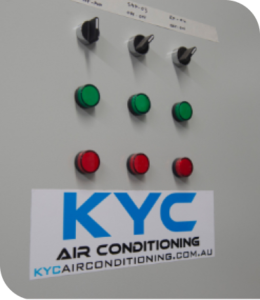
Your aircon may have its own breaker at the switchboard. After a blackout, check whether it’s slipped to the off or tripped position.
Do not remove switchboard covers. Do not touch exposed wiring. Do not attempt electrical repairs. You’re only looking at the normal, user-accessible switches. A breaker exists to protect the wiring and equipment when something abnormal happens electrically.
And if it has tripped? As long as there’s no sign of burning, damage, moisture or another obvious hazard, you can reset the normal user-operated breaker — once. But keep one rule front of mind: if it trips again, stop. Forcing a protective device back on repeatedly isn’t troubleshooting; it’s overriding a warning. The cause could sit inside the air conditioner, its wiring, the outdoor unit or elsewhere on the circuit — and NSW guidance updated in 2026 is clear that electrical installation work needs properly licensed people.
3. Your aircon may just be protecting itself
This one catches people out. Power returns, you press ON, nothing. You press ON again — still nothing. That doesn’t mean the unit’s died.
Some air-conditioning controls use a delay after power is restored to protect the compressor from restarting under poor conditions. A technical reference updated in July 2026 documents a specific “Blackout Setting” designed to control compressor restart delay following a supply interruption. Exactly how it behaves depends on your particular system.
The practical takeaway is simple: don’t judge the system in the first few seconds after power comes back. Switch it on normally and give it time to respond.
4. Check the outdoor isolator
Many Sydney split and ducted aircon sydney systems have an isolating switch near the outdoor unit, there to let the supply to the equipment be isolated. Look at it — without opening anything. If it’s clearly marked and accessible, check whether it’s in its normal operating position.
Don’t remove covers, don’t open the outdoor unit, and don’t touch wiring. And if the switch looks burnt, wet, cracked or damaged, leave it well alone. That’s past homeowner troubleshooting.
5. Check the remote and controller before assuming the worst
It sounds almost too obvious, but blackouts create confusing moments. Someone checks the switchboard, someone checks the outdoor unit — and then the technician turns up to find flat remote batteries or a stray timer setting.
Before booking a repair, check the remote batteries, the mode (cooling or heating), the set temperature, any timer, sleep mode, the controller display and any visible error code.
Here’s a common trap: say the room is 28°C but the aircon is set to cool at 30°C. It’ll look like it’s doing nothing, because you haven’t actually asked it to cool the room below where it already is. An accidentally activated timer can make a perfectly healthy system look faulty too. Simple checks — but they save call-outs.
6. Why an aircon won’t restart after a blackout
If the basics don’t fix it, a few faults come into play.
A tripped protective device — during the outage or when power returns.
A controller or communication fault — modern systems lean heavily on electronic communication between components, and an interruption can leave the controller showing a fault or failing to talk to the rest of the system.
A protection delay — as above, a delayed restart can be completely normal.
Control-board damage — electronic components can be affected by abnormal electrical events. That needs diagnosis, not guesswork.
An outdoor-unit fault — the indoor unit can look alive while the outdoor section refuses to run.
An existing electrical weakness — sometimes the blackout isn’t really the cause; it just exposes a component that was already close to failing.
That last point is why timing misleads people. “My AC broke because of the blackout” is an understandable conclusion — but the outage and the failure landing together doesn’t prove the outage caused it. A proper diagnosis sorts it out.
7. What does an aircon power outage reset actually mean?
People search for an aircon power outage reset expecting one magic button. There isn’t a universal reset sequence — different systems use different controllers and protection logic.
A sensible homeowner reset is about restoring normal operating conditions, not bypassing safety systems. In practice that means: turn the system off normally, confirm household power is back, check the accessible breaker and isolator, give the equipment time, then restart it normally. If an error code appears, record it. And if the system still won’t respond after all that, the next step is diagnosis — not endless resetting.
When should I stop troubleshooting?
This might be the most important section here. Stop straight away if you notice:
- A burning smell — don’t keep trying to restart it.
- Smoke — switch the equipment off if you can do so safely, then get professional help.
- Sparking — don’t touch the unit.
- A breaker that keeps tripping — one repeat trip is reason enough to stop forcing it.
- Visible electrical damage — leave it alone.
- Water around electrical equipment — never touch electrical switches while standing in water.
- A shock or tingling sensation — stop using it.
NSW’s 2026 electrical-safety guidance specifically warns that even a slight electrical “tingle” should be treated as a warning, and that suspected electrical problems need qualified attention.
Aircon not working after a blackout: reset or repair?
A simple way to split it.
Try basic troubleshooting when:
- the rest of the house has normal power,
- there’s no burning smell,
- there’s no smoke,
- there’s no visible damage,
- the breaker hasn’t repeatedly tripped, and
- the system simply hasn’t restarted.
Arrange professional diagnosis when:
- it won’t restart after the normal checks,
- the breaker keeps tripping,
- there’s a persistent fault code,
- the indoor unit runs but the outdoor unit stays dead,
- there’s an electrical smell,
- you hear unusual buzzing or clicking,
- the system starts then immediately shuts down, or
- you suspect an aircon electrical fault a technician needs to investigate.
At that point, repeatedly restarting the machine can actually make diagnosis harder and put the system under more stress.
Could a power surge damage my air conditioner?
It’s possible. NSW power-outage advice warns that appliances can be damaged by power surges and recommends taking precautions with sensitive equipment during outages. Air conditioners carry electronic controls as well as motors and compressors, which is why electrical diagnosis matters when a unit that ran fine before the outage won’t budge afterwards.
That said, don’t jump straight to assuming you need an expensive replacement board or compressor. Symptoms alone aren’t enough — a technician needs to pin down what actually failed.
Should I search for cheap aircon Sydney repairs?
Cost matters, of course. But a search for cheap aircon Sydney repairs shouldn’t turn into a race to find the lowest number before anyone’s even looked at the system. Electrical faults are notoriously hard to price without diagnosis — a dead controller, a damaged circuit, a failed component and a simple reset issue can all look identical to a homeowner at first glance.
KYNEX’s published Sydney repair guidance makes the same point: there’s no reliable single price without knowing the actual fault, the system type, access requirements, labour and parts. The smarter question isn’t “who’s cheapest?” — it’s “what’s wrong, what needs fixing, and what will that cost?” Diagnosis first, price second.
A Sydney scenario: the lights are back but the aircon is dead
Picture a summer storm rolling through Sydney. Power drops at 7:20 pm. Twenty minutes later the lights return. You grab the remote — nothing. You press it four more times. Still nothing. First thought: the blackout has killed the air conditioner.
Not necessarily. A better process: confirm the rest of the house has stable power, check the remote, check the accessible air-conditioning breaker, look for an error code, and give the unit time to restart. If the breaker trips again or there’s still no response, stop. That sequence clears several simple causes without turning you into an electrician.
What will an air conditioning technician check?
If the AC still won’t start, the visit should amount to more than someone pressing the remote. A technician may need to check the electrical supply, the controls, the communication between components, the protective devices, the fault history and how the system behaves in operation — with the exact process shaped by what they find.
KYNEX Air Conditioning’s published repair process runs from an initial assessment through diagnostic testing, repair or component recommendations where needed, and final testing once the work’s done. That structure matters after an outage, because several different faults all produce the same symptom — nothing happens — and only proper testing tells them apart.
Need air conditioning repair in Sydney?
If your system’s still dead after the checks above, you can arrange air conditioning repairs near me with KYNEX Air Conditioning. When you get in touch, hand the technician as much detail as you can:
- your Sydney suburb,
- whether it’s split or ducted,
- whether the indoor unit has power,
- whether the outdoor unit does anything,
- whether the breaker tripped,
- whether it tripped more than once,
- any error code,
- when the blackout happened, and
- what the system did when power returned.
That information makes the first inspection far more productive.
2026 evidence: what we can verify
There’s no shortage of air-conditioning advice online that sounds authoritative but cites nothing. For this guide, the useful 2026 evidence is more specific. NSW electrical-safety guidance updated 1 July 2026 confirms electrical wiring work must be done by licensed electricians. NSW electrical compliance information updated the same day confirms the formal compliance requirements around electrical work. NSW air-conditioning and refrigeration licensing guidance updated 23 June 2026 confirms that regulated aircon and refrigeration work needs the relevant licence or certificate. And a technical air-conditioning reference modified 29 July 2026 documents the compressor delay behaviour that follows a blackout or supply interruption.
Frequently asked questions
Why won’t my AC turn on after a power cut?
Common culprits are a tripped breaker, a controller issue, a protection delay or an electrical fault. First confirm normal household power, check the accessible breaker and controller, and give the unit time to restart.
How long should an air conditioner take to restart after a blackout?
There’s no universal restart time. Some systems intentionally delay the compressor after power returns. Follow your own system’s operating instructions rather than forcing repeated restarts.
Can a blackout damage an air conditioner?
Potentially. Supply disturbances can affect appliances and electronics. But a unit failing right after a blackout doesn’t prove the blackout caused the damage.
Should I reset the breaker?
You can inspect the normal user-accessible controls if it’s safe to, but don’t attempt electrical repairs. If a breaker trips repeatedly, stop resetting it and get a professional diagnosis.
Why is my air conditioner on but not cooling after the power came back?
It could still be in a restart delay, the outdoor unit may not be running, a fault may have been logged, or there may be another technical issue.
What if the aircon keeps tripping the breaker?
Stop resetting it. Repeated trips signal a fault that needs investigating.
Should I replace the air conditioner after a surge?
Not automatically. Diagnosis comes first — a relatively minor electrical or control problem can mimic total system failure.
Related KYNEX guides
If you’re digging further into the topic, these related reads help:
- Air Conditioning Repairs Near Me: The Complete Sydney Homeowner’s Guide
- When Should I Call an Air Conditioning Repair Technician?
The verdict
When an AC won’t turn on after a power cut, don’t leap to the conclusion that the whole system’s ruined. Start with the simple things: confirm the property has stable power, check the controller, check the accessible breaker, check the isolator, and look for error codes. Then give the system enough time to complete any built-in restart protection.
If it still refuses to run — and especially if the breaker trips again, there’s a burning smell, you hear electrical buzzing, or you see any damage — stop resetting it. That’s the point where troubleshooting becomes fault diagnosis, and electrical fault diagnosis isn’t something worth gambling with.
For Sydney homeowners, the safest approach stays simple: check the obvious, record what happened, don’t keep forcing the system to restart, and get the fault properly diagnosed if normal operation doesn’t come back on its own.