The short answer: Yes — in most NSW strata buildings you need owners corporation approval before a split system air conditioning installation, because the outdoor unit, refrigerant pipes and wall drilling almost always touch common property. In practice it’s treated as a “minor renovation” you get signed off before the installer arrives.
TL;DR
- Approval first, install second. Getting strata approval for air conditioning installation in Sydney apartments is expected, not optional.
- A split system is usually a minor renovation under Section 110 — approved by ordinary resolution, or by the committee if your by-laws allow it.
- If the outdoor unit changes the building’s look or sits on common property, you may need a by-law and a special resolution.
- 2025 reform: where the committee can approve minor renovations, no written refusal within 3 months means it’s deemed approved.
- Approval can’t be unreasonably refused — and NCAT can step in if it is.
Sydney summers don’t wait for a strata meeting. If you’re sweating through a 38°C afternoon in a Bondi or Newtown apartment, “do I need permission for this?” is the last hurdle between you and a cool bedroom. Here’s exactly how the process works in 2026 — in plain English.
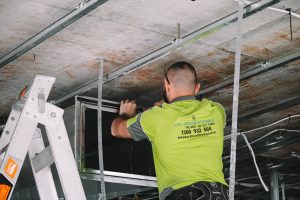
Why does strata even get a say over my air conditioner?
Because a split system rarely stays inside your four walls. The indoor head unit is yours, but the refrigerant pipes usually run through an external wall, and the outdoor condenser sits on a balcony, wall bracket or slab — and in a strata scheme, those parts are often common property. Once your work affects shared property or the outside of the building, the owners corporation is legally in the loop.
If you’ve never had to think about strata language before, here’s the jargon translated:
- Owners corporation: The collective body of every owner in your building (people often just say “strata”). It votes on shared decisions.
- Strata committee: A small elected group that runs day-to-day matters and, if the by-laws allow, can approve minor renovations without a full meeting.
- Common property: Shared parts of the building — external walls, façade, roof, slabs, and often balconies or airspace, depending on your strata plan.
- By-law: Your building’s rulebook. Some schemes have a specific air conditioning by-law that sets colours, noise limits and who maintains the unit.
- Ordinary vs special resolution: Ordinary = more than 50% of votes cast. Special = no more than 25% against. Bigger changes need a special resolution.
Is installing a split system a “minor renovation” in NSW?
Usually, yes. Under Section 110 of the Strata Schemes Management Act 2015, installing a reverse-cycle split system is treated as a minor renovation to common property. That’s good news, because minor renovations only need approval by ordinary resolution at a general meeting — a special resolution is not required.
Even better: your scheme can pass a by-law that lets the strata committee approve minor renovations directly. Where that by-law exists, you don’t have to wait for the next annual general meeting — you can get written committee approval instead. Since the 2025 NSW strata reforms, a committee that receives a proper request must give written reasons if it refuses, and if it doesn’t refuse in writing within three months, your minor renovation is automatically approved. The owners corporation also has to keep a record of the approval for ten years.
Worth knowing: “minor renovation” only applies while the work doesn’t change the external appearance of your lot, affect waterproofing, or make structural changes. That single word — appearance — is where a lot of Sydney apartment approvals get more complicated.
When do you need a by-law or a special resolution instead?
Here’s the honest nuance most quick answers skip. If your outdoor condenser will be visible on the façade, mounted on an external wall, or needs the exclusive use of a piece of common property, your scheme may treat it as more than a simple minor renovation. In that case the building might register a common property rights by-law — which needs a special resolution (no more than 25% of votes against) and spells out who maintains the unit for its whole life.
This is why two neighbours in the same street can get very different answers. A split with the outdoor unit tucked on the balcony floor, out of sight, often sails through as a minor renovation. The same split with a condenser bolted to the front of a heritage building can trigger a by-law, extra screening conditions, and a longer wait. The system is the same — the location changes everything.
What paperwork does the owners corporation want to see?
A tidy application is the single biggest reason approvals go fast. Owners corporations aren’t trying to block you — they’re trying to avoid noise complaints, water damage and disputes later. Give them everything up front and you remove the reasons to say no. Tick these off before you submit:
- Make, model & capacity (kW) — include the spec sheet; many by-laws want a minimum energy rating.
- Photos or a plan of the outdoor unit location — show exactly where the condenser and pipes will sit.
- Noise data (sound level in dB) — committees increasingly ask for the sound rating at 1 metre.
- Drainage plan for condensate water — water must go to a proper drain, never onto a neighbour or common property.
- Licensed installer & insurance details — refrigerant work must be done by a licensed technician; DIY isn’t lawful.
- Colour / finish and any screening — neutral colours and a shroud can turn a “no” into a “yes.”
If the whole thing feels like homework, that’s normal — and it’s exactly the part a good installer handles for you. KYC puts this pack together as standard, so you hand your strata manager one clean document instead of a back-and-forth email chain.
How long does strata approval take, and can they say no?
Timing depends on how your scheme is set up:
- Committee-approved (by-law in place): a well-documented request can be signed off in a couple of weeks. If there’s no written refusal within three months, it’s deemed approved.
- General meeting required: you’re tied to the meeting calendar. Allow a few weeks to a couple of months, depending on when the next meeting falls.
- New by-law needed (façade / exclusive use): allow roughly 6–12 weeks or more, since a by-law has to be drafted, voted on and registered.
Curious about real-world timeframes? We break them down in detail in how long strata approval usually takes for air conditioning in Sydney .
Can strata refuse you? Yes — but not unreasonably. The law says approval for a minor renovation cannot be unreasonably withheld, and any refusal must come in writing with reasons. If you think a “no” is unfair, you can take it to the NSW Civil and Administrative Tribunal (NCAT), which has overturned unreasonable air conditioning refusals before. We cover your rights in whether strata can legally refuse your air conditioning request in NSW . For the full apartment walk-through, see our companion guide on strata approval for a split system in a Sydney apartment.
What about noise, drainage and where the outdoor unit goes?
These three details cause more strata drama than the paperwork ever does. In a dense Sydney building, your condenser might be a metre from someone’s bedroom window, so:
Noise. Sydney has day-and-night noise limits that apply to air conditioners, and a unit that’s fine at 2pm can breach the rules at 11pm. Choosing a low-noise model and a smart location protects you from complaints — read our guide to the best outdoor unit locations to avoid neighbour noise complaints.
Drainage. A split system drips condensate all summer. That water has to reach a proper drain — letting it run onto common property or a neighbour’s balcony is a fast route to a dispute. Here’s where you can legally drain condensate on an NSW strata balcony
Placement. Balcony-floor or rear-wall positions with anti-vibration feet keep both your committee and your neighbours calm — and they make the unit easier to service later.
How KYC makes split system air conditioning installation simple
KYC Air Conditioning installs split systems across Sydney’s apartments, terraces and homes every week — from the Eastern Suburbs to the Inner West and North Shore. That means we’ve seen how dozens of owners corporations actually behave, not just what the legislation says. When you book a split system air conditioning installation with us, we scope the best low-visibility outdoor-unit location, pick a quiet, efficient model, and prepare the strata-ready document pack — model, noise data, drainage plan, photos and licensing — so your approval isn’t held up by missing details.
Every install is done by licensed, insured technicians who handle the refrigerant circuit lawfully, so the finished job is compliant, quiet and tidy — the kind of work that keeps you (and your neighbours) happy for the 15–20 year life of the system.
About KYC Air Conditioning
KYC is a Sydney-based air conditioning company specialising in split system and ducted installation, service and repair. We work in strata apartments, heritage terraces and family homes right across Sydney and NSW. This guide reflects the Strata Schemes Management Act 2015, the 2016 Regulations and the 2025 NSW strata reforms — but every building’s by-laws differ, so we always check yours before we quote. See our split system installation service →
What Sydney customers say
Real reviews build far more trust than anything we could write. The cards below are placeholders — swap in your genuine, dated 2026 reviews from your Google Business Profile or Trustindex feed.
“[ We recently had our air conditioner installed and are extremely happy with the service and overall result. The technicians who attended were very polite, professional, and efficient. Their workmanship was neat and thorough, and they worked extremely well as a team. We were particularly impressed that the indoor area was left perfectly clean after the installation. The technician who worked on the outdoor unit (Jason, I believe) demonstrated outstanding skill and attention to detail. The installation was completed flawlessly, and the outdoor area was left spotless. This clearly reflects the high standards and professionalism of the company. From start to finish, the entire process was smooth and reassuring. We are very satisfied with the quality of the work and would confidently recommend this company to anyone looking for a reliable air conditioning installer.]”
“[ Excellent service for both home and the workplace air conditioning. The setup was smooth and professional. The team was punctual, efficient, and left the space clean after installation and servicing. The air con works perfectly and has made a huge difference in comfort. Highly recommend for anyone needing reliable air conditioning setup for their home or business.]”
“[ Can’t recommend highly enough, Kristian, Rhys, Jason and Victoria have been fantastic. Great quotes, fitting was excellent – great finish with attention to detail, 2 units done in one day and to really high spec. Thanks so much! ]”
Frequently asked questions
Do I need strata approval to install a split system air conditioner?
In most NSW strata buildings, yes. Because the outdoor unit, pipes and drilling affect common property, the owners corporation approves the work first — usually as a minor renovation under Section 110.
Is a split system a “minor renovation” or a “major renovation”?
Usually minor, which needs an ordinary resolution (or committee sign-off if a by-law allows). It can tip into by-law territory if the outdoor unit changes the building’s external appearance or uses common property exclusively.
How much does a split system air conditioning installation cost in Sydney?
Cost depends on the room size, the model, pipe run length and your building’s access. Because apartment installs vary so much, the honest answer is to get a fixed quote after a site check rather than a one-size-fits-all figure.
Can I install a split system myself to skip approval?
No. Refrigerant handling legally requires a licensed technician, and skipping strata approval can mean being ordered to remove the unit at your own cost. Approval plus a licensed installer is the safe path.
I’m renting — can I get a split system approved?
You’ll need your landlord’s consent, and the landlord (not the tenant) goes through the strata approval process. Landlords can’t unreasonably refuse reasonable requests.
Sources: Strata Schemes Management Act 2015 (NSW) s110; Strata Schemes Management Regulation 2016; NSW Government strata renovation guidance; 2025 NSW strata reforms (commenced 1 July 2025). This article is general information, not legal advice — always confirm your own by-laws with your strata manager.