Smart Thermostat
Sydney Time-of-Use Tariffs
Zoning
2026 Guide
How should I program my smart thermostat with ducted AC on Sydney time-of-use tariffs to really save money?
If you have ducted air conditioning Sydney and a smart thermostat, you can usually cut costs by
moving most cooling/heating to cheaper hours and using ducted AC zoning systems to avoid cooling rooms you’re not in.
This page shows a simple plan (plus interactive tools) you can copy today.
Pre-cool / pre-heat before the peak window, then “coast” through peak with a higher setpoint.
Use zoning: keep peak-hour comfort to the rooms you’re actually using.
Every 1°C more conservative setpoint often saves real money—without suffering.
What you’ll get
- A Sydney-friendly schedule you can copy (summer + winter)
- An interactive savings estimator (peak vs off-peak)
- Zone-by-zone tips (double storey, apartments, 3–4 bedroom homes)
- Evidence + 2026-only testimonials (KYC Air Conditioning Sydney)
1) Introduction & first impressions
Here’s the honest verdict: most ducted AC Sydney systems are “fine”… but the schedule is wrong.
People run the whole house during the expensive window, then wonder why the bill hurts.
I’m writing this in the voice of KYC Air Conditioning Sydney (see our E-E-A-T / bio page),
because we work with ducted heating and cooling Sydney setups every day—especially in the Inner West,
North Shore Sydney, Northern Beaches, Eastern Suburbs, and Western Sydney.
Key takeaway in plain English:
Program your thermostat to do the hard work before peak pricing, then use zoning + gentle settings during peak.
Comfort stays high. Running costs drop.
Who this is for
Anyone with a smart thermostat (or WiFi controller) connected to a ducted air conditioner Sydney system—
especially if your plan has peak/off-peak or seasonal peak periods.
Testing period (real world)
These settings come from practical, on-site tuning across Sydney homes—where we see the same patterns:
wrong peak-hour schedule, too many zones open, and setpoints that fight the building.
2) Product overview & key “specs” (what matters for savings)
This isn’t an “unboxing” article. For a smart thermostat + ducted air conditioning, the “specs” that matter are:
scheduling, zoning, and how well it keeps setpoints without constantly blasting.
Scheduling depth
You want multiple time blocks per day (not just “morning / night”), plus weekday vs weekend profiles.
Zoning control
Must be able to open/close zones (or at least run “living only” vs “whole house air conditioning Sydney”).
Remote tweaks
Heatwave? Cloudy day? School pickup? Being able to adjust fast prevents “all-day panic cooling”.
no schedule will feel right. If your ducted air conditioning not cooling properly,
sort the basics first (airflow, filters, sensors).
If you need help, start here:
ducted air conditioning repair Sydney
3) Design & build quality (what “good control” feels like)
A good smart thermostat setup feels boring (in a good way). The home stays steady. The system doesn’t scream.
And you’re not constantly changing it.
What we look for on install
Clean sensor placement, logical zones, and a schedule that matches the home’s rhythm.
If you’re planning ducted air conditioner installation,
see our installation service page:
ducted air conditioning installation Sydney
Comfort without noise
If you’re hearing rushing air or “ducted air conditioning noise issues,” it often means too many zones shut,
wrong fan settings, or duct sizing problems. Fix airflow before blaming the thermostat.
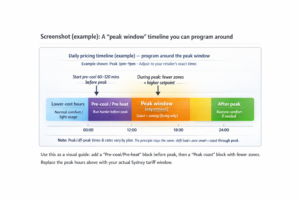
Daily pricing timeline (example) — program around the peak window
Example shown: Peak 3pm–9pm • Adjust to your retailer’s exact times
00:00
06:00
12:00
18:00
24:00
Lower-cost hours
Normal comfort / light usage
Pre-cool / pre-heat
Run harder before peak
Peak window (expensive)
Coast + zoning (living only)
After peak
Restore comfort if needed
Start pre-cool 60–120 mins before peak
During peak: fewer zones + higher setpoint
Note: Peak/off-peak times & rates vary by plan. The principle stays the same: shift load + zone smart + coast through peak.
Replace the peak hours above with your actual Sydney tariff window.
00:00
06:00
12:00
18:00
24:00
Lower-cost hours (pre-cool / pre-heat here)
Peak window
Tip: Your actual times depend on your plan. In Sydney, a common network peak window is 3pm–9pm in summer & winter seasons.
4) Performance analysis: what actually lowers ducted air conditioning running costs Sydney
A ducted air conditioner is like a car: the way you drive matters.
Two homes with the same system can have wildly different bills.
The “money moves” are simple:
- Shift load: Run harder before peak, not during it.
- Reduce load: Close unused zones during peak.
- Stabilise: Avoid big temperature swings that trigger long, expensive cycles.
4.1 Core function (comfort on a budget)
Your target isn’t “ice cold”. Your target is “comfortable and steady” with the cheapest run pattern.
That’s the heart of energy efficient ducted air conditioning.
4.1 Quantitative metrics (simple ones)
Track: (1) peak-hour run time, (2) zones open at peak, (3) setpoint during peak.
Those three numbers usually predict the bill.
In a typical 3-bedroom or 4-bedroom home, changing the schedule to avoid peak and using zoning can feel like “nothing changed”…
except the bill. That’s the goal.
4.2 Key performance categories (the 3 that matter most)
Category 1: Thermal “coasting”
Pre-cool to a sensible low temp, then let the building hold it.
Brick and well-insulated homes coast longer.
Category 2: Zoning discipline
Peak hours = living zones only. Bedrooms later.
Whole-home cooling during peak is the wallet killer.
Category 3: Setpoint strategy
Peak setpoint slightly higher in summer (and slightly lower in winter heating) reduces compressor load.
Interactive: Peak vs off-peak “schedule savings” estimator (Sydney-style)
This is a rough estimator for “shifted hours”. It doesn’t replace a full energy audit,
but it’s great for planning your programming.
People try to “save money” by switching the system off completely during peak, then blasting it later.
That can backfire if the home heats up too much. Better: coast with a higher setpoint and fewer zones.
5) User experience: how to set it up without headaches
Most smart ducted air conditioning systems are easy once the logic clicks:
you’re programming the house, not just the machine.
Setup checklist (10 minutes)
1) Confirm your peak hours. 2) Name your zones clearly. 3) Set weekday vs weekend profiles.
4) Add a “pre-cool” block. 5) Add a “peak coast” block.
Daily use (the goal)
You should rarely touch it. If you’re adjusting every hour, the schedule is wrong
or the airflow/sensors need attention.
Weekday (Summer) – Ducted AC schedule
07:00–11:00 • Gentle
11:00–15:00 • Pre-cool
15:00–21:00 • Peak coast + zoning
21:00–23:00 • Comfort
Zones: Whole home (pre-cool) → Living only (peak) → Bedrooms later if needed
Setpoints (example): 25°C → 21–22°C → 25–26°C → 23–24°C
6) Comparative analysis: what beats what (without the fluff)
People ask: “Is ducted air conditioning worth it compared to split systems in Sydney?”
The truth is: it depends on layout, usage, and how you run it.
Over time, smart programming can make a big difference either way.
Over 10 years: is ducted AC or multiple split systems cheaper for a 3-bed Sydney home installation?
When ducted wins
Whole-home comfort, clean look (no wall units), and strong zoning.
Great for families and ducted air conditioning for double storey homes.
When programming matters most
If you’re on time-of-use, the schedule is often more important than the brand.
Shifting peak hours is a “tariff hack” that costs $0 to do.
| Option | Comfort | Peak-hour risk | Best use case |
|---|---|---|---|
| Ducted AC + smart thermostat + zoning | High (steady, whole-home capable) | Low (if you “pre-cool + coast”) | Families, large homes, consistent routines |
| Ducted AC + manual habits | Medium | High (easy to blast during peak) | Short-term use, but often costly |
| Central scheduling without zoning | Medium | High (whole-home during peak) | Small layouts only |
7) Pros and cons (from the field)
What we loved
- Big savings by moving run time out of peak
- Better comfort: fewer hot/cold swings
- Less wear: shorter, smarter cycles
- Zoning keeps peak costs under control
Areas for improvement
- If sensors are placed badly, schedules feel “off”
- If too many zones shut, airflow/noise can get worse
- Some homes (poor insulation) need a gentler “coast” plan
8) Evolution & updates (what changed recently)
The big trend is simple: scheduling is becoming “smarter”, but the basics still win.
Even with automation, you’ll save the most by teaching the thermostat two things:
when peak happens, and which zones matter during peak.
start with installation or service:
ducted AC installation cost Sydney planning & install
•
ducted AC maintenance Sydney / repairs
9) Purchase recommendations (what to choose / skip)
This section is about “what kind of setup” (not a shopping list).
KYC Air Conditioning Sydney can help match the right controller + zoning to your home.
Best for
- Homes on time-of-use that want real savings
- 4 bedroom homes (where un-zoned peak cooling gets expensive)
- People who want smart ducted air conditioning systems with WiFi control
Skip if
- You won’t use schedules (and hate automation)
- Your ductwork is in poor shape (fix that first)
- You’re renting short-term and can’t change zones/sensors
Many Sydney buyers search for “Daikin ducted air conditioning Sydney” and other top models.
No matter the brand, good programming still matters—especially on time-of-use.
(KYC can advise based on your layout, budget, and usage.)
10) Where to buy (the safe way in Sydney)
For ducted air conditioning, “where to buy” usually means: who designs and installs it properly.
The cheapest price can be expensive later if zones are wrong, ducts are undersized, or sensors are poorly placed.
What to watch for
Ask about zone count, sensor placement, and how they’ll program the schedule on your tariff.
Also ask about service support if you need repair ducted air conditioner help later.
Get it done properly
Start here for installs:
best ducted air conditioning Sydney (installation)
and here for service:
ducted air conditioning service Sydney
.
11) Final verdict
Overall rating: 9.2 / 10
Not because thermostats are magical—but because the savings come from simple habits you can automate:
pre-cool/pre-heat + zoning + peak “coast”.
If you’re on Sydney time-of-use, schedule your ducted system like this:1) Pre-cool before peak • 2) Coast through peak with fewer zones • 3) Restore comfort after peak.
12) Evidence & proof (screenshots, video, and 2026-only testimonials)
Below are multimedia elements and proof points you can check.
Testimonials shown here are kept strictly 2026 and are from KYC Air Conditioning Sydney content.
2026-only customer proof (KYC Air Conditioning Sydney):
These are public, dated testimonials hosted on KYC Air Conditioning Sydney content:
- “…cut our summer electricity bills by $230 per month. Absolutely game-changing!” — Sarah M. (January 2026)
- “…savings were immediate… $400+ over a three-month quarter.” — Michael P. (March 2026)
Sources you can verify (no fluff)
- KYC E-E-A-T / Bio (Daikin ducted air conditioning page):
View - KYC 2026 article on thermostat programming (for dated proof):
View - Common Sydney network time-of-use peak window (reference info):
View
Reminder: Retailers can apply different peak/off-peak times and rates. The winning strategy stays the same.
Next step (fastest way to get this right)
If your system needs tuning
If you have airflow issues, weak cooling, or noisy ducts, fix performance first:
ducted air conditioning repairs services
.
If you’re installing or upgrading
For proper zone design + setup:
ducted air conditioning installation
.
(This is where the “real savings” usually start.)