

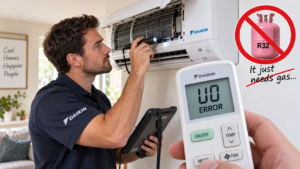
Daikin U0 Error Code: What It Actually Means (and Why “It Just Needs Gas” Is Usually Wrong)
Your Daikin stops cooling, you glance at the controller, and there it is: U0. If someone has already told you it “just needs a top-up of gas,” hold that thought for a minute.
U0 means your air conditioner has detected a refrigerant shortage condition. That’s real, and low refrigerant from a leak is the cause people jump to first. But here’s the catch that trips up a lot of homeowners — and a few technicians who should know better: the code doesn’t prove a simple refrigerant top-up will fix anything.
Daikin’s own technical documentation lists a whole spread of possible causes behind U0 — a refrigerant shortage, sure, but also a closed stop valve, faulty temperature sensors, a struggling compressor, or a dodgy electronic expansion valve. So when your Daikin suddenly quits cooling and throws U0, the smart move isn’t to assume it’s thirsty for gas.
The better question is this: why does the system think refrigerant is low? That’s the thing that actually needs diagnosing.
Quick answer: what does the Daikin U0 error code mean?
Daikin defines U0 as a refrigerant shortage. In plain terms, the air conditioner is seeing operating conditions that suggest there might not be enough refrigerant circulating through the system.
Depending on the model, the control board pieces this together from data like compressor operating frequency, electrical current, refrigerant temperatures, heat-exchanger temperatures, pressure readings, and the position of the electronic expansion valve.
That’s why U0 is genuinely more helpful than “the aircon isn’t cold.” It hands a technician a direction to head in. But it’s a starting point, not a finished diagnosis — and that distinction is the whole point of this article.
The most likely causes of a Daikin U0 error
Here’s the shortlist worth investigating:
| Possible cause | What it means |
|---|---|
| Refrigerant leak | Refrigerant has escaped from the sealed system |
| Incorrect refrigerant charge | The system doesn’t hold the right amount |
| Closed stop valve | Refrigerant can’t circulate properly |
| Faulty thermistor | A temperature sensor is feeding back bad data |
| Electronic expansion valve fault | Refrigerant flow isn’t being controlled correctly |
| Compressor problem | The compressor isn’t pumping effectively |
| Circuit restriction | Flow is blocked somewhere in the system |
| Installation/commissioning issue | On a newer install, a charge, valve, or piping problem |
One thing to keep in mind: the exact list shifts between models. A wall-mounted Daikin split and a big ducted or VRV-style system can both flash U0, but the way you get to the bottom of it isn’t identical. Always diagnose the specific model in front of you.
Cause 1: A refrigerant leak
This is the one everybody associates with U0, and for good reason — it’s common.
The thing to understand is that refrigerant runs inside a sealed circuit. It isn’t fuel that gets burned off during normal use. So if a properly charged system has genuinely lost a meaningful amount of it, the very next question should be: where did it go?
Leaks tend to show up at pipe joints, flare connections, service valves, the indoor or outdoor coils, or somewhere along damaged pipework. Pinning down the exact spot takes proper testing.
And this is where the lazy fix bites you. Add refrigerant without finding the leak, and you’ve signed up for a loop: the system loses gas, you add gas, it works for a while, the gas escapes again, U0 comes back. Round and round. That’s not a repair — it’s a subscription to the same problem.
Cause 2: A closed stop valve
This one matters most right after an installation or major service.
The outdoor unit has refrigerant service valves (stop valves) that have to sit in the correct operating position. Daikin’s service documentation specifically names a closed stop valve as a possible trigger for U0. If a valve wasn’t opened properly after install, the system can behave exactly as though it’s short on refrigerant — even though the charge is fine.
This is firmly not a homeowner adjustment. It belongs in the technician’s process, full stop.
Cause 3: Faulty temperature sensors
Daikin units rely on thermistors — temperature sensors whose electrical resistance changes with temperature — dotted around the system. Depending on the model, the service documentation flags sensors like the discharge pipe thermistor, the indoor and outdoor heat-exchanger thermistors, and the room and outdoor-temperature thermistors as possible contributors to a U0 reading.
Why would a sensor cause a “refrigerant” code? Because the controller doesn’t have eyes. It works out what’s happening purely from sensor data. If one of those sensors is disconnected, sitting in the wrong spot, or simply failing, the control board can misread the situation as a refrigerant shortage.
Which is precisely why dumping in more refrigerant before testing the system can be a costly mistake — you might be “fixing” a sensor with a bottle of gas.
Cause 4: A faulty electronic expansion valve
The electronic expansion valve controls how much refrigerant flows through the system. Think of it as a very precise tap that opens and closes based on operating conditions, metering the right amount of refrigerant into the right part of the circuit.
When that valve misbehaves, flow goes wrong — and Daikin lists a defective electronic expansion valve among the possible U0 causes on the systems it applies to. Frustratingly, it can mimic low refrigerant almost perfectly. The unit cools poorly, so everyone blames the charge, when the real culprit is refrigerant control.
Cause 5: A compressor problem
The compressor is the heart of the whole refrigeration circuit — it moves refrigerant and builds the pressure conditions that make heat transfer possible.
Daikin’s documentation lists poor compressor performance as a possible cause of U0 on applicable systems, and this is a far more serious prospect than a dirty filter. If the compressor isn’t pumping properly, the system can’t generate the flow or pressure the controller expects, and fault protection kicks in.
Before anyone condemns a compressor, a technician will usually check operating pressures, current draw, the compressor’s behaviour, temperatures, and overall performance. It’s not a snap judgement.
Cause 6: A restriction in the refrigerant piping
On some Daikin systems, U0 can also point to a restriction or blockage in the refrigerant circuit — and this one’s easy to miss, because low refrigerant flow doesn’t always mean low refrigerant quantity.
A restriction can stop refrigerant moving correctly even when the system isn’t actually short on charge. The usual suspects are piping issues, expansion devices, contamination, or installation faults. It’s yet another reason pressure readings and a proper system-level look matter more than a quick guess.
What symptoms show up with a U0 error?
You might notice one or several of these:
- Poor cooling or poor heating
- The room never reaching the set temperature
- The system stopping out of nowhere
- A flashing operation light
- The error showing on the controller
- The indoor unit running but barely cooling
- The outdoor unit behaving oddly
- Longer-than-usual running times
- The fault coming straight back after a reset
Not every U0 looks the same. Some Daikin systems shut down once the fault repeats; others log or display it differently depending on the system type and controller.
Can you fix a Daikin U0 error yourself?
There are a few safe checks worth doing. There’s also a list of things you genuinely shouldn’t touch. Let’s take the safe stuff first.
Confirm the code. If your controller supports fault-code retrieval, make sure you’re actually looking at U0 and not something similar. Split-system manuals usually let you pull fault codes through the remote, though the button sequence varies by controller, so follow your specific model’s instructions. If it’s already showing clearly on a wired controller, just note it down — along with the model number, when the trouble started, whether it cools at all, and whether the fault returns after a restart. All of that helps the technician.
Check the air filter. A dirty filter doesn’t create a genuine refrigerant leak, but a badly blocked one chokes airflow, drags down cooling, and can push operating conditions out of whack. Clean any accessible filters per the manufacturer’s instructions — just don’t assume that solved a refrigerant-side problem if U0 sticks around.
Look for obvious airflow blockages. Make sure indoor vents aren’t blocked, furniture isn’t crowding the indoor unit, and the outdoor unit has room to breathe without leaves and debris packed around it. That’s it — you’re checking the area, not opening panels or dismantling anything.
Try one controlled restart. If your manual allows it, switch the system off and back on once. Just once. Don’t let repeated resetting become your repair strategy — if U0 comes back, the system is telling you there’s a real, unresolved fault. Write the code down and book a diagnosis.
What you should NOT do with a U0 error
- Don’t try to “top up the gas” yourself. Refrigerant work isn’t DIY maintenance. In NSW, air-conditioning and refrigeration work requires the appropriate licence or certificate.
- Don’t open the refrigerant valves. Stop valves are part of the sealed system — leave them to a qualified technician.
- Don’t assume a leak from a single symptom. U0 signals a shortage condition; it doesn’t name the failed part.
- Don’t keep resetting the unit. If the fault keeps returning, get the cause diagnosed rather than clearing it on repeat.
- Don’t ignore poor cooling for weeks. A system running abnormally can pile extra stress on its components. Early diagnosis is usually simpler — and cheaper — than waiting for the next thing to break.
Does U0 always mean a refrigerant leak?
No. If you take one thing from this whole article, make it this.
Daikin’s own service documentation lists several possible U0 causes beyond a leak. Depending on the model, that includes thermistor faults, closed stop valves, electronic expansion valve problems, poor compressor performance, and restrictions in the refrigeration circuit — alongside an actual refrigerant shortage.
So the honest summary is: a refrigerant leak is one important possibility, but U0 on its own is not proof of a leak. A technician has to test the system to know.
Why “it just needs gas” should make you ask another question
Picture a car tyre that keeps going flat. Would you be happy with someone pumping it up over and over? Or would you eventually ask where the air is escaping?
Same logic with refrigerant. A working sealed system shouldn’t need refrigerant added as routine maintenance. If the charge really is low, the technician should be working out why.
Depending on the system and the fault, a proper process might run something like: confirm the U0 condition, check how the refrigerant circuit is operating, check the valves, test the sensors, look for leakage, repair the underlying fault, recharge the correct amount if needed, then test that everything’s actually working. The exact sequence changes with the model and the diagnosis — but you can see it’s a lot more than “add gas, close the van door.”
How U0 differs from other Daikin split-system error codes
A Daikin error code points a technician toward a specific condition, which is exactly why you shouldn’t treat every fault as “needs gas.” For context, Daikin manuals separate U0 from codes such as:
- U2 — power-supply voltage abnormality (on relevant models)
- U4 — communication failure between indoor and outdoor units
- A6 — indoor fan motor fault
- E7 — outdoor DC fan motor fault
- J3 — discharge pipe temperature sensor fault
The lesson is simple: the code matters. Check it first, then match the diagnosis to your specific model rather than assuming.
Daikin ducted air conditioner fault codes: is U0 different?
The core meaning still relates to a refrigerant shortage condition, but ducted and larger systems lean on more complex diagnostic logic. Depending on the Daikin product family, working through U0 can involve refrigerant pressure, temperature sensors, expansion-valve operation, compressor operation, circuit restrictions, and the pipework configuration.
That’s why generic fault-code lists only take you so far. If you’ve got a ducted system, hand the technician the full indoor model number, the outdoor model number, the controller code, and any sub-code on display. The more specific you can be, the faster they can get to the answer.
What will a technician actually check?
A thorough U0 diagnosis usually involves some mix of:
- Refrigerant charge — does the system hold the right amount?
- Leak testing — is refrigerant escaping anywhere?
- Stop valves — are the relevant ones fully open?
- Temperature sensors — are the thermistors connected, positioned, and reading correctly?
- Expansion valve — is refrigerant flow being controlled properly?
- Compressor — is it operating as it should?
- Pipework — any sign of restriction, installation error, or damage?
- System history — was it recently installed or serviced? Has it needed refrigerant before? Did U0 start right after another repair?
That context can seriously shorten the diagnostic path, which brings us to a checklist you can fill in before anyone turns up.
A homeowner troubleshooting checklist
Before you call for service, jot down which of these apply. Your Daikin system:
- Displays U0
- Is cooling poorly
- Is heating poorly
- Stops shortly after starting
- Was installed recently
- Was recently repaired
- Has shown U0 before
- Has previously needed refrigerant work
- Makes unusual noises
- Has visible oil marks near refrigerant connections
That last one’s worth a note — refrigerant oil can sometimes travel with refrigerant at a leak point, so an oily residue near a connection can be a clue. Don’t go pulling the system apart hunting for it, though. Just report anything obvious.
What if U0 shows up soon after installation?
That deserves a proper look. On a new install, the causes to rule out include the refrigerant charge, the stop-valve position, the pipework, flare connections, commissioning, and the overall system configuration.
Don’t accept repeated resets as “normal” for a brand-new system. A newly installed air conditioner throwing a persistent U0 should be diagnosed, not shrugged off.
What if it appears years later?
On an older unit, the odds shift. A technician will likely look harder at refrigerant leakage, ageing components, sensor faults, compressor performance, expansion-valve problems, and the repair history.
Age by itself doesn’t decide whether to replace the thing. That call should weigh the system’s condition, the repair cost, its age, parts availability, past failures, and how it’s been performing overall.
Should you keep running a Daikin showing U0?
If U0 keeps coming back, carrying on as normal isn’t a plan — it’s just delaying the inevitable. The sensible approach: record the fault, stop the repeated resetting, and arrange a professional diagnosis.
If the system still runs but cools poorly, forcing it to work harder won’t fix the cause. In many cases the unit is already protecting itself from abnormal operating conditions, and overriding that is the opposite of helpful.
What do 2026 KYNEX customers say about repairs and servicing?
Recent feedback is more useful than a stale testimonial — and it’s more honest not to pretend it proves how your U0 will play out. In June 2026, customer Mike Morgan described having an ageing air conditioner serviced and cleaned, with a pump replaced during the visit. A March 2026 customer, Andrew Barlow, mentioned it was the second time they’d used the business for install, maintenance, or repairs, and singled out responsiveness and knowledge.
Neither review proves KYNEX fixed a Daikin U0 fault specifically. What they do show is recent, independently surfaced feedback tied to actual servicing and repair work — which beats inventing a tidy U0 success story.
How KYNEX Air Conditioning can help with a Daikin U0 error
KYNEX Air Conditioning services and repairs systems across Sydney and works with Daikin equipment. The company’s current website reports more than 10 years of industry experience and over 2,000 Sydney homes and systems serviced and installed.
If your Daikin is flashing U0, the useful goal isn’t to erase the code — it’s to work out which part of the refrigerant system or control process set it off. In practice that can mean checking system pressures and temperatures, the refrigerant charge, possible leaks, the sensors, the valves, the compressor, and the installation itself.
If you’re searching for air conditioning repairs near me, give the U0 code and your Daikin model number when you book. That hands the technician something genuinely useful before they’ve even arrived.
When does a U0 repair become a replacement decision?
A U0 code doesn’t automatically mean you’re up for a new air conditioner. Repair tends to make sense when the system is relatively young, the fault is isolated, parts are available, the cost is reasonable, and it’s otherwise been reliable.
Replacement earns more thought when the system is old, refrigerant or major-component repairs are getting expensive, several faults are cropping up at once, the compressor is failing, parts are hard to find, or you’ve already been paying for repair after repair. Either way — don’t decide from the error code alone. Decide from the diagnosis.
Frequently asked questions
What does U0 mean on a Daikin air conditioner? Daikin defines U0 as a refrigerant shortage condition.
Does Daikin U0 always mean low refrigerant? Not necessarily. Daikin’s technical documentation also lists causes like faulty thermistors, a closed stop valve, electronic expansion valve problems, and poor compressor performance.
Can I reset a Daikin U0 error? Some systems clear temporarily after a restart, but if U0 returns, the underlying fault still needs diagnosing.
Does refrigerant need regular topping up? No. A properly working sealed system shouldn’t consume refrigerant. If it’s genuinely low, the cause should be found and fixed.
Can I refill Daikin refrigerant myself? No. Refrigerant work should be handled by appropriately licensed personnel.
Can a dirty filter cause U0? A dirty filter hurts airflow and performance, but U0 relates specifically to refrigerant-shortage detection. Don’t assume cleaning the filter has cleared a persistent U0.
Can a sensor cause U0? Yes. Daikin service documentation lists disconnected or faulty temperature sensors among possible causes on applicable models.
Can a compressor cause U0? Yes. Poor compressor performance is listed as a possible cause for certain systems.
Can U0 appear on both split and ducted Daikin units? Yes. U0 is used across multiple Daikin product families, though the diagnostic logic and possible causes vary by model.
Should I turn my Daikin off if U0 keeps returning? If it keeps coming back, record the code and arrange a professional diagnosis rather than resetting and running it as normal.
Related Readings
The bottom line
Treat U0 as a refrigerant-shortage warning, not as a green light to blindly add gas. Daikin’s own documentation confirms the code means the system has detected refrigerant shortage conditions — and a leak is only one of the possible reasons. Depending on the model, it can just as easily trace back to closed valves, faulty thermistors, expansion-valve trouble, compressor performance, or a restriction in the circuit.
So the right response is straightforward. Confirm the code. Record the model number. Check the basics — airflow and filters. Try one restart if the manual allows. And if U0 comes back, stop guessing and get the system properly diagnosed.
Because the repair worth paying for isn’t the one that makes the error vanish for an afternoon. It’s the one that figures out why your Daikin threw U0 in the first place.