

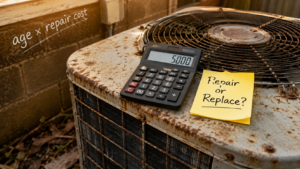
Ducted Air Conditioning Replacement: Should You Repair or Replace Your Existing System?
If your ducted air conditioning has packed it in, replacement isn’t automatically the answer. Repair usually makes sense when the fault is isolated, the parts are available, and the rest of the system is in decent shape. Ducted air conditioning replacement starts to look like the smarter move when major faults keep coming back, key parts are getting hard to find, the ductwork needs work too, or the running total of keeping an old system alive stops adding up.
The thing to get right is diagnosis before decision. A noisy fan doesn’t mean the whole system is done for. But throwing money at one expensive component in an ageing unit that already has weak airflow, damaged ducts, and a habit of breaking down often just delays a bigger bill. This guide walks Sydney homeowners through that call without the guesswork.
The short answer: repair or replace?
Lean toward repairing your ducted system when it’s been reliable up to now, the fault is limited to one repairable part, the parts are available, the ductwork is still in good condition, the compressor and major components are healthy, the airflow was fine before the fault, and the repair cost is reasonable.
Lean toward replacement when major breakdowns are becoming a regular thing, the system is into the back half of its life, several components are wearing out at once, suitable parts are hard or expensive to find, the compressor has a serious fault, the ductwork needs major work too, some rooms have never cooled properly, your electricity use has crept up without an obvious reason, or you keep tipping money into repairs.
The right answer comes from looking at the whole system, not just its age.
How old is your ducted system, really?
Age is a useful signal, but it should never be the only reason to pull out a working unit. KYNEX Air Conditioning Sydney’s current guidance suggests a well-maintained ducted system commonly gives around 15 to 20 years of service — though that varies with usage, install quality, maintenance, and operating conditions.
That gives you a frame. A five-year-old system with one failed component is a completely different conversation from an 18-year-old one that’s broken down four times across two summers.
With a relatively young system, repair usually deserves serious thought if the fault can be pinned down, the rest of the equipment is healthy, parts are easy to get, and performance was good before the failure. With a much older system, replacement gets more appealing when age stacks up alongside other problems — repeated failures, unavailable parts, noisy operation, poor airflow, worn controls, damaged insulation or ducts, uncomfortable rooms, and pricey major-component repairs.
Don’t replace a system just because someone says “it’s old.” Ask what’s actually wrong with it.
What has actually failed?
This might be the single most important question in the whole decision. An old ducted air conditioning system has a lot of moving parts — the controller, a temperature sensor, a zone motor, a damper, the fan, an electrical component, drainage, a duct connection, a control board, the outdoor unit, the refrigerant circuit, the compressor. And those faults aren’t remotely equal in cost.
A small control or zoning fault shouldn’t trigger a whole-system replacement. A serious failure in a costly major component on an already ageing system is a different sum entirely. KYNEX’s current repair guidance recommends identifying the model, diagnosing the actual failed part, checking whether parts are available, and assessing the condition of everything else before you weigh repair against replacement. That beats guessing from symptoms every time.
Don’t confuse the symptom with the fault
Say your bedroom suddenly stops cooling. The easy conclusion is “my ducted system is dying.” But it could just as easily be a failed zone motor, damaged ductwork, a controller issue, or an airflow problem.
Now imagine the whole system stops cooling. That sounds worse — and it might be — but diagnosis still comes first. A technician may need to check the indoor unit, the outdoor unit, the electrical supply, the controls, the airflow, and the refrigeration side before anyone can tell you whether ducted air conditioning repairs are practical. The symptom tells you something’s wrong. It doesn’t tell you what needs replacing.
How many times have you fixed it lately?
One breakdown is annoying. Repeated breakdowns are information. Jot down what you’ve spent over the past two or three years — something like:
| Repair history | Cost |
|---|---|
| Year 1 repair | $450 |
| Year 2 electrical fault | $700 |
| Year 3 controller repair | $900 |
| New fault now | Quote pending |
That history doesn’t automatically make replacement cheaper, but it changes the question. Instead of asking “can this fault be repaired?” you start asking “does repairing this fault still make financial sense given the condition and repair history of the whole system?” Those are two different questions. A good technician can probably fix an old unit — that doesn’t mean fixing it is the best use of your money.
What does the repair cost against replacement?
People go looking for a magic percentage or a neat rule of thumb. Real homes are messier than that. A better approach is to lay the two options side by side.
For repair, add up the diagnostic cost, parts, labour, the likely remaining condition of the system, the chance of another major failure, and ongoing maintenance. For replacement, add up the new indoor and outdoor equipment, installation, electrical work, new controls, any zoning changes, duct repairs or replacement, removal of the old gear, commissioning, and warranty coverage. Then ask how long each option is likely to keep the problem solved.
If a $1,000 repair will restore a healthy system, replacement is probably unnecessary. If a large repair is being proposed for a system that also has failing ducts, obsolete controls, and other ageing parts, spending more on the old equipment gets hard to justify.
What does ducted air conditioning replacement cost in Sydney in 2026?
Replacement is rarely just the price of an indoor and outdoor unit. KYNEX’s current 2026 replacement guide gives these broad planning ranges:
| Home / project | Indicative 2026 range |
|---|---|
| 3-bedroom home | $10,000–$15,000 |
| 4-bedroom home | $12,000–$18,000 |
| Large 5-bedroom or complex property | $16,000–$22,000+ |
These are planning figures, not fixed prices — roof access, system capacity, zoning, ductwork, electrical requirements, return-air design, and general property complexity can all shift the final number. For a fuller breakdown, KYNEX has a guide to ducted AC replacement cost in Sydney.
One thing worth holding onto: don’t compare a $2,000 repair with a $14,000 replacement as if the replacement is just a dearer way to fix the same part. A replacement gives you a whole new system; the repair keeps the existing one going. You’re buying two different outcomes.
Can you still get parts?
Parts availability matters more as equipment ages, but old doesn’t automatically mean unrepairable. Some older systems still have original replacement parts, updated equivalents, or compatible parts approved for the job. Others are much harder to support.
KYNEX’s current guide recommends checking the model and serial details, identifying the failed component, and investigating what’s available before writing off an older air conditioner. There’s more on whether parts can still be found for an old air conditioner if you’re weighing that up. If a critical component simply can’t be sourced, that pushes the decision hard toward replacement. If the part’s easy to get and everything else is healthy, repair may still be the sensible path.
Should you replace the ductwork too?
Not necessarily — and this is where homeowners tend to either overspend or cut corners in the wrong place. The existing ducts should be inspected for damaged insulation, crushed sections, loose connections, air leaks, poor sizing, deteriorated flexible duct, bad routing, and airflow problems.
Good ductwork can sometimes carry over. Poor ductwork will quietly undermine a brand-new unit. Picture installing shiny new equipment but keeping the same ducts that were already causing a hot bedroom, weak airflow upstairs, noisy outlets, and big temperature swings between rooms — the new gear may not fix any of that. Which is exactly why a replacement ducted system is better treated as a system-design project than a swap of two boxes.
Can the existing refrigerant pipework be reused?
Sometimes — but don’t assume it. KYNEX’s current Sydney guidance says existing pipework should first be checked for correct sizing, condition, cleanliness, and compatibility with the replacement equipment. Homeowners naturally ask, “Can’t we just connect the new system to what’s already there?” Sometimes that’s perfectly sensible; sometimes it isn’t. A proper assessment separates the infrastructure worth reusing from the bits that would weaken the new install.
Is poor airflow a reason to replace the whole system?
Not on its own. Poor airflow has plenty of possible causes: a dirty filter, a damaged duct, a closed damper, a failed zone motor, an undersized duct, poor balancing, restricted return air, a fan problem, or a flawed original design. KYNEX’s current ducted-zone troubleshooting guidance shows why diagnosis has to look at the controller, motorised dampers, wiring, duct condition, static pressure, airflow, balancing, and return air rather than blaming a single failed part.
If the old ducted unit itself is still healthy, fixing part of the air-distribution system may sort the problem out. If both the equipment and the airflow network are ageing badly, replacement gets easier to justify.
What about rising electricity bills?
A high power bill doesn’t automatically mean you need a new air conditioner. First, ask what changed. Did you run it longer, cool more rooms, adjust the thermostat, start working from home, get a run of hotter weather, or switch electricity plans? Then look at the system itself — blocked filters, poor airflow, duct leakage, incorrect zoning, control problems, or an equipment fault can all show up on the bill.
KYNEX’s 2026 ducted running-cost guidance makes the same point: a high bill should prompt a look at system capacity, zones, airflow, return air, filters, duct condition, thermostat settings, and equipment condition before anyone jumps to replacing the gear.
A simple repair-or-replace table
| Situation | Repair may make sense | Replacement deserves consideration |
|---|---|---|
| One minor isolated fault | ✓ | |
| Parts easily available | ✓ | |
| Good airflow before breakdown | ✓ | |
| Ducts in good condition | ✓ | |
| System otherwise reliable | ✓ | |
| Multiple recent breakdowns | ✓ | |
| Major component failure | ✓ | |
| Parts becoming unavailable | ✓ | |
| Significant duct problems | ✓ | |
| Poor comfort for years | ✓ | |
| Several ageing components | ✓ | |
| Major redesign needed | ✓ |
Treat this as a guide, not a diagnosis — a site assessment still matters.
Example: when repair makes sense
A Sydney homeowner has an eight-year-old ducted system. Until now it’s cooled evenly, run quietly, needed little repair work, and been serviced regularly. Then one zone stops working, and testing shows the equipment itself is healthy — the culprit is an isolated zoning component. Replacing the whole system over that would make little sense. A targeted repair is the obvious call.
Example: when replacement starts to win
Now take an older home. Over the last few years the system has thrown repeated electrical faults, weak airflow in several rooms, noisy operation, and zoning problems — and it’s coughed up another major fault this summer. The technician also finds ageing ductwork and warns that some important parts are getting hard to source.
The system might still be repairable. But that’s no longer the only question. At this point the homeowner should weigh the repair cost against investing in a complete new ducted air conditioning system designed around the home’s current needs.
What should a ducted AC replacement actually include?
Don’t assume replacement means swapping two boxes. Depending on the existing setup, the project might involve the indoor fan-coil unit, the outdoor unit, the controller, the zone system, dampers, a return-air box, a return-air grille, ductwork, refrigerant pipework, drainage, electrical work, removal of the old equipment, airflow balancing, and commissioning.
KYNEX’s current replacement guidance notes that older Sydney homes can sometimes need changes to return air, ducts, zoning, or electrical infrastructure during a replacement. Ask for those items to be spelled out in the quote.
Could maintenance buy you more time?
Sometimes, yes. Regular air conditioning maintenance can catch issues before they grow into big ones, with checks around filters, coils, drainage, electrical components, airflow, and general system operation. It can’t turn worn-out equipment new again — but a neglected system can look like it’s failing when the real culprit is poor airflow, dirt, or another serviceable issue. Another good reason to diagnose first.
When should you book repairs first?
Start with air conditioning repairs when you don’t yet know what’s wrong. A proper diagnosis answers the questions that actually drive the decision: What has failed? Why did it fail? Can it be repaired? Are parts available? What will the repair cost? What condition is the rest of the system in? Is another major repair likely soon? And what would replacement involve?
That gives you real numbers and facts to compare. Without diagnosis, “repair versus replace” is mostly guesswork.
What do 2026 KYNEX customers say?
Current 2026 feedback on KYNEX’s website offers useful signals about what homeowners value when someone’s working on an existing system. In January 2026, Kieran O’Connor described the service as “prompt, professional and polite.” Amy Sarra’s January 2026 feedback pointed to helpful advice, affordability, and a quick turnaround from quote to completion. And in February 2026, Michele Collings singled out supportive advice and a short turnaround.
Reviews don’t guarantee every repair or replacement lands the same way. But they do underline something that matters a lot when you’re staring down an expensive decision: good advice counts. You want a technician who can explain why repair or replacement makes sense, rather than one who just points at the pricier option.
How KYNEX Air Conditioning Sydney can help
KYNEX Air Conditioning Sydney works across ducted installation, fault diagnosis, repairs, and maintenance. The business currently states it has more than 10 years of industry experience and has serviced or installed over 2,000 systems across Sydney.
If your ducted system is ageing or has stopped working, the useful first move is establishing what’s actually failed. KYNEX can assess the indoor and outdoor equipment, the controller, the zoning, the ductwork, the airflow, the return air, the drainage, the electrical components, and the overall condition of the system. From there you can compare the real cost of repair against a properly scoped replacement, instead of replacing equipment blindly.
Questions to ask before you replace your ducted system
Before you sign off on a replacement quote, ask:
- What exactly has failed in my existing system? Don’t accept “it’s old” as the whole diagnosis.
- Can the failed component be repaired? Ask what the repair involves.
- Are replacement parts readily available? Availability can swing the decision.
- What condition is the rest of the system in? Repair makes more sense when everything else is healthy.
- Can my existing ducts be reused? They should be inspected first.
- Can the existing zoning be reused? Old controls may or may not suit the new gear.
- Does the existing electrical setup suit the replacement? Find out before install day.
- Will the replacement fix my current comfort problems? If one bedroom has always run hot, new equipment alone may not solve it.
- What parts of the old installation are being replaced? Get it in writing.
- What happens if extra work turns up? Know how variations get handled.
Related reading
If replacement is starting to look like the sensible path:
The bottom line
Choose repair when the problem is isolated, the rest of the system is healthy, suitable parts are available, and the fix gives you a reasonable run of reliable operation.
Consider ducted air conditioning replacement when the problems start stacking up — repeated breakdowns, a major component failure, ageing equipment, hard-to-find parts, poor ductwork, weak airflow, outdated controls, ongoing comfort issues, and mounting repair bills.
There’s no single age or dollar figure that makes the call for every Sydney home. The most useful question is: if I spend money fixing this fault today, what condition will the rest of my system be in tomorrow? If the answer is “still healthy and reliable,” repair is probably the smart move. If it’s “old, inefficient, hard to support, and likely to need more work soon,” replacement earns serious consideration.
Diagnose first. Compare the full repair cost against the full replacement scope. Then put your money on the option that fixes the underlying problem — not just the symptom.