

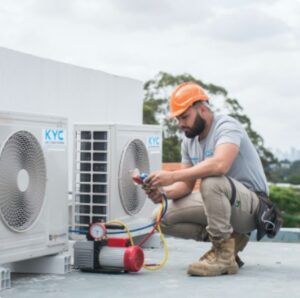
If your air conditioner’s outdoor unit isn’t running while the indoor unit still blows air, the likeliest culprits are a power problem, a communication fault, an outdoor fan issue, a compressor fault, a control-board problem, or a simple protection delay.
But don’t write off the outdoor unit just because you can’t hear it for a few minutes.
Modern inverter systems are perfectly happy to slow down, pause, or delay starting when the room has already hit temperature, the system has just been restarted, heating mode is warming up, the unit is running a defrost cycle, or protection logic has kicked in. A quiet outdoor unit isn’t automatically a dead one.
The genuine warning sign is this: the indoor unit keeps blowing, but the room isn’t cooling or heating, and the outdoor unit never properly fires up. That’s when it’s time to start troubleshooting.
Quick answer: indoor unit working, outdoor unit not?
Here’s what’s usually behind it:
| Possible cause | What it means |
|---|---|
| Outdoor unit has no power | Breaker, isolator, or supply problem |
| Restart delay | System is briefly protecting itself |
| Communication fault | Indoor and outdoor units can’t talk |
| Outdoor fan fault | Fan is jammed, damaged, or faulty |
| Compressor won’t start | Compressor or inverter may have an issue |
| Control-board fault | Outdoor PCB isn’t running the system |
| Voltage issue | System stops to protect itself |
| Blocked outdoor airflow | Unit trips a protection mode |
| Error condition | System has flagged another fault |
The good news: a few of these you can check safely yourself. The bad news: the moment you’re looking at outdoor electrical covers, compressor circuits, or refrigerant components, the DIY stops and a licensed tech takes over.
First: is the outdoor unit even supposed to be running right now?
Before you call anyone, make sure you’re not just watching the system behave exactly as designed.
The room might already be at temperature. If your thermostat is set to 24°C and the room is already 24°C, the indoor fan may keep moving air while the compressor winds down or stops. That’s normal. Set a target a few degrees below the room temperature in cooling mode and watch what happens.
The system might be in a restart delay. Air conditioners don’t always leap back to life the instant power returns — many deliberately wait several minutes to protect the compressor from a harsh rapid restart. Current Australian operating manuals note that after you flick a breaker back on, some systems spend a few minutes just preparing to run. So after a blackout, breaker reset, or power interruption, give it time. Don’t stand there cycling the power every 30 seconds.
Heating mode looks different. In winter, the outdoor unit behaves its own way during warm-up, defrost, and low-load operation, and the indoor airflow may even pause briefly at heating startup while the system gets warm air ready. None of that is necessarily a fault. The concern is when the system repeatedly fails to produce any heating or cooling at all.
Cause 1: The outdoor unit has lost power
One of the first things to rule out. The indoor unit can have power while the outdoor section has a supply issue all its own — a tripped breaker, an isolator problem, a power interruption, or an electrical fault.
Check the switchboard safely and look for the circuit labelled AC, air conditioner, split system, or ducted air conditioning. If the breaker’s tripped, you can reset it once — but only if there’s no burning smell, no water near the electrics, no damaged wiring, and no melted components.
If it trips again, stop. Don’t keep forcing it back on. Repeated tripping usually points to a real electrical or compressor-side fault, and the breaker is the only thing standing between you and a bigger problem.
Cause 2: The two units aren’t talking to each other
A split system is really two machines working as a team. The indoor unit reads the room and controls airflow; the outdoor unit houses the major refrigeration gear. They have to swap information constantly — and if that communication drops out, the indoor unit can still look completely alive.
You’ll see lights, moving louvres, a running indoor fan… and an outdoor unit doing absolutely nothing. The usual causes are damaged communication wiring, loose connections, a control-board fault, or a voltage problem. Most systems throw an error code when this happens, so write it down — that code can save a technician a big chunk of diagnostic time.
Cause 3: The outdoor fan isn’t spinning
Look at the outdoor unit from a safe distance. Is the fan turning? If not, there are a few possibilities: it could be blocked by debris, electrically faulty, mechanically seized, suffering a wiring fault, or simply not being told to run by the PCB.
A blocked outdoor fan can stop the unit rejecting heat properly, and the system may then shut down to protect itself. Current manufacturer troubleshooting guidance specifically tells homeowners to check for blocked indoor or outdoor air inlets and outlets when a system stops unexpectedly.
The safe check: switch the system off, then look for leaves, branches, rubbish, plants, or stored items crowding the unit. Don’t reach through the grille, and never spin the fan by hand with the power connected.
Cause 4: The compressor won’t start
The compressor is the heart of the outdoor unit — the main refrigeration component. If it can’t start, the indoor unit may keep blowing air while no actual cooling or heating happens. Behind that you might find an electrical fault, an inverter problem, a compressor winding issue, a mechanical failure, or voltage protection stepping in.
Tell-tale signs include the outdoor fan running but no cooling developing, humming or clicking, the outdoor unit trying to start and then stopping, breaker trips, or a fault code. This is firmly not a DIY repair — compressor testing means high-voltage electrical systems and refrigeration equipment, both of which need a licensed professional.
Cause 5: The outdoor control board has a fault
The outdoor PCB is part of the system’s electronic brain. It manages or monitors the fan, the compressor, the sensors, the communication link, and the inverter control. If that board fails, the outdoor unit can look stone dead even while the indoor section carries on happily.
Symptoms can include the fan not starting, the compressor not starting, intermittent operation, error codes, or the unit stopping after just a few seconds. But — and this is important — a PCB shouldn’t be replaced just because the outdoor unit is silent. Power, wiring, fan, and compressor all need testing first, because any one of them can produce the same silence for a fraction of the cost.
Cause 6: The system has detected a voltage problem
Air conditioners want a stable electrical supply. A big voltage disturbance can make the system stop temporarily to protect itself, and manufacturer guidance notes that some systems shut down after a sudden large voltage fluctuation and then restart automatically after a short delay.
This tends to follow local power fluctuations, storms, electrical work, or grid interruptions. If it happens once and never returns, it was probably just a blip. If it keeps happening, the electrical supply or the equipment needs proper investigation.
Cause 7: The outdoor airflow is blocked
Your outdoor unit shifts a huge amount of air, which means it can’t be boxed in tightly. Trouble shows up when the condenser is smothered by garden growth, hidden behind a solid screen, crowded by stored gear, tucked under a very low deck, or packed with leaves.
KYNEX’s installation guidance recommends putting outdoor units in open, well-ventilated spots so the hot discharge air isn’t trapped and sucked straight back into the unit. Poor airflow forces the system to work harder and can contribute to protective shutdowns.
Cause 8: The system has stored an error code
This is one of the most useful clues you’ll get. If the indoor operation lamp is flashing, the system probably already knows something’s wrong — and the code will point to a category like an outdoor fan fault, a communication problem, a power issue, compressor protection, a sensor fault, or an inverter fault.
KYNEX’s current error-code guide makes a point worth repeating: treat the code as a clue, not a verdict. It helps steer the diagnosis, but it doesn’t always name the exact failed part. Note down the code, the model number, what the outdoor unit is doing, and when the fault appears — all of it is valuable.
AC outdoor unit not working: what you can check safely
- Check the thermostat — is the room actually above the cooling target?
- Confirm the mode — use COOL when testing cooling.
- Check the breaker — reset once, only if it’s safe.
- Wait after a power reset — give it several minutes.
- Look for error lights — record any fault code.
- Check the outdoor area — clear safe external obstructions.
- Listen — do you hear humming, clicking, buzzing, or grinding?
- Watch the fan — does it sit still, try to start, or start then stop?
Every one of those details helps a technician.
What you should NOT do
Don’t open the outdoor electrical panel — it’s full of hazardous parts. Don’t test live wiring; that’s licensed-technician work. Don’t force the fan blade, because it can start without warning. Don’t keep resetting the breaker — repeated trips mean something needs investigating. Don’t add refrigerant, because an outdoor unit that isn’t running doesn’t automatically mean it’s low on gas. And don’t replace the PCB on a hunch — an electrical fault can imitate several expensive component failures.
AC fan not spinning outside: does that mean the motor’s dead?
No — that’s just one possibility. The fan might not turn because the motor has failed, sure, but also because a connector is loose, wiring is damaged, the PCB isn’t driving it, debris is jamming it, or the system simply isn’t commanding it to run. This is exactly why diagnosis matters: a silent fan does not, on its own, justify a new motor.
AC compressor not starting: how can you tell?
Honestly, you usually can’t confirm this safely without test equipment. But the clues include the outdoor fan running while no cooling develops, the compressor trying to start and then stopping, clicking, breaker trips, an error code, or pipework that never changes temperature. These are clues — not proof. A technician may need to check voltage, current draw, winding resistance, inverter operation, and the overall condition of the compressor.
What if the outdoor unit starts and stops every few minutes?
That’s a different beast — it may be short cycling, which can involve sensor problems, voltage issues, airflow restrictions, refrigerant faults, compressor protection, or oversized equipment. If your system keeps restarting rather than never starting, our related guide on air conditioner short cycling walks through it in detail. Repeated stop-start behaviour is a separate problem from an outdoor unit that never fires up at all.
What if the indoor fan runs but the air is warm?
Classic clue. The indoor unit is moving room air around, but the refrigeration system may not be running behind it — think an outdoor power fault, a compressor that won’t start, an outdoor fan fault, a communication issue, or error protection. KYNEX’s air conditioner not cooling Sydney guide covers the wider troubleshooting path for when you’ve got airflow but no cooling.
Whatever you do, don’t crank the thermostat down to 18°C and hope the outdoor unit suddenly wakes up. The target temperature isn’t the problem here.
Could the outdoor unit be running so quietly I don’t notice?
Yes, genuinely. Modern inverter systems can idle at very low speed — the compressor can be near-silent and the fan can barely turn. Before you declare it dead, check whether the fan is moving at all, whether the refrigerant pipes change temperature, and whether the room is actually cooling. If it’s reaching temperature normally, there may be nothing wrong at all.
Why does this so often happen on very hot Sydney days?
Extreme heat piles on the load, and an outdoor unit that’s already struggling — a dirty coil, a failing fan, a weak electrical component, a voltage problem — may finally show its hand under peak conditions. That’s why a system can look perfectly fine on a mild 25°C day and fall over on a brutal 38°C afternoon. The heat usually isn’t the root cause; it just exposes a weakness that was already there.
What if it happened after a storm?
Storms bring power outages, voltage swings, and electrical surges. If the aircon was fine beforehand, note the timing. Try one normal restart if the manufacturer allows it — but if the outdoor unit stays dead, don’t keep power-cycling it. Electrical testing may be needed.
Can a dirty filter stop the outdoor unit?
Usually a dirty filter shows up first as reduced airflow, poor cooling, and coil-temperature trouble — but a severe airflow restriction can contribute to a protective shutdown, so cleaning the filter is still worth doing. If the outdoor unit stays off afterward, the filter clearly wasn’t the whole story.
Can a water leak cause this?
Potentially. Water leaks and drainage faults can affect sensors, wiring, or protection devices depending on how the system’s installed. If your outdoor-unit trouble started right after indoor water leakage, a ceiling leak, or a frozen coil, tell the technician — the sequence matters. A fault history often reveals connections that are easy to miss once everything’s dried out.
Outdoor air conditioner repair: when should you call?
Book a professional diagnosis when the outdoor unit never starts, the breaker keeps tripping, an error code returns, the fan won’t spin, the compressor keeps trying and failing to start, there’s buzzing or a burning smell, cooling or heating is completely gone, the system died after a storm, or the wiring looks damaged.
And when you go looking for professional air conditioning repairs, give the team more than “my outdoor unit isn’t working.” Try: “Indoor unit is running, outdoor fan isn’t moving, breaker stays on, cooling is gone, and the operation light is flashing.” That tells them a great deal more and gets you a faster visit.
What will a technician check?
A proper diagnostic runs through the power supply (is correct voltage reaching the outdoor unit?), the communication wiring (are the two units exchanging signals?), the outdoor fan (is it powered and rotating?), the compressor (can it start and run?), the inverter and PCB (are the control electronics working?), the sensors (are the temperature readings plausible?), the stored error history, and the refrigeration conditions (is the system tripping protection because pressures or temperatures are abnormal?).
That whole checklist is why “the outside unit is dead” is nowhere near enough to name the repair.
How much does this kind of repair cost?
There’s no single figure, because the fault could be anything from small to serious:
- Smaller: a loose connection, a minor electrical fault, an obstruction.
- Moderate: a sensor, an outdoor fan motor, a control component.
- Larger: an inverter board, a PCB, a compressor, or major electrical work.
The useful first step is always a proper diagnosis. KYNEX’s current aircon diagnostic fee Sydney guide explains that the diagnostic fee pays for the actual fault-finding — electrical checks, airflow assessment, error-code investigation, and working out the real cause — not simply for someone to turn up.
Repair or replace?
An outdoor-unit fault doesn’t automatically mean the whole system is finished. Repair usually makes sense when the system is relatively young, the fault is isolated, parts are available, the compressor is healthy, and the repair cost is reasonable. Replacement is worth serious thought when the unit is old, the compressor has failed, the inverter and other major components are failing, several expensive repairs have already stacked up, or parts are hard to get. Either way, get the diagnosis first — then make the money decision.
A simple outdoor-unit troubleshooting tool
- Indoor unit running? Yes → keep going.
- Room reaching temperature? Yes → the outdoor unit may just be idling low. No → keep going.
- Outdoor fan moving? No → check for safe external obstructions.
- Power just restored? Yes → allow the restart delay.
- Breaker tripped? Yes → reset once, if safe. Trips again? → stop and book a repair.
- Operation light flashing? Yes → record the error code.
- Still nothing? → Book a diagnosis.
Two real Sydney scenarios
Case one: a bedroom split starts up fine — louvres open, air blows — but 15 minutes later the room’s still hot and the condenser fan outside is completely still. The breaker’s tripped. The homeowner resets it; it trips again. That’s not a thermostat problem anymore. That’s electrical, and it needs diagnosis.
Case two: the indoor fan is running gently, the outdoor unit is almost silent — but the room’s already at 24°C, exactly matching the controller. That’s very likely normal inverter behaviour.
Same observation both times — “I can’t hear the outside unit” — completely different situations. That’s why context beats guessing.
2026 KYNEX customer evidence
Rather than invent an outdoor-unit repair story, here’s real recent feedback. In June 2026, Mike Morgan had an ageing unit serviced and cleaned, including a failed pump replaced. In March 2026, Andrew Barlow noted it was his second time using KYNEX across installation, maintenance, and repairs, and singled out the team’s responsiveness and knowledge. In September 2026, Michael Cohen described KYNEX working through a tricky installation issue and landing on a practical fix.
None of these claim a specific outdoor-unit repair — but together they’re recent, real evidence of genuine repair, servicing, and technical problem-solving.
How KYNEX can help
KYNEX Air Conditioning provides repairs, maintenance, and system assessment across Sydney. The company’s current website cites 10+ years diagnosing, repairing, and maintaining air-conditioning systems, and 2,000+ Sydney homes serviced and installed.
If your indoor unit runs but the outdoor unit won’t, an air conditioning repair technician in Sydney can test whether the fault sits in the outdoor power, the communication link, the fan motor, the compressor, the inverter, the PCB, the sensors, or refrigeration protection. The repair worth paying for isn’t the one that swaps out the first expensive part someone suspects — it’s the one that proves why the outdoor unit failed to start.
Frequently asked questions
Why is my indoor AC unit running but the outside unit is not? Likely causes include an outdoor power fault, a restart delay, a communication problem, an outdoor fan fault, a compressor problem, or a control-board issue.
Is it normal for the outdoor unit to stop sometimes? Yes. Inverter systems reduce output or pause once the room hits temperature, and heating mode and restart protection can cause temporary pauses too.
Why is my air conditioner fan not spinning outside? Possible causes include debris, a failed fan motor, wiring problems, or a control-board fault.
Can the indoor unit work if the compressor is broken? Yes. The indoor fan and controller can keep operating even when the outdoor compressor won’t start.
Why doesn’t my AC outdoor unit start after a blackout? Some systems have a protective restart delay. If it still won’t start after a wait, check the breaker and fault lights.
Should I reset the breaker? Once, if it’s safe. If it trips again, stop and arrange a professional diagnosis.
Can low refrigerant stop the outdoor unit? Refrigeration faults can trigger protection, but a silent outdoor unit doesn’t automatically mean low refrigerant.
Can a dirty filter cause the outdoor unit to stop? A severe airflow restriction can contribute to a protective shutdown, but consider other faults if the outdoor section stays off.
Why does the outdoor unit hum but not start? Possible causes include fan, compressor, inverter, or electrical problems. Professional testing is needed.
Can a faulty PCB stop the outdoor unit? Yes. A control-board fault can stop the compressor or fan running.
Should I keep running the indoor unit if the outdoor unit is dead? If no cooling or heating is being produced and you suspect a fault, running it on repeat won’t help — get it assessed.
Does this mean I need a new air conditioner? Not necessarily. Many outdoor-unit faults are repairable. Replacement should follow diagnosis, not precede it.
The bottom line: why is the outdoor unit not running?
If your air conditioner’s outdoor unit isn’t running while the indoor section still works, start by deciding whether the pause is actually abnormal. Check the room temperature, the controller mode, the power and breaker, the restart delay, the error lights, the outdoor airflow, and whether the fan even tries to move.
If the indoor unit is blowing but there’s no cooling or heating, the outdoor fan never starts, the breaker trips, or an error code appears — professional diagnosis is the next step. The most likely fault areas are the power supply, communication, the outdoor fan, the compressor, the control board, the inverter electronics, or system protection.
And here’s the thing worth holding onto: the indoor fan working only proves that part of the system has power. It doesn’t prove the refrigeration system is running. That’s exactly why the right repair starts by testing the outdoor unit — not by guessing which part must be broken.