

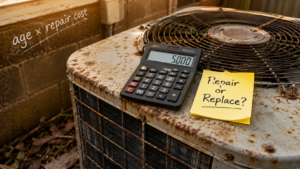
The $5,000 Rule: Should You Repair or Replace Your Air Conditioner in Sydney?
Every summer, somewhere around the first 38-degree week, our phones start ringing with the same question dressed up in different ways. The air con has died, a repair quote is sitting on the kitchen bench, and the homeowner wants to know: do I pay this, or do I bite the bullet and buy a new one?
Somewhere along the line, a lot of people picked up a shortcut for answering that. It’s called the $5,000 Rule, and it goes like this: take the age of your air conditioner in years, multiply it by the repair quote, and if the result is over $5,000, start thinking about replacement.
It’s a tidy little formula. It’s also nowhere near enough on its own, and we’ve watched perfectly good systems get carted off to the kerb because a calculator said so.
So let’s talk about what the rule is actually good for, where it falls down, and what we’d look at instead before spending thousands of dollars either way.
The $5,000 Rule in plain terms
Age × repair cost. That’s it.
| Age | Repair quote | Result | What it’s hinting |
|---|---|---|---|
| 5 years | $400 | $2,000 | Repair is probably fine |
| 8 years | $500 | $4,000 | Repair still looks reasonable |
| 10 years | $600 | $6,000 | Worth comparing both options |
| 12 years | $900 | $10,800 | Replacement deserves a hard look |
| 15 years | $1,200 | $18,000 | Strong case for replacing |
Notice the word in that last column: hinting. The $5,000 Rule isn’t an Australian standard, it isn’t written into any NSW regulation, and no manufacturer we know of uses it. It’s a rule of thumb that drifted into HVAC advice and stuck because it’s easy to remember.
Your air conditioner does not become a lost cause the moment the sum ticks over to $5,001. Treat the number as a warning light on the dashboard, not the mechanic’s verdict.
Same age, very different answers
Here’s why we’re wary of it.
Picture two homes in Sydney, both with ten-year-old systems, both facing a repair this week.
The first unit has been serviced every couple of years, has never missed a beat, and needs a fairly modest part replaced. The second has already had two callouts in the past eighteen months, struggles to keep the back bedrooms cool on a hot afternoon, and now needs something more substantial done.
Run the $5,000 Rule and you might land on similar numbers. Ask anyone who has worked on both and you’ll get very different advice. One is a healthy system with a single fault. The other has been quietly telling its owner for a while that it’s on the way out.
Age and one repair quote simply can’t capture that.
What the formula doesn’t know
Quite a lot, as it turns out. It has no idea:
- whether you’ve got a split system or ducted
- what capacity the system is, and whether it was ever right for the house
- how well it was installed in the first place
- what shape the compressor is in
- how many times it has already broken down
- whether earlier repairs were done properly
- whether parts are still easy to get
- how much power it’s chewing through compared with something newer
- what a properly installed replacement would actually cost for your property
And, crucially, it can’t tell you whether the repair on the table actually fixes the underlying problem or just buys a few months.
Replacing a small component on an otherwise healthy system is one thing. Pouring a large sum into a unit that’s showing three or four other signs of wear is a different conversation altogether, even if the calculator spits out the same result.
Three numbers to get before you say yes
If a technician hands you a significant repair quote, don’t make the call with just one figure. You want three:
The repair cost. What it costs to fix the diagnosed fault properly, not patch it.
The replacement cost. What a correctly sized new system, installed, would run for your home. Not a ballpark from a mate. An actual quote.
The cost of keeping the old one alive. What have you already spent on it recently? Is anything else looking tired?
Put those three side by side and the decision usually gets a lot clearer.
A quick example
Say you’ve got a twelve-year-old system and the quote is $850. The rule gives you 12 × $850 = $10,200. Replacement territory, apparently.
But if that unit has never given you a day of trouble and the tech can point to one isolated component that has failed, spending $850 to get several more summers out of it is entirely reasonable.
If, on the other hand, this is the third repair since early last year, it has started rattling, and the lounge never quite gets cold anymore, another $850 starts to feel like throwing good money after bad.
Same age. Same quote. The history is what changes the answer.
When repairing is the smart move
Plenty of the time, fixing it is the right call. A few signs you’re in that camp:
It’s still relatively young. A younger system with a single repairable fault shouldn’t be replaced just because someone’s happy to sell you a new one. If the core equipment is sound, a repair can buy years.
This is the first real problem. Repair history matters nearly as much as age. One breakdown after a long stretch of reliable service is a different animal from a callout every January.
The fault is clearly identified. A good technician should be able to tell you what failed, why, what needs replacing, whether the rest of the system looks healthy, and what the repair is expected to achieve. If someone is recommending expensive parts without a clear diagnosis, slow down.
It still does the job. If the system heats and cools properly, the power bills aren’t alarming, and it suits the house, there’s no rule that says you must upgrade because a newer model exists.
When replacement starts to make sense
Replacement gets more compelling when several of these start stacking up.
The repairs keep coming. This one sneaks up on people. A $300 repair looks cheap next to a new system. Then there’s a $450 one. Then another callout. Then something major goes. Each invoice on its own seems fine; it’s only when you add them up that you realise what the old unit is really costing you. Keep a simple record. If you’ve spent $1,500 in a short stretch keeping an ageing system going, the next quote deserves more scrutiny than the first did.
A major component has gone. Not all faults are equal. A blocked drain or a small electrical part is a very different decision from a compressor or refrigeration-circuit failure. This is exactly why diagnosis comes before the calculator. If you’re looking for air conditioner repair sydney wide, one of the most useful questions you can ask the technician is whether the failed part is the whole problem or just a symptom of a system nearing the end of its economical life.
It technically works but isn’t really working. An air conditioner can switch on and blow air and still be letting you down. Bedrooms that stay warm. Long run times without ever reaching the set temperature. Weak airflow. Uneven rooms. Poor heating in winter. Frequent cycling on and off. Bills that keep climbing. Any of those could be maintenance, installation, sizing or plain wear, which is why you want it looked at rather than assumed.
Your house has changed. Sometimes there’s nothing wrong with the unit at all. You’ve renovated. Two people now work from home. Rooms that were rarely used are occupied every day. You put in a single split years ago and now you want the whole house comfortable. In those cases it’s often more sensible to look at the modern air conditioning systems Sydney homeowners are installing now than to keep modifying something that no longer fits the property.
What about running costs?
Energy efficiency belongs in the conversation, but it gets oversold.
Australia’s Energy Rating program notes that reverse-cycle systems can be highly efficient for combined heating and cooling, and non-ducted units carry the Zoned Energy Rating Label, which shows seasonal efficiency across different Australian climate zones. That’s useful. It means anyone weighing up reverse cycle air conditioning Sydney options can compare more than the sticker price.
But “the new one is more efficient” doesn’t automatically mean “replacing now saves money.” You need to weigh the purchase price plus installation plus expected running costs against how many years the old system realistically has left. A modest efficiency gain on a unit that still works well can take a long time to pay back. A big gain, when you’re already staring at an expensive repair, is a different story.
Don’t forget the installation
This is the bit that gets overlooked.
A great air conditioner installed badly is just an expensive air conditioner. Sizing, where the outdoor unit sits, indoor airflow, pipe runs, drainage and electrical work all shape how the system performs for the next fifteen years.
So if you do decide to replace, don’t just pick whatever’s being called the best air conditioner Sydney has going this year and assume the box will sort everything out. The system has to suit your property. With home air conditioning Sydney installs, we regularly see two houses of near-identical floor area with completely different cooling loads because of window orientation, insulation, ceiling height and how much western sun they cop.
A better five-step check
Here’s roughly the process we’d walk through before spending real money.
- Pin down the age. Check installation paperwork, old service records or the unit’s data plate. The rule is useless without a reasonably accurate number.
- Get the fault properly diagnosed. “Not cooling” has a dozen possible causes. “Leaking water” is usually drainage, not a dead system. Don’t decide off symptoms alone.
- Run the $5,000 sum. Age × quote. Note the result and treat it as an early warning, nothing more.
- Look at the history. How many recent repairs? Is performance sliding? Is the same fault coming back? Has maintenance been skipped? Is anything else looking worn?
- Get a real replacement quote. This is the step most people skip, and it’s the one that matters most. You can’t judge whether an $800 repair is good value without knowing what a replacement actually costs for your home.
A quick scorecard
Give yourself a point for each yes.
- [ ] It’s around ten years old or older
- [ ] It has broken down more than once recently
- [ ] The current repair is expensive
- [ ] It struggles to heat or cool the house
- [ ] It runs for long stretches without hitting temperature
- [ ] It has got noticeably noisier
- [ ] It no longer suits how you use the house
- [ ] Another major component is showing wear
0–2: Repair is probably worth serious thought. 3–5: Get both quotes and compare them carefully. 6–8: Replacement deserves strong consideration.
This isn’t a technical diagnosis. It’s just a way to stop one number from making the whole decision for you.
What Sydney homeowners actually care about
Price matters, obviously. But when we look at what customers tell us afterwards, the quote is rarely the thing they remember.
In August 2026, Emma-Charlotte Browne described her ducted install with the KYNEX team as a fantastic experience and singled out the punctuality and the fact the crew took time to explain what they were doing. In June, another Sydney customer made a point of praising the team for asking practical questions during quoting instead of pitching a system straight away. A separate June review mentioned prompt arrival, tidy workmanship and value.
That’s relevant here because a repair-or-replace decision needs someone willing to inspect what you’ve got before they try to sell you what they’ve got.
Why let KYNEX weigh in?
KYNEX Air Conditioning brings more than ten years of industry experience and has serviced and installed over 2,000 systems across Sydney. That matters because this isn’t a sales question. It’s a diagnostic one.
It’s also worth knowing that air-conditioning and refrigeration work in NSW requires the appropriate licence or certificate. It isn’t a general handyman job, and credentials are worth checking before you approve anything significant.
So when you get in touch, don’t open with “how much is a new air conditioner?” Start with “what’s actually wrong with mine, and is it still worth fixing?” We’ll inspect the system, diagnose the fault and lay out the repair option. If replacement makes better financial sense, we’ll assess the property and size a system for it properly. For anyone looking for experienced aircon sydney support, that gives you an actual basis for the decision instead of guesswork.
What a proper assessment should leave you with
Whoever you use, you should walk away understanding:
- what failed
- what caused it
- what the repair costs
- whether the repair is likely to hold
- whether anything else is on the way out
- what replacement would involve
- which option gives you better value over the next several years
You shouldn’t need an engineering degree to follow the recommendation. If you do, ask more questions.
The bottom line
The $5,000 Rule sounds beautifully simple. Under $5,000, fix it. Over, replace it.
Real houses are messier than that.
Repair generally makes sense when the system is relatively young, the fault is isolated, the repair is reasonably priced, it still performs well, parts are available and there’s no pattern of breakdowns.
Replacement gets more attractive when the system is older, major repairs are expensive, breakdowns are becoming a habit, performance has dropped off, efficiency is poor, it no longer suits the house, or you’re already spending heavily just to keep it going.
The aim isn’t to run an old unit into the ground, and it isn’t to bin a perfectly fixable one early either. It’s to put your money where it buys the most reliable comfort.
Frequently asked questions
What is the $5,000 Rule for air conditioning? Multiply the unit’s age in years by the repair quote. Over $5,000 is commonly read as a signal that replacement is worth considering. It’s a rule of thumb, not an Australian regulation.
Is the $5,000 Rule accurate in Australia? It’s a reasonable conversation starter but shouldn’t be used alone. Local repair and installation costs, system type, efficiency and the condition of your specific unit all shift the answer.
Is it worth repairing a 10-year-old air conditioner? Often, yes. A well-maintained ten-year-old system with its first minor fault is usually worth fixing. One the same age with a string of expensive failures behind it is a better replacement candidate.
Should I replace my air conditioner if the repair is expensive? Compare the repair price with an installed replacement quote, then factor in age, condition and history. The cheapest option today isn’t always the cheapest over the next five years.
Can a technician tell me how long my air conditioner has left? Nobody can guarantee it. What a good technician can do is assess its condition, point out worn components and tell you whether the current repair is a sensible bet.
My air conditioner is leaking water. Does it need replacing? Not necessarily. Water leaks have several causes, and drainage problems are common. Get it diagnosed before assuming the worst.
Does a new air conditioner always use less electricity? Newer equipment generally offers better efficiency, but real savings depend on the model, sizing, installation quality, how you use it and how inefficient the old system was.
Final word
If age times repair cost tips past $5,000, don’t panic and don’t rush. Dig a little. Check the repair history. Think honestly about how it has been performing. Find out exactly what has failed. Then compare the repair with a properly scoped replacement quote.
For Sydney homeowners, that extra twenty minutes of homework is often the difference between replacing a system that had years left in it, and dropping another big repair bill on one that had already been telling you it was time to go.