
Yes — you can put split system air conditioning into a Sydney apartment. In most strata buildings, though, you’ll need approval before anyone starts work.
The air conditioner is seldom the hard part. The hard parts are questions like:
- Where can the outdoor unit physically go?
- Does the installation touch common property?
- Can pipes pass through the external wall?
- Where does the condensate water end up?
- Will the condenser annoy the neighbours?
- Does your scheme actually allow it?
- Who’s responsible for the system down the track?
That list is what separates split system air conditioning Sydney apartment jobs from fitting the identical unit to a detached house in Marrickville.
NSW Government strata guidance updated in June 2026 lists installing or replacing a reverse-cycle air conditioner as a minor renovation. Minor renovations need approval, and the exact route depends on your scheme’s by-laws.
So the order matters:
Check the apartment → plan the installation → check strata requirements → get approval → then install.
Doing it backwards is how people end up removing equipment they’ve already paid for.
Can you actually put a split system in an apartment?
In plenty of cases, yes.
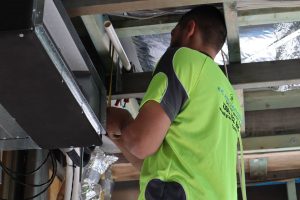
A typical split system is two pieces of equipment. The indoor unit goes on a wall inside your apartment. The outdoor unit sits outside — usually on a balcony, service area, roof area or another approved spot. Refrigerant pipework, electrical wiring and a drain connect them.
Simple enough, right up until the installer needs to drill through an external wall.
In an apartment building, that wall may well be common property. Your balcony may be subject to strata rules too. And where the outdoor unit ends up can affect how the building looks, generate noise complaints, or force pipework across areas you don’t own.
Hence the extra planning.
Do I need strata approval?
Assume yes until your strata manager or owners corporation tells you otherwise. That’s the safe default and it costs you nothing.
NSW Government guidance sorts strata renovation work into three groups: cosmetic work, minor renovations and major renovations. Installing or replacing a reverse-cycle air conditioner sits squarely in the minor renovation bucket.
For minor renovations, the guidance says to contact the owners corporation, strata committee or strata managing agent and request permission. You may be asked for:
- plans for the proposed work
- proposed installation dates
- installer details and trade qualifications
- unit placement
- pipework route
- drainage method
- electrical details
The approval route itself varies with your scheme’s by-laws. Some schemes let the strata committee sign off minor renovations under an existing by-law. Others need a vote.
One warning worth taking seriously: don’t assume that because unit 12 has an air conditioner on their balcony, you can install yours the same way. Their approval may have come with conditions you know nothing about, or under by-laws that have since changed.
Is a split system allowed on an apartment balcony?
Potentially, and this is one of the more useful points in current NSW planning guidance.
The NSW Planning website states that exempt development standards can allow an air-conditioning unit to be placed on the floor of an apartment balcony.
But read the next line too: strata apartment buildings may have by-laws controlling where and how those units are installed.
In plain English — planning rules saying your installation can be exempt development do not hand you strata permission. You may still need the owners corporation to sign off.
Worth understanding before you buy the system, not after.
What does “exempt development” actually mean?
It’s a term that causes a lot of confusion, so here’s the short version.
Exempt development means certain minor building works may not need separate planning or building approval, provided all the applicable development standards are met. NSW Planning includes qualifying residential air-conditioning installations in that framework.
What it does not mean is “council approval isn’t required, so I can do whatever I like.” You still have to comply with the relevant standards. And if the property is strata titled, the strata rules are a separate matter entirely.
The way to hold it in your head: planning approval and strata approval are two different questions with two different answers.
What if the installation changes the outside of the building?
This is where jobs get complicated.
NSW strata guidance says minor renovations cannot change the outside or structure of the strata property. Work that does affect the exterior or structure may land in the major renovation category instead.
Which matters, because a perfectly ordinary apartment air conditioner can involve an outdoor compressor, wall penetrations, visible pipework, external conduit, brackets and drainage pipes.
Whether any of that counts as affecting common property or the building exterior depends on your specific apartment and strata plan. And where the installation does affect common property, the NSW Government notes a by-law change may be required in some situations.
All of which is a good argument for assessing the job properly before ordering equipment.
Where can the outdoor unit go?
Usually the biggest design question in the whole project.
The candidates are typically a balcony floor, a designated service balcony, an approved external area, a rooftop plant area, or somewhere else the owners corporation signs off on.
Picking between them means balancing a few things at once.
Airflow. The condenser needs clear space to move air. Wedging it into a tight enclosure hurts performance, and it’ll cost you on running costs every summer afterwards.
Noise. The compressor and fan make sound. Putting the unit outside a neighbour’s bedroom window is unlikely to win you friends at the next AGM.
Appearance. Many schemes have rules aimed at keeping the building looking consistent from the street.
Access. A technician has to reach the thing for servicing and repairs. Plan for that now rather than discovering the problem in four years.
Pipe distance. Long or awkward refrigerant runs add cost and complexity.
Drainage. The indoor unit makes water while it cools, and that water needs somewhere safe to go.
Which is why a good apartment installation starts with placement — not with brand or capacity.
What if the balcony is tiny?
Small balconies are the Sydney norm, and they don’t automatically rule anything out.
A compact outdoor unit can work if minimum clearances are maintained, airflow isn’t blocked, the unit stays accessible, drainage can be handled and strata approves the position.
That said, surrendering most of a small balcony to a large condenser isn’t always a sensible trade. If you’d rather still fit a chair out there, it’s worth looking at the alternatives.
This is where a multi-split can enter the conversation, particularly if several rooms need conditioning. A multi-split runs several indoor units off one outdoor unit, which cuts the number of condensers taking up space outside.
Multi-splits aren’t automatically better, though. Pipework, installation complexity and system design all need assessing first.
Can it be mounted on the external wall?
Possibly — but don’t assume it.
An apartment’s external wall very often involves common property. Brackets bring their own set of issues: building appearance, structural fixing, vibration, access, noise, waterproofing and future maintenance.
In a lot of apartment situations, an approved balcony-floor position is simply easier to get across the line than something bolted to the facade. The final answer comes down to the building and the approval conditions.
Can I install air conditioning if I’m renting?
Not on your own initiative.
NSW Government guidance says tenants should write to their landlord before making changes. If the landlord agrees, the landlord then follows the relevant strata approval process on the tenant’s behalf.
So renters face two layers: landlord approval, then strata approval where required.
And because a split system becomes a fairly permanent fixture, landlords will generally want it settled in writing who pays for installation, servicing, repairs, removal, and making good the property later. Sort that out early — it’s much harder to negotiate once the unit is on the wall.
Do you need a licensed installer?
Yes. Air-conditioning work is licensed work in NSW.
The NSW Government states that a licence or certificate is required before carrying out air-conditioning and refrigeration work in NSW, including associated electrical wiring within the licence scope. Electrical wiring work separately requires the appropriate electrical licence or certificate.
Refrigerant handling is regulated on its own track. The Australian Refrigeration Council states that people handling refrigerant while installing relevant split-system equipment need an appropriate Refrigerant Handling Licence.
Which is a reason to be sceptical of unusually cheap quotes that don’t clearly spell out who’s doing the installation, what licences they hold, how the electrical and refrigerant work is covered, how drainage is handled and whether the system gets properly commissioned.
A cheap unit badly installed becomes an expensive unit remarkably fast.
What should you send to strata?
A clean application is far easier for a committee to assess than a one-line email asking “can I put an aircon on my balcony?”
Give them a proper proposal:
Indoor unit location — which wall it’s going on.
Outdoor unit location — exactly where the condenser sits, not “somewhere on the balcony.”
System specifications — dimensions where relevant.
Pipe route — how the two units connect.
Wall penetration — where drilling is required.
Drainage — where the condensate discharges.
Electrical requirements — how the system is supplied.
Installer information — contractor details and qualifications.
Proposed working hours — strata buildings often restrict renovation times.
The NSW Government specifically notes that minor renovation applicants may need to provide plans, proposed work dates and tradesperson qualifications. The more clearly you explain the job, the fewer open questions the committee has to chase you about.
The problems that actually derail apartment installations
No workable outdoor-unit position. This one can stop an otherwise simple project dead.
Long pipe runs. Two units that would sit a metre apart in a house can end up several metres apart in an apartment, because the pipes have to follow an approved route rather than the shortest one.
Condensate drainage. Water can’t just drip onto the balcony below. Sorting this properly is often the fiddliest part of the job.
Noise and vibration. Position the condenser with the neighbouring apartments in mind, not just the installer’s convenience.
Common-property penetrations. Drilling frequently involves parts of the building you don’t personally own.
Limited electrical capacity. Older buildings sometimes need a closer look at what the switchboard can actually handle.
Building access. High-rises come with lift bookings, loading dock times, parking restrictions and working-hour rules.
None of these are reasons to give up on air conditioning. They’re reasons to plan the job before booking it.
A realistic Sydney example
One-bedroom apartment, west-facing living room, unbearable by four in the afternoon. The owner wants a single reverse-cycle split system, and there’s a balcony directly off the living room.
On paper it’s about as easy as it gets:
- Indoor unit: living-room wall
- Outdoor unit: balcony floor
- Pipework: short run through the wall
- Drainage: routed to an approved drainage point
Straightforward. But before anyone books a date, the owner still needs to confirm whether the balcony position complies with the scheme’s by-laws, whether the wall penetration affects common property, whether the condenser position meets the approval conditions, whether noise could reach the neighbours, and what documentation strata wants before work starts.
That’s the gap between a technically possible installation and an approved one.
Split system vs portable
Portables look appealing because there’s no permanent installation work. They’re solving a different problem, though.
A split system gives you permanent installation, efficient heating and cooling, no compressor noise inside the room, and equipment suited to regular use. In exchange you need professional installation, somewhere to put the outdoor unit, and probably strata approval.
A portable is less permanent, easier for renters, and needs no external condenser. The trade-offs are the exhaust hose out a window, the floor space it eats, noticeably more noise in the room, and diminishing appeal if you’re cooling most days of summer.
If you own the apartment and plan to stay, a properly approved split system usually wins on a five-year view. If you’re a tenant who can’t get permission for permanent work, the maths changes completely.
One split or a multi-split?
Depends how many rooms you need to condition.
A single split tends to suit studios, one-bedroom apartments, open-plan living areas, or one bedroom you actually use.
A multi-split tends to suit two or three bedrooms, apartments with limited outdoor space, or schemes that would rather see one condenser on a balcony than three.
The appeal of multi-split air conditioning is obvious — several indoor units sharing one outdoor unit. The catch is complexity. Sizing, pipe routes and placement all need proper assessment rather than a rule of thumb.
Noise in strata buildings
Noise matters more in apartments for the obvious reason: your neighbours are a few metres away, sometimes on the other side of a shared wall.
NSW Planning specifically points homeowners toward environmental noise guidance when considering air-conditioning installations.
Don’t let the outdoor unit end up somewhere just because it’s convenient for the installer. Think about nearby bedrooms, neighbouring balconies, hard walls that reflect sound, vibration through the structure, whether you’ll run it overnight, and what the by-laws say.
A few extra metres of planning can save you years of complaints.
How KYNEX Air Conditioning can help
Apartment air conditioning isn’t a matter of turning up with a split system and drilling a hole. The site has to make sense first.
KYNEX Air Conditioning’s published Sydney service information says its team handles split systems, multi-splits and other residential systems, and works specifically with small apartments and boutique homes where space is tight. It also describes a process that starts with a site assessment and system-placement planning before any installation.
For an apartment, that assessment is where you find out about suitable indoor-unit placement, realistic outdoor-unit positions, pipework options, drainage, electrical requirements, access limitations and likely strata concerns — ideally before you’ve committed to anything.
If you’re weighing up an installation, have a look at KYNEX’s split air conditioning installation Sydney service. The Split Installation Service Page is also worth reviewing while you’re planning the work. For broader home-comfort options, see residential air conditioning Sydney.
KYNEX’s published business information states that its team has more than 10 years of combined industry experience and has installed or serviced more than 2,000 systems across residential and commercial properties.
For an apartment owner, the valuable part isn’t picking an air conditioner. It’s getting someone to look at the property and answer: can we install this here properly, and what has to happen first?
Checklist before you pay a deposit
The property
- Is the apartment owner-occupied or rented?
- Where will the indoor unit go?
- Where can the outdoor unit go?
- Is the balcony big enough to keep clearances?
- Can condensate drain safely?
Strata
- Have you read the current by-laws?
- Does the installation need approval?
- Does it affect common property?
- Does strata want plans or specifications?
- Are renovation hours restricted?
- Are there rules about lift or loading-area use?
The installation
- Is the installer appropriately licensed?
- Is refrigerant work covered?
- Is the electrical work covered?
- How will pipes be routed?
- How will wall penetrations be finished?
- Who handles future maintenance?
The neighbours
- Could the outdoor unit affect someone’s bedroom?
- Could vibration travel through the structure?
- Could water discharge reach another apartment?
Answering these beforehand is dramatically easier than resolving a dispute afterwards.
Frequently asked questions
Can strata refuse air conditioning in NSW? A strata scheme has an approval process for relevant renovations and can impose conditions consistent with the applicable legal framework and its by-laws. Whether a particular proposal can be refused depends on the work and the scheme. Don’t assume approval is automatic.
Is reverse-cycle installation a minor renovation? NSW Government’s June 2026 strata guidance lists installing or replacing a reverse-cycle air conditioner as a minor renovation.
Can the strata committee approve it? For minor renovations, a committee can consider approval where the scheme has a by-law allowing it. NSW guidance says otherwise the work may need to go through the owners corporation’s approval process.
Can the outdoor unit go on my balcony? NSW Planning says air-conditioning units may potentially be installed on the floor of an apartment balcony under the exempt development standards. Strata by-laws can still control the installation.
Do I need council approval? Not necessarily. Qualifying installations may be exempt development when all relevant NSW development standards are met — which doesn’t remove any separate strata requirement.
Can I install air conditioning if I rent? Get your landlord’s permission first. NSW guidance says the landlord then follows the relevant strata approval process on your behalf.
Can one outdoor unit run several rooms? Yes — a multi-split connects multiple indoor units to a single outdoor unit. Whether it’s the right call depends on apartment size, pipework and where the condenser can go.
Is a split system good for a small apartment? Often, yes. A correctly sized single split works well in a studio, one-bedroom or open-plan living area, because you’re conditioning the space you actually occupy.
Related reading
- Where Is the Best Place to Install a Split System Air Conditioner?
- Do I Need an Electrician to Install a Split System Air Conditioner in Sydney?
The bottom line
Yes — in plenty of Sydney apartments, a split-system installation is entirely achievable.
Buying the unit just shouldn’t be step one.
Start by working out where the indoor unit can go, where the outdoor condenser can go, whether the installation touches common property, what your by-laws require, whether approval is needed, how drainage and electrical work and pipework will be handled, and whether your installer holds the right licences.
NSW’s current 2026 guidance makes the key point clearly enough: installing or replacing a reverse-cycle air conditioner can fall within the strata minor-renovation process, while planning rules can allow qualifying units on apartment balconies as exempt development. Two separate issues. Both need answering.
So for most apartment owners the better question isn’t “can I install a split system?”
It’s “where can it be installed properly, and what approvals do I need before work starts?”
Get that right and the rest of the job is comparatively easy.