
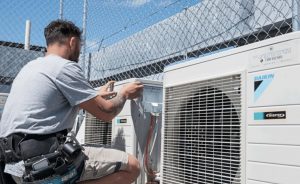
Short answer: most single split systems are done in three to six hours. If you’re taking time off work for it, block out half a day and you’ll almost certainly be fine.
The jobs that blow out past that are usually the ones with a long pipe run, an outdoor unit that’s awkward to get to, an old system that needs pulling out first, or a switchboard that isn’t ready for another circuit. Those can stretch to six or eight hours, and occasionally the whole day.
Here’s the part homeowners don’t expect: the size of the unit matters far less than where it has to go. A 7kW system on a straightforward external wall can be quicker than a 2.5kW unit that needs pipework snaked through an apartment.
Rough timings to plan around
| Type of installation | Time to allow |
|---|---|
| Simple back-to-back | 3–4 hours |
| Standard residential | 4–6 hours |
| Long pipe run or tricky access | 5–8 hours |
| Replacing an existing system | 4–8 hours |
| Difficult two-storey job | Half a day to a full day |
| Two or more splits | Most of the day |
Treat these as planning figures, not promises. Any installer who quotes you a time before looking at the property is guessing.
Why one split takes three hours and another takes eight
Once it’s finished, a split system air conditioning installation Sydney looks simple enough — a head unit on the wall inside, a condenser sitting outside. The work is in connecting the two safely.
A split system is really two pieces of equipment joined by refrigerant lines: the compressor outside and the fan coil inside. To get from empty wall to working aircon, the installer has to confirm both positions, mount the indoor bracket, core a hole through the wall, run the refrigerant pipes, set up a drain that actually drains, do the electrical connections, position and secure the outdoor unit, pressure test and evacuate the lines, then commission and test the whole thing before showing you how the remote works and cleaning up.
Every one of those steps is quick in a well-laid-out house. In a difficult one, three or four of them turn into small projects of their own.
What “back-to-back” actually means
If your installer mentions a back-to-back install, they mean the indoor unit is going on an external wall with the outdoor unit sitting more or less directly behind it. Bedroom wall inside, condenser on the ground just outside.
It’s the cheapest and fastest arrangement because the pipe run is barely a metre, there’s one penetration, and the drain has a short, easy fall to daylight. Around three to four hours is a fair allowance.
Not every home gives you that option, which is where the extra hours come from.
The five things that add time
Distance between the two units. Sometimes the condenser has to go five or ten metres away — around a corner, down a side passage, up on a bracket. That’s more refrigerant line, more cable, more drain, and a route that has to be planned so it doesn’t end up looking like a bad plumbing job across the front of your house.
The walls themselves. Sydney housing is a real mixed bag. A modern apartment with plasterboard and a stud wall is one thing. Double brick, rendered besser block, or a heritage terrace is another entirely. Core drilling through 270mm of double brick takes real time, and doing it neatly takes more.
Getting to the outdoor unit. Ground level with clear access is easy. First-floor bracket work, a narrow side passage, or a courtyard you can only reach through the house is not. The unit also has to end up somewhere it can breathe and somewhere a technician can reach it in five years’ time for a service. Tucking it into a cramped spot to save an hour on install day tends to cost you later.
Electrical work. The unit needs its own properly rated supply. Some homes are already sorted. Older places sometimes need a new circuit run from the board, and occasionally the board itself is the problem. That’s usually the discovery that turns a five-hour day into a seven-hour one.
Removing the old system. Replacements look easier because there’s already a unit on the wall. Often they aren’t. The old system has to be isolated, the refrigerant recovered properly rather than vented, both units taken off, redundant pipework dealt with, and the wall made good before the new bracket goes up. New models rarely line up with old mounting points or pipe positions either.
Apartments and strata
The physical install in an apartment is often still a half-day job. It’s the paperwork that catches people out.
In a strata scheme, the external walls, the balcony slab and the building facade are generally common property, and drilling through them or mounting a condenser on them needs owners corporation approval. Your by-laws may also have something to say about where units can go, how they’re screened, and noise limits.
Sort that out before you book the installer, not the morning they arrive. A rejected outdoor unit location on install day means the job stops.
Do you need council approval?
Usually not. In NSW, residential air conditioning is generally exempt development, meaning no DA and no complying development certificate, provided the install meets the standards in the exempt development code — things like setbacks, noise limits and not putting the condenser somewhere it upsets a neighbour.
That’s not a blanket permission to put the unit anywhere. Heritage items, conservation areas and some unit blocks have their own rules on top. Worth a five-minute check before install day rather than an argument afterwards.
Why it has to be a licensed installer
A split system isn’t an appliance you screw to the wall and plug in. It involves refrigerant handling and fixed electrical work, and both are licensed activities. Anyone installing or decommissioning a split system needs the appropriate ARC refrigerant handling licence, and the electrical side needs a licensed electrician.
This is worth remembering when you’re comparing quotes. A suspiciously fast install usually means something got skipped, and the things that get skipped are the invisible ones — proper evacuation of the lines, a leak test, actually commissioning the unit rather than just switching it on to hear the fan spin. Those are also the steps that determine whether the system is still running well in eight years, and whether your warranty holds up.
What happens on the day
Confirming positions (15–30 minutes). The installer looks at airflow, pipe route, drain fall, outdoor clearances and future access. Worth walking through it with them.
Mounting the indoor unit and coring the wall (30–60 minutes). Bracket goes up level, hole gets cored for pipes, drain and cable. Longer on difficult wall types.
Pipework and drainage (45–90 minutes). The refrigerant lines get run, insulated and flared, and the drain is set up with a continuous fall. Condensate is the number one cause of callbacks, so this is not a step to rush.
Outdoor unit (30–60 minutes). Either onto a slab, feet, or a wall bracket, sitting level and with clearance around the coil.
Electrical and refrigeration connections (varies widely). Circuit termination, vacuum, pressure test, gas release.
Commissioning and testing. Running the system in both heating and cooling, checking pressures and temperature split, confirming the drain runs. The job isn’t finished when the unit turns on.
Can it be done in one day?
Yes — for one split system in a normal house, expect a same-day install. You shouldn’t be looking at tradies coming back tomorrow for a single head unit.
A full day becomes realistic when there’s difficult access, significant electrical work, unusual wall construction, a long pipe run, an old system to strip out, several units going in, or an apartment with a tight access path.
The question worth asking isn’t “can you do it quickly?” It’s “based on my walls and where these units need to go, how long should I allow?” You’ll get a far more useful answer.
Making install day go faster
None of this turns an eight-hour job into a two-hour job, but it removes the stupid delays:
- Clear the wall inside. Move furniture, take down pictures, shift anything fragile well out of the way.
- Clear the path outside to where the condenser is going.
- Sort parking if you can. In parts of Sydney, carrying gear from three streets away takes longer than coring the wall.
- Have strata approval in hand.
- Lock in the unit positions beforehand. Changing your mind after the hole is cut isn’t ideal.
- Clear the access route — garage, side passage, stairwell, balcony.
Two systems, and how splits compare to ducted
Two splits don’t take exactly twice as long, since setup and some of the electrical work overlaps. But each head unit and each condenser still needs its own pipe run, drain and commissioning, so allow most of the working day. Three or more, and you’re either looking at a longer visit or a bigger crew.
Compared to ducted, a split is a much lighter touch on the building. Ducted adds a roof-space fan coil, ductwork, ceiling outlets, return air, zoning and a lot more planning — a multi-day job in most homes. If you’re trying to fix one hot bedroom, a west-facing living room or a home office, a split is the simpler path by a long way.
Questions worth asking before you book
- Where exactly is the indoor unit going, and where’s the outdoor unit?
- How long should my install take, based on my property?
- Is the electrical work included, or is that separate?
- Is removal and disposal of my old system included? Don’t assume.
- Will you commission and test it before you leave?
If the answers are specific to your house rather than generic, that’s a good sign.
How KYNEX Air Conditioning can help
If you’re planning a split system installation in Sydney, KYNEX Air Conditioning Sydney will assess the site before quoting — wall construction, indoor and outdoor positions, pipe distance, drainage, electrical requirements and access — so the timeframe you’re given actually reflects your property rather than an average.
If you’re looking at more than one room, or a whole-home solution, it’s worth looking at the full range of air conditioning installation services as well.
Work out the right approach first. The realistic timeframe follows from that.