
Best Air Conditioner Brands in Sydney: Daikin vs Mitsubishi Electric vs Fujitsu (2026)
For homeowners comparing the best air conditioner brands Sydney has to offer, Daikin is our all-round shortlist pick, Mitsubishi Electric stands out for split-system owner feedback, and Fujitsu is worth comparing for practical room-by-room comfort. The best choice still depends on the exact model, your home and the quality of installation.

Product reference image. Brand awards and specifications below are linked to published sources; this image is not evidence of a KYNEX installation or test.
The 30-second answer
Choose Daikin if you want a strong all-round contender and are comparing air-quality or ducted options. Choose Mitsubishi Electric if simple controls, quiet-room features and strong 2026 split-system owner feedback are your priorities. Choose Fujitsu if you want a sound alternative with a wide choice of room sizes and useful reverse-cycle options.
Most important: ask for the exact model number, energy label, indoor and outdoor noise figures, and a properly scoped installation quote. No brand name can fix a unit that is too big, too small or poorly positioned.
Which are the best air conditioner brands in Sydney in 2026?
Daikin, Mitsubishi Electric and Fujitsu all deserve a place on a Sydney homeowner’s shortlist. They sell reverse-cycle systems that cool in summer and warm rooms in winter. Yet comparing brands without model numbers is like comparing cars without engines: you miss what matters most.
| Buying factor | Daikin | Mitsubishi Electric | Fujitsu |
|---|---|---|---|
| Best starting point | All-round comparison; air treatment features | Quiet bedrooms; easy day-to-day use | Room-by-room reverse-cycle choice |
| Example split system | Alira X | MSZ-AP | Lifestyle range |
| 2026 independent overall brand score* | 74% | 71% | 71% |
| 2026 brand reliability score* | 91% | 92% | 92% |
| Watch closely | Specific feature package and installed quote | Wi-Fi and sound specifications by model | Controls and efficiency by model |
| Our buying advice | Compare for whole-home plans | Compare for a bedroom or living room | Request a like-for-like alternative |
*2026 Best Brand report scores, not failure probabilities, lab ratings for every model, or KYNEX test findings. Reliability scores are calculated from owner survey evidence with methodology described by the publisher. Read the 2026 methodology and results.
What do you actually get with each brand?
A normal wall-mounted split system air conditioning Sydney includes an indoor unit, outdoor unit and controller, with pipes and electrical work needed to connect it. What is supplied in an installation package varies, so check the written quote. Here are three real product families, not invented test units.
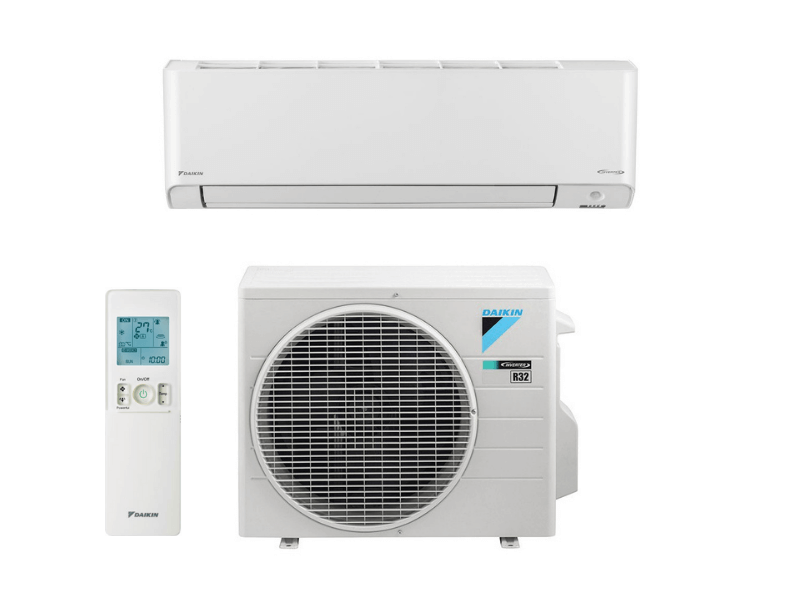
Daikin Alira X
Available in listed reverse-cycle capacities from 2.2 to 7.1 kW, depending on model. Published features include R32 refrigerant, a humidity sensor, Streamer air-treatment technology and redesigned airflow vanes.
Look for: air treatment, airflow direction and the exact efficiency label.
Mitsubishi Electric MSZ-AP
Published models span rated cooling capacities from 2.5 to 7.8 kW. The range uses R32 refrigerant. Quiet operating figures depend on model and mode; do not apply a headline decibel claim to every unit.
Look for: bedroom sound ratings, controller details and individual ZERL ratings.
Fujitsu Lifestyle range
For example, the Australian ASTG09KMTC technical sheet lists 2.5 kW rated cooling, 3.2 kW rated heating, R32 refrigerant and a wireless remote. Larger Lifestyle units cover bigger spaces.
Look for: the correct room size, seasonal efficiency and available control options.
Images identify example product types; they are not side-by-side scale images. Technical details are from published specifications, not our own bench tests. Daikin specifications · Mitsubishi Electric specifications · Fujitsu specifications.
Which design will look better in a Sydney room?
All three offer simple, light-coloured indoor units that can sit high on a wall. The better design is the one that fits without blowing directly at your bed or couch. In a narrow terrace bedroom, a compact indoor unit and careful pipe route may matter more than a glossy feature list. In a large open-plan living room, the direction and reach of airflow can matter more than the front-panel shape.
What do real Australian owners say in 2026?
Rather than inventing customer testimonials, this guide uses published 2026 survey results. One 2026 owner-awards study named Mitsubishi Electric the winner for split-system performance, reliability, ease of use and overall affection. Its survey scores included 4.66 out of 5 for split-system reliability, with Daikin and Fujitsu both receiving 4.54 out of 5 in that category.
A separate 2026 comparison reached a different headline result. It scored Daikin 74% for its overall best-brand measure, versus 71% each for Mitsubishi Electric and Fujitsu. That study also included model testing, reliability and satisfaction research, so the results are not directly interchangeable with an owner-only award.
2026 best-brand scores
Daikin
74%
Mitsubishi Electric
71%
Fujitsu
71%
Source: published 2026 independent Best Brand scores. This chart is a visualisation of published figures, not an original KYNEX experiment.
How to read this honestly: the studies ask different questions, sample different owners and weight results differently. They support a shortlist, not a promise that a given unit will last longer. No first-hand long-term KYNEX test diary or independently verified 2026 KYNEX customer testimonial was supplied for this article, so none is presented as fact.
Which brand is most energy-efficient for Sydney?
There is no honest brand-wide winner. The Zoned Energy Rating Label (ZERL) compares air conditioners by climate zone, size and heating or cooling use. For Sydney, the average-climate column is a useful starting point. Then compare units with similar rated cooling capacity.
A 2026 Australian government guide explains that the label gives seasonal stars, estimated annual energy use and sound data. More stars can mean less power use when the system is the right size. But a model with a higher rating can still cost more to run if it has to cool a much larger space. Also check insulation, afternoon sun and how many rooms you actually use.
For a true comparison, request the model-specific label for each quote. A 2.5 kW unit should not be judged against a 7.1 kW unit just because both have stars. Nor should a published lowest fan noise figure be treated as the sound level at full cooling speed.
Interactive: estimate your air conditioner’s energy use
Use this simple calculator to see how power draw and daily hours affect use. It is not a brand comparison, bill forecast or claim about a specific model. Real inverter systems speed up and slow down during the day.
Illustrative calculation only: electrical input × hours per day × days. Cooling capacity (kW) is not the same as electrical input (kW).
Which air conditioner suits your Sydney home?
Picture three common Sydney homes. These are illustrative planning scenarios, not claimed customer installations.
Small Randwick apartment: one hot bedroom
A quiet reverse-cycle split system is often the first option to investigate. Compare the Mitsubishi Electric MSZ-AP with similar Daikin and Fujitsu models. Ask how the indoor fan sounds at night, where condensate water drains and whether strata approval applies. A low-noise claim means little if the outdoor unit sits near a neighbour’s window.
Older Inner West terrace: two levels and afternoon sun
A single wall unit may not reach an upstairs bedroom, even if its cooling rating looks generous. Before choosing the best split system air conditioner Sydney shoppers recommend, map room layout, heat gain and doors. Two correctly placed splits or a multi-room design might suit better than one large unit pointed at a staircase.
Western Sydney family home: long, hot afternoons
Insulation, glazing and western sun deserve special attention. A larger system is not always better: oversizing may bring extra cycling and poor humidity control. Compare energy efficient air conditioner brands by specific models, not advertising slogans. If the goal is whole-home comfort, ask whether ducted air conditioning Sydney is a better fit.
Does installation matter more than the brand?
It can. A reliable air conditioner can underperform when it is installed in the wrong place or chosen for the wrong room. A good installer should assess room size, ceiling height, windows, insulation, outdoor-unit ventilation, noise and a safe service route. They should also explain drainage, cleaning access and what happens if a fault appears.
After installation, daily use is simple: set a sensible temperature, keep doors and windows in mind, and clean filters as the manual directs. For app or Wi-Fi control, check that the exact quoted model supports it. Digital features can vary across production versions and optional accessories.
For long life, do not block indoor returns or outdoor airflow. Book servicing when needed and follow the model’s official care guide. No 2026 evidence reviewed here supports a promise that any of the three brands is maintenance-free.
Daikin vs Mitsubishi Electric vs Fujitsu: pros and cons
What stands out
- Daikin: a strong 2026 all-round result, with specific models offering advanced airflow and air treatment.
- Mitsubishi Electric: standout 2026 split-system owner feedback and model-dependent quiet operation.
- Fujitsu: competitive 2026 reliability score and a practical range of reverse-cycle capacities.
What to check
- Daikin: not every model includes the same premium functions.
- Mitsubishi Electric: headline quiet-mode data may apply only to selected sizes and settings.
- Fujitsu: confirm the precise controller, connectivity and ZERL label before ordering.
The three brands continue to offer current model documentation, but future product launches and software support should not be assumed. Ask for the current manual and warranty conditions for the unit on your quote.
Which brand should you buy, and where?
Best for an all-round shortlist: Daikin. Best for shoppers who place high value on 2026 split-system owner results: Mitsubishi Electric. Best additional quote for a like-for-like comparison: Fujitsu. Skip any model that fails your room-size, outdoor-noise or access requirements, no matter how strong the brand reputation.
Because installed prices change with unit size, pipe length, access, electrical work and site conditions, we do not publish a fixed price or claim a deal is available. Ask for a written scope showing model number, indoor and outdoor units, installation work, commissioning, warranty and any exclusions. The best-value purchase is the right system properly installed, not simply the cheapest sticker.
For air conditioning installation Sydney, KYNEX Air Conditioning & Trades can discuss suitable models and quote the supply-and-install job. To compare a split against a whole-home system, also read its ducted installation service.
How can KYNEX Air Conditioning & Trades help?
KYNEX helps Sydney homeowners choose, install and maintain suitable air conditioning. Its published installation service describes more than 10 years in the industry and work across multiple brands. A useful first call covers the rooms you want comfortable, whether heating is needed, unit placement and the best service access.
Local contact: Suite 206 Level 2/71 Belmore Rd, Randwick NSW 2031. For exact availability, model options and a site-specific quote, call 0484 59 59 59. The public website and the supplied suite address should be reconciled before publication, as the online contact details currently show a different suite number.
Final verdict: which brand wins for Sydney?
Our editorial shortlist rating is 4/5 for each of Daikin, Mitsubishi Electric and Fujitsu as brands worth quoting, not as laboratory performance ratings. That equal score is intentional. There is no verified, like-for-like KYNEX installation test proving one wins every Sydney household. Independent 2026 results place Daikin strongly overall, while another 2026 owner study favours Mitsubishi Electric in several split-system categories. Fujitsu remains a reasonable competitor with strong reliability findings.
The best next step is to compare two or three exact models for your room, using the same heating and cooling needs, energy-label climate column, noise limits and installation scope. If your priority is a quiet bedroom, do not shop as though you are cooling an entire house. If you want whole-home heating and cooling, start with a system design before picking the badge.
Frequently asked questions
Is Daikin better than Mitsubishi Electric in Sydney?
Not in every case. Daikin scores slightly higher in one 2026 overall brand measure. Mitsubishi Electric performs especially well in a separate 2026 split-system owner study. Compare exact models and installation suitability before deciding.
Is Fujitsu as reliable as Mitsubishi Electric?
The referenced 2026 overall brand report lists both at 92% on its brand reliability measure. That is a survey-based brand metric, not a guarantee that any one product will never fail.
Which is the best split system air conditioner for a Sydney bedroom?
Start with a correctly sized, quiet reverse-cycle unit. Compare low-speed and normal fan sound figures, bedroom airflow direction, control options and the outdoor unit’s position. Brand is only one part of the choice.
Which air conditioner is cheapest to run?
Compare the Zoned Energy Rating Label for models of similar capacity using the average climate zone. Annual energy estimates and your actual hours of use are more useful than a brand-wide claim.
Should I choose split system or ducted air conditioning?
Split systems often suit one room or selected zones. Ducted air conditioning may suit people seeking a more integrated whole-home plan, depending on roof space, design and budget. Ask for a site assessment.
How do I get an accurate installation quote in Sydney?
Share your suburb, room dimensions, home type and preferred installation location. Ask the installer to specify the model numbers, scope of work, warranty and exclusions. KYNEX can be reached on 0484 59 59 59.