

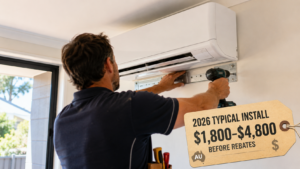
What Air Con Installation Actually Costs in Australia in 2026 (Before Any Rebate)
Here’s the honest starting point: a small, simple split system, supplied and installed, usually runs somewhere around $1,200 to $1,800 in 2026. Bigger splits climb to $3,000–$5,000 and beyond. And a full ducted setup in a Sydney home? Budget anywhere from $9,500 to $18,000-plus before any rebate touches the number.
That’s the quick version.
But it doesn’t explain why your neighbour got quoted $1,600 while you’re staring at a $3,200 quote for what looks like the exact same air conditioner.
A quick note on the numbers: Every price in this guide is a general 2026 planning range based on typical Sydney and Australian installations — not a fixed quote. What you actually pay depends on your property, the system you choose, access, electrical requirements and who does the work. Rebate amounts, eligibility criteria and program end dates are set by the relevant government schemes and can change without notice. For an accurate figure, get a written, site-assessed quote, and confirm any current rebate directly with an accredited provider or the NSW Energy Savings Scheme.
The thing is, you’re not just paying for the box that goes on the wall.
You’re paying for the refrigeration pipework, the electrical work, the drainage, the brackets, the labour, the access to your property, the commissioning, and the sheer complexity of getting the system to sit properly in your house. And that’s before anyone mentions ductwork, zoning, or a switchboard upgrade.
So before you line up three quotes and pick the cheapest, make sure you’re actually comparing the same thing. A “$700 install” and a “$2,000 air conditioner installation” can both be honest prices — one’s labour only, the other includes the unit. That single distinction trips people up more than anything else in this entire process.
The 2026 Ballpark, In One Table
Treat these as planning ranges, not quotes carved in stone.
| Installation type | Rough 2026 range |
|---|---|
| Basic split install (labour only) | ~$600–$1,100+ |
| Small split, supplied & installed | ~$1,200–$1,800 |
| Medium split, supplied & installed | ~$1,500–$2,800 |
| Large split, supplied & installed | ~$2,200–$4,500+ |
| Complex Sydney split job | Can top $5,000 |
| Ducted, smaller home | ~$9,500+ |
| Typical Sydney ducted | ~$9,500–$18,000+ |
| Large/premium ducted project | $18,000+ |
Your final figure can swing hard depending on the property. Keep reading and you’ll see exactly why.
First Question, Always: Does the Quote Include the Unit?
Sounds obvious. It isn’t.
Search “how much does split system installation cost” and you’ll get hit with $700, then $1,500, then $2,800, and your first instinct is that someone’s ripping people off. But look closer, and those three prices are three completely different products:
- $700 might mean install a unit you already bought.
- $1,500 might mean supply the unit and fit it.
- $2,800 might mean supply, install, sort the electrical, deal with awkward access, run extra pipe, and haul away your old system.
Same words on the ad. Different jobs entirely. So the one question that saves you the most grief is simply: is this supply and install, or install only?
What a Split System Actually Costs in 2026
For a clean, straightforward split system installation, a small bedroom unit tends to sit at the lower end of that $1,200–$1,800 supplied-and-installed band. As the capacity goes up, so does the price of the gear. A decent living-area system lands closer to $2,000–$3,500, and the big or fiddly jobs push toward $4,000–$5,000 and up.
Notice the phrase I keep leaning on: straightforward. Every cheap advertised price quietly assumes a “back-to-back” job. So let’s talk about what that means, because it’s where the money lives.
Back-to-Back: The Cheapest Layout Going
A back-to-back install means the indoor unit sits on an external wall, and the outdoor unit goes directly behind it, just outside.
Indoor unit → wall → outdoor unit, a metre away.
Short pipe run. Simple drainage. Easy access. Less labour. That’s it. That’s the layout every bargain price is secretly built around — and it’s exactly the layout plenty of houses can’t offer.
The moment your property can’t do back-to-back, the price starts moving.
Why the Same Split Costs $1,500 Here and $3,000 There
Because installers don’t fit air conditioners into spreadsheets. They fit them into real, awkward, lived-in houses. The usual culprits:
Longer pipe runs. If the indoor and outdoor units need to be several metres apart, that’s more copper, more insulation, more drainage, more conduit, more time.
A tricky spot for the outdoor unit. Sitting it on the ground is easy. Bracketing it up a wall at height is a genuinely different job.
Double brick or difficult walls. Punching services through a simple wall is nothing like fighting through thick masonry or a finished, complicated structure.
Electrical work. Your existing setup might not cut it. A dedicated new circuit adds to the bill.
Drainage. That condensation has to go somewhere sensible. Sometimes gravity does the work for free. Sometimes it really doesn’t.
Access. A clear external wall is one thing. A narrow side passage, an upper-floor apartment, a dodgy balcony, a high wall, or a cramped roof space is another. Access costs money because access costs time.
A Real-World Example
Picture two Sydney homes, both buying similar 5 kW systems.
Home A: indoor unit on an external wall, outdoor unit directly outside, easy electrical, simple drainage. Close to the textbook install.
Home B: indoor unit has to go on an internal wall, so the pipework travels further. The outdoor unit gets mounted well away from the room. Extra electrical work needed. Access is a pain.
Same capacity. Wildly different job. Which is exactly why “what does a 5 kW aircon cost to install?” is the wrong question. The right one is “what will a 5 kW system cost to install in my house?”
Sydney Adds Its Own Curveballs
There’s no such thing as a standard “Sydney house.” You could be fitting a system into a slick new apartment, a narrow terrace, a Federation home, a new-build townhouse, a double-storey suburban place, a strata property, or an older brick cottage — and every one of them creates its own puzzle.
An apartment might need strata permission and careful thought about where the outdoor unit can even go. An older home can throw up electrical or access headaches. A double-storey place complicates pipe routes and outdoor positioning.
This is why a proper air conditioning install Sydney quote has to be based on your actual property. A phone estimate gives you a range. A scoped-out job gives you a number you can genuinely decide on.
What Ducted Air Conditioner Installation Costs
Ducted is a different conversation and a different price bracket. For Sydney in 2026, a sensible planning range is roughly $9,500–$18,000+ supplied and installed. Breaking that down:
- Three-bedroom home: often around $9,500–$13,500
- Four-bedroom place: closer to $12,000–$16,000
- Larger or double-storey: $14,000–$18,000+
- Big, complex or premium jobs: more again
Why Ducted Costs So Much More
Look at what’s actually being installed. A wall split is basically one indoor unit, one outdoor unit, some pipework, drainage and an electrical connection.
A ducted ac installation is an outdoor unit, an indoor fan-coil, ductwork through your ceiling, multiple outlets, a return-air grille, zone controls, dampers, a controller, electrical work, refrigeration pipework and ceiling access work. The installer isn’t bolting on a bigger air conditioner — they’re building an air-distribution system through your entire home.
The Five Things That Really Drive Ducted Cost
- House size — more space means more capacity and more duct.
- Number of zones — controlling areas independently is brilliant, but it’s not free; more zones mean more controls and components.
- Roof access — a big, walkable roof cavity is quick; a cramped one is slow.
- Number of outlets — a modest three-bed layout is a world away from a big home with bedrooms, a study, kitchen, living areas and several zones.
- Electrical requirements — the existing supply has to suit the gear, and upgrades add cost when they’re needed.
Split vs Ducted: Which Is Actually Better Value?
There’s no universal winner, so ignore anyone who tells you there is.
Splits make sense when you only want to cool a room or two, simplicity matters, your upfront budget is tight, or independent room control is genuinely useful.
Ducted makes sense when you want whole-home comfort, you like the look of discreet ceiling outlets, several rooms get used regularly, zoning matters, and the layout suits ductwork.
Say you’ve got a four-bedroom home. If you really only run the living room during the day and one bedroom at night, two splits might be the smart, practical call. But if you want five or six rooms conditioned regularly, bolting on separate systems one by one gets less appealing fast. The right answer depends on how you actually live in the place.
What a Good Quote Should Spell Out
Before you sign anything, you should be able to see:
which system’s being supplied, its model and capacity, where the indoor and outdoor gear goes, the rough pipe route, what electrical work’s included, the drainage plan, whether brackets and mounting are covered, any ductwork and outlets, zoning and controller details, whether the old unit gets removed, GST, and the exclusions.
If the cheapest quote leaves half those unanswered, it might not be the cheapest quote at all. It might just be the least complete one.
The Hidden Costs People Find Out About Too Late
Extra pipework — the “simple install” allowance usually includes a limited run; more distance, more cost.
Wall brackets — if the outdoor unit can’t sit on a ground base, mounting it adds labour and materials.
Electrical upgrades — don’t assume every switchboard or circuit is ready.
Old system removal — ask outright whether removal and disposal are in the price.
Access equipment — height or awkward access changes the labour.
Strata requirements — apartment jobs can need approvals before anyone lifts a drill.
Building work — installers aren’t magicians; if the job needs structural work or another trade, nail that down before install day.
What NSW Legally Requires From Your Installer
This is where price should stop being your only filter.
NSW Government guidance is clear that you need the appropriate licence or certificate before carrying out air-conditioning and refrigeration work in NSW — and that covers the electrical wiring that falls within the licensed refrigeration work. So when you’re weighing up air conditioning installations Sydney homeowners are considering, the question isn’t only “who’s cheapest?” It’s “who’s actually qualified to do this?”
A bad install can wreck your drainage, performance, reliability, noise levels, efficiency and long-term serviceability. The cheapest job on the street gets expensive fast when you’re paying someone else to fix it.
What About NSW Rebates in 2026?
Everything above is a before-rebate number on purpose — incentives shouldn’t be used to disguise the real cost of the job.
In NSW, eligible households and small businesses may currently get an upfront discount when installing or replacing a qualifying energy-efficient air conditioner under the Energy Savings Scheme. Indicative amounts sit around up to ~$550 for installing a new 6 kW system, and ~$560 for replacing an old unit with an eligible 6 kW split. Actual discounts hinge on eligibility, product, location and the specifics of your install.
There’s also a limited enhanced program running in eligible postcodes, with bigger discounts through participating accredited businesses, scheduled to run until 30 June 2027 or until the funding runs dry.
The lesson is simple: get the pre-incentive number first. Then ask what the install actually costs, what discount you qualify for, and what you’ll genuinely pay. That’s far clearer than a shiny “rebate price” with no underlying quote behind it.
And a warning — don’t pick an air conditioner just because it attracts a discount. A rebated unit that’s the wrong size for your home isn’t good value, it’s just cheaper. You still have to weigh up capacity, efficiency, room size, insulation, sunlight, windows, layout and how you actually use the space. Let the rebate help you buy the right system. Don’t let it choose the system for you.
A Dead-Simple Budget Calculator
For a split system:
Unit price + basic install + extra pipework + electrical + mounting/access + old-unit removal = your real pre-rebate cost.
For ducted:
Equipment + ductwork + outlets + zones + controls + electrical + labour + access/complexity = your real pre-rebate cost.
Then subtract any confirmed, eligible discount. Never subtract a rebate you haven’t qualified for yet.
Which Job Sounds Like Yours?
- Small bedroom split on an external wall → aim for the lower end of split pricing.
- Big living-room split with an awkward outdoor spot → expect to sit above basic pricing.
- Several rooms needing separate systems → compare multiple splits against multi-split or ducted.
- Three or four-bed house wanting whole-home comfort → start planning in the ducted five-figure range.
- Double-storey with tricky roof access → expect site complexity to move the number.
That’ll serve you far better than picking a system off a single price you found on Google.
Why KYNEX Starts With the Property, Not the Price
A good installation decision happens before anyone drills a single hole.
KYNEX Air Conditioning works across residential and commercial systems throughout Sydney, and the genuinely useful part of a site assessment is working out what the property actually needs — room dimensions, heat load, orientation, insulation, where the units can go, drainage, electrical requirements, pipe routes, zoning, and how the household really uses each room.
KYNEX says its team brings more than 10 years of industry experience and has serviced or installed over 2,000 systems across Sydney. If you’re researching air conditioning sydney, the goal isn’t the biggest unit at the lowest advertised price — it’s a system matched to your home, with a clear installed price before work starts. For homeowners ready to weigh up their options, a proper air conditioning Installation Sydney assessment establishes exactly what the job involves. And where a wall-mounted system suits the property, a well-planned split system air conditioning installation can deliver targeted heating and cooling without the cost of going fully ducted.
Quotes That’d Make Us Raise an Eyebrow
A price with no scope. “$1,500 installed” tells you almost nothing. Installed where? How much pipe? What electrical? What happens to the old unit?
No talk of capacity. A real recommendation is more than matching the number printed on your old unit.
No look at where the units go. Position matters — a lot.
Heavy discount pressure. A rebate should support your decision, not stampede you into one.
A quote far below everyone else’s. Sometimes it’s a genuine bargain. Sometimes something’s quietly been left out. Ask.
Frequently Asked Questions
What’s the average air conditioner installation cost in Australia in 2026?
A small supplied-and-installed split can start around $1,200–$1,800, with medium and larger systems commonly in the $1,500–$4,500+ range. Complexity pushes it higher.
How much is installation if I already own the split system?
A straightforward install-only job often lands around $600–$1,100+, though access, pipe length, electrical, brackets and other factors can lift it.
How much does ducted air conditioning cost in Sydney?
A useful 2026 planning range is roughly $9,500–$18,000+ supplied and installed. Larger or more complex systems can exceed that.
Why is one quote so much higher than another?
Check whether both include the same equipment, pipework, electrical, mounting, removal, zoning, ductwork and access.
Is a back-to-back installation cheaper?
Usually, yes. The indoor and outdoor units sit close together, cutting pipe length and complexity.
Does capacity change installation cost?
Yes. Bigger systems cost more to buy, and their install requirements can differ too.
Are air-conditioning rebates available in NSW in 2026?
Yes. Eligible NSW households and small businesses may access upfront discounts for qualifying energy-efficient units. Eligibility and amounts vary.
Should I work out the rebate before comparing quotes?
Compare the underlying install price first, then apply confirmed incentives. It makes the true value of each quote much clearer.
Do I need a licensed installer in NSW?
Yes. NSW requires the appropriate licence or certificate for air-conditioning and refrigeration work.
Is ducted worth the extra cost?
It can be for whole-home comfort, discreet outlets and zoning. For one or two rooms, splits often offer better value.
The Bottom Line
Ditch the idea that there’s a single Australian aircon installation price. There isn’t. For planning: small supplied-and-installed splits sit roughly $1,200–$1,800; medium and larger splits commonly land around $1,500–$4,500+; and typical Sydney ducted projects run roughly $9,500–$18,000+.
But the cheapest number on Google is rarely the number that applies to your house. The wall matters. The electrical supply matters. Where the outdoor unit goes matters. The pipe run matters. With ducted, roof access, zones, outlets and duct design matter too. And rebates come after you understand all of that.
So the smartest question isn’t “how cheap can someone install an air conditioner?” It’s “what does a correctly sized, properly installed system cost for this property, what exactly is included, and what will I pay before and after any incentive?”
Answer that, and comparing quotes suddenly gets a whole lot easier.