
When a Daikin throws up an error code, most people read it as a diagnosis. It isn’t. The code tells you where the system noticed something wrong — not which part has failed and definitely not which part needs buying.
Sometimes the cause is boring. A choked filter. A blocked return-air grille. A quick communication hiccup after a blackout. Other times the code is pointing at sensors, refrigerant, fan motors, compressors or control boards, and that’s licensed-technician territory.
This guide walks through the daikin air conditioner error codes that actually turn up in Sydney homes, including the common Daikin split system error codes and the Daikin ducted air conditioner fault codes people ring us about in January. It also draws a fairly firm line between what you can safely check yourself and the point where you should stop hitting the power switch and book someone.
Daikin’s own material describes these codes as a way of identifying the status and the detected problem inside the system. Note the wording — detected. The same code can still need testing before anyone knows the real cause.
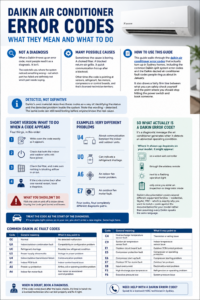
Short version: what to do when a code appears
Four things, in this order:
- Write down the code exactly as it appears.
- Check that both the indoor and outdoor units still have power.
- Check the filter, and make sure nothing is blocking airflow in or out.
- If the code comes back after one normal restart, book a diagnosis.
What you shouldn’t do is flick the unit on and off a dozen times hoping the code gets bored and leaves.
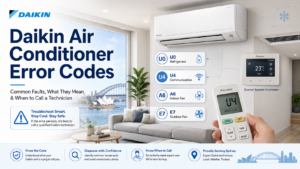
Consider how different these are: U4 is about communication between the indoor and outdoor units. U0 can indicate a refrigerant shortage. A6 is an indoor fan motor problem. E7 is an outdoor fan motor fault. Four codes, four completely different diagnostic paths.
So what actually is a Daikin error code?
It’s a diagnostic message the air conditioner generates when it detects an abnormal operating condition.
Where it shows up depends on your model. It might appear:
- on a wired wall controller
- through the wireless remote
- next to a flashing operation light
- only once you enter an inspection or diagnostic mode
Daikin’s documentation covers several different equipment families — residential, SkyAir, VRV — which is exactly why you want to match a code against the documentation for your model rather than assuming every Daikin speaks the same language.
Treat the code as the start of the diagnosis. If the engine light comes on in your car, you don’t order a new engine. Same logic here.
Common Daikin AC fault codes
Here’s the reference table most homeowners need.
| Code | General meaning | What it may point to |
|---|---|---|
| 00 | Normal | No detected malfunction |
| UA | Indoor/outdoor combination fault | Compatibility or configuration problem |
| U0 | Refrigerant shortage | Possible low refrigerant condition |
| U2 | Power supply abnormality | Voltage or power problem |
| U4 | Indoor/outdoor transmission failure | Communication problem |
| A1 | Indoor PCB fault | Indoor control board issue |
| A5 | Freeze-up protection | Airflow, coil or operating condition problem |
| A6 | Indoor fan motor fault | Fan motor or associated control problem |
| C4 | Heat exchanger temperature sensor fault | Thermistor or wiring issue |
| C9 | Suction air temperature sensor fault | Indoor temperature sensor issue |
| E1 | Outdoor circuit board fault | Outdoor PCB/control problem |
| E5 | Compressor protection fault | Compressor or operating protection |
| E6 | Compressor start-up fault | Compressor starting problem |
| E7 | Outdoor DC fan motor fault | Outdoor fan problem |
| E8 | Input overcurrent | Electrical/current problem |
| F3 | High discharge pipe temperature | Refrigeration or operating problem |
| F6 | High-pressure control in cooling | Airflow, pressure or refrigeration problem |
| H0 | Sensor fault | Sensor circuit problem |
| J3 | Discharge pipe temperature sensor fault | Thermistor or wiring issue |
| J6 | Heat exchanger temperature sensor fault | Thermistor problem |
| L3 | Electrical component heat fault | Excess temperature in electrical components |
| L4 | Inverter heatsink temperature too high | Inverter cooling or electrical problem |
| L5 | Output overcurrent | Inverter/compressor electrical fault |
| P4 | Inverter heatsink temperature sensor fault | Sensor or inverter circuit problem |
These come from Daikin’s diagnostic material, but interpretation shifts between system families. Your model-specific manual is always the final word.
U0 — refrigerant shortage
U0 generally means the system has detected a low refrigerant condition.
It does not mean your air conditioner “needs a gas top-up.” That phrase gets thrown around a lot and it causes real damage.
A properly sealed refrigeration circuit doesn’t consume refrigerant. If the level is genuinely low, something is letting it out. Adding more without finding the leak just means you’ll pay for the same job again next summer, and the refrigerant ends up in the atmosphere either way.
Can you fix U0 yourself? No. In Australia, anyone doing work involving fluorocarbon refrigerants needs the appropriate Refrigerant Handling Licence. Record the code and get it looked at.
U4 — indoor/outdoor communication failure
U4 means the two halves of the system have stopped talking to each other.
A technician will typically work through:
- power supply at both units
- interconnecting wiring
- terminals and connections
- the indoor control board
- the outdoor control board
- communication circuit faults
This is the best example of why a code isn’t a shopping list. U4 does not mean “replace the PCB.” It means communication failed. Working out why is a separate job.
A5 — freeze-up protection
A5 relates to freeze-up protection, or to pressure-related protective control, depending on the system. Daikin’s residential reference lists it as freeze-up protection; the broader diagnostic documentation also links A5 to high-pressure control in heating and freeze-up protection in cooling.
Airflow is the one thing worth checking yourself here:
- dirty return-air filters
- blocked indoor intake
- blocked supply outlets
- closed or obstructed vents
A badly clogged filter can starve the indoor heat exchanger of air, and a coil that isn’t getting enough warm air across it can ice up. Cleaning a washable filter is normal homeowner maintenance. Opening refrigeration components is not.
A6 — indoor fan motor fault
A6 points at the indoor fan motor.
The symptoms are usually obvious. The indoor unit stops moving air, or airflow drops out mid-cycle, or the system runs for a minute and shuts itself down, or the operation light starts flashing.
Please don’t reach into the fan assembly with fingers or tools. A technician will need to test the motor, the wiring, the connectors, the motor feedback circuit and possibly the control board before anyone knows what’s actually failed.
E7 — outdoor DC fan motor fault
E7 flags a problem with the outdoor DC fan motor on applicable systems.
Before you call, have a look around the condenser. Leaves, garden waste, a fallen branch, a bin pushed up against it — anything obstructing airflow is worth clearing.
Beyond that, leave the covers on. The fan, inverter electronics and everything else inside the outdoor unit aren’t homeowner-serviceable.
F3 — high discharge pipe temperature
The discharge pipe carries hot refrigerant away from the compressor. F3 means the temperature there has gone outside expected limits, and the system has protected itself by stopping.
Several different refrigeration and operating conditions can push discharge temperature up, which is why F3 needs proper diagnosis rather than a guess.
L5 — inverter output overcurrent
L5 is an inverter output overcurrent condition, and it’s one of those codes where repeated resetting is genuinely a bad idea.
The inverter controls the compressor electronically. Investigating L5 usually means looking at compressor operation, inverter circuitry, wiring, current draw, power supply and the surrounding electrical components.
If L5 comes back after a restart, stop and book someone.
J3 — discharge pipe temperature sensor fault
J3 points to a thermistor problem on the discharge pipe.
A thermistor is just a temperature sensor whose electrical resistance changes as it heats and cools. The system relies on a handful of them to understand what’s happening inside the refrigeration circuit. With J3, the sensor itself, its connector, the wiring or the circuit reading it all need checking.
How do you check the code on a Daikin split system?
It depends entirely on your controller.
Some wireless remotes use an inspection or test mode. Others use the Cancel button to enter fault diagnosis. For one common method, Daikin’s instructions are to hold Cancel for roughly five seconds until 00 flashes, then step through the codes until the controller gives you the confirmation tone.
Other controllers behave completely differently, and Daikin publishes separate instructions for wired and wireless versions — including ones where the fault simply appears on the screen with no button pressing at all.
Before you start pressing combinations: find the model number of the unit, find the controller model if you can, and use the manual for that exact system. Daikin Australia’s support library holds model-specific operation manuals across its ranges.
Should you reset a Daikin after an error?
One controlled restart is fair enough, especially after a power interruption or a storm.
But resetting isn’t a repair. If the code returns, the system is telling you it has detected the same abnormal condition again. And every reset wipes out symptoms the technician could have used.
A better habit: record the code, take a photo, note what the unit was doing, and book a diagnosis if it comes back.
Details worth writing down:
- Was it cooling or heating?
- Did it stop suddenly or wind down?
- Had there been a blackout?
- Did the indoor fan stop?
- Was the outdoor unit running?
- Any unusual noise?
- Did the fault show immediately, or after half an hour of running?
That last one in particular narrows things down enormously.
Can a dirty filter cause a fault code?
Not every code, no. But restricted airflow causes real operating problems, and it’s the cheapest thing to rule out.
Reasonable homeowner checks:
- clean the user-serviceable filter
- clear the return-air grilles
- check supply vents are open
- clear leaves and rubbish from around the outdoor unit
- confirm the circuit hasn’t obviously lost power
That’s about where DIY should stop. Don’t open switchboards, test live wiring, touch refrigerant lines or pull the condenser apart.
Why is my Daikin flashing green but not cooling?
A flashing operation light can mean the system has detected a malfunction. But here’s the part people miss: not every poor-cooling problem produces a code at all.
A 2026 Australian user report described a Daikin still delivering cool supply air that couldn’t get the room below roughly 20°C — with no fault code stored. It’s a useful case because it shows performance problems and stored fault codes are related but not the same thing.
Poor cooling with no code can come from settings, dirty filters, restricted airflow, excessive heat load, undersized equipment, duct leakage or genuine refrigeration performance issues. It still needs to be established rather than assumed.
Daikin ducted air conditioner fault codes
Ducted systems follow the same diagnostic logic, but there’s more in the chain to go wrong.
On top of the refrigeration equipment, you’re dealing with a wired controller, return-air ductwork, supply ductwork, zone controls, dampers, sensors, the indoor fan assembly, the outdoor unit and all the electrical and communication wiring between them.
Daikin Australia publishes dedicated operation manuals for its ducted zone controllers as well as its other system controllers — which tells you something about how much variation is out there.
A ducted fault is often more than two characters pointing at one broken component.
A real 2026 example worth learning from
An Australian homeowner reported last year that their ducted Daikin struggled badly through extreme heat, despite clean filters and genuine attempts to cut the cooling load. The discussion involved outdoor temperatures above 40°C, and it ranged across building heat load, duct condition, airflow and installation factors.
The lesson isn’t that one particular fix solves every system. It’s the reverse.
Performance has to be diagnosed in context — equipment, airflow, refrigerant circuit, controls, ductwork and the building itself. That’s a far more honest approach than “it’s not cold enough, so it must need gas.”
Which codes need a professional?
As a working rule, book diagnosis for:
- U0 – refrigerant shortage
- U4 – indoor/outdoor communication
- A1 – indoor control board
- A6 – indoor fan motor
- E1 – outdoor control board
- E5 / E6 – compressor protection or start-up
- E7 – outdoor fan motor
- E8 – electrical overcurrent
- F3 / F6 – abnormal refrigeration pressure or temperature
- L3 / L4 / L5 – inverter or electrical temperature and current faults
Call regardless of the code if the breaker keeps tripping, you smell burning, wiring looks damaged, water is getting into electrical areas, the compressor keeps short-cycling, or the same fault returns the moment you restart.
Why Sydney homeowners need to be careful with DIY
Air conditioning work sits across two licensed trades at once.
In NSW, air conditioning and refrigeration work requires the appropriate licence or certificate, and electrical wiring work requires an electrical licence or certificate. On top of that, Australian refrigerant rules require a Refrigerant Handling Licence wherever work creates a risk of fluorocarbon refrigerant being released.
So there’s a genuine line between homeowner checks and air conditioning repair.
Cleaning a washable filter is one thing. Opening the refrigeration circuit or working on wiring is a different matter entirely.
How KYNEX Air Conditioning can help
If your Daikin keeps stopping, flashes a code or has quietly stopped cooling properly, the job is to move from guessing to diagnosis.
A proper service call starts with the symptoms and the system history, then works through what’s relevant: controller fault history, electrical supply, indoor–outdoor communication, temperature sensors, fan operation, refrigeration pressures and temperatures where appropriate, airflow, filters, ductwork, control boards and compressor operation.
Find the cause first. Recommend parts second.
If you’re booking air conditioning repairs Sydney, give us the fault code when you call, and take a photo of the controller. It sounds minor. It saves a surprising amount of time on site.
Before you book: the checklist
1. The error code. Exactly as displayed. “U4” is useful. “I think it had a U in it” is not.
2. Indoor unit model. It’s on the label.
3. Outdoor unit model. Photograph the model plate if it’s easy to reach — without removing any covers.
4. Controller model. Especially important on ducted systems.
5. What happened just before. Blackout, storm, extreme heat, recent servicing, renovations, electrical work, an unusual noise, a water leak.
6. Does it come back? Immediately, or only after the system has been running a while?
Those six things narrow the diagnostic path more than people expect.
Frequently asked questions
What does 00 mean on a Daikin air conditioner? Daikin lists 00 as normal — the diagnostic system isn’t identifying a malfunction under that code.
What does U4 mean? A communication failure between the indoor and outdoor units.
What does U0 mean? Refrigerant shortage, according to Daikin’s fault-code documentation. Get it diagnosed rather than topped up.
What is A6 on a Daikin split system? An indoor fan motor fault.
What does E7 mean? An outdoor DC fan motor fault on applicable systems.
Can I clear a code myself? You can usually restart the system, but clearing a code doesn’t repair anything. If it returns, record it and book a diagnosis.
Do all Daikin systems use the same codes? Not necessarily. Residential, ducted, SkyAir and other ranges vary, so check the information for your exact model. Daikin maintains model-specific Australian operation manuals.
Should I keep running it with a code showing? If the system keeps stopping or the fault is confirmed, no. Record the code and organise diagnosis.
Related guides
- Air Conditioner Error Codes: Complete Australian Troubleshooting Guide — how fault codes work across different types of air conditioning systems.
- Why Is My Air Conditioner Not Cooling? — for when the unit runs but the room stays warm.
- Air Conditioner Repair or Replacement: Which Makes More Sense? — for older systems where repair costs are climbing.
- How Long Does Air Conditioning Repair Take? — what actually happens during a diagnosis, and what slows it down.
The bottom line: a code isn’t a parts list
Daikin error codes are genuinely useful. They tell you where the system detected something abnormal. What they don’t always tell you is why it happened.
A U4 doesn’t automatically mean a new circuit board. A U0 shouldn’t lead straight to somebody adding refrigerant without asking where the old refrigerant went. An A6 still needs testing to work out whether it’s the motor, the wiring, a connector or the control system.
For Sydney homeowners, the process is simple enough: identify the code, check basic airflow and power, record the symptoms, stop the repeated resets, and get persistent faults properly diagnosed.
Do that and you’re far more likely to pay for the repair the system actually needs — rather than the one that was easiest to guess.