
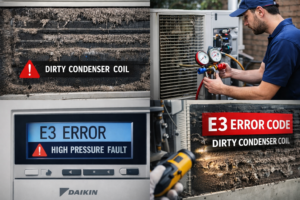
Your air conditioner has stopped cooling, there’s a blinking light on the indoor unit, and the wall controller is showing “E6” like that’s supposed to mean something to you. Frustrating, but not a disaster — and definitely not a reason to start pulling panels off.
Here’s the thing most online fault-code lists won’t tell you: an error code is a clue, not a diagnosis. It tells you roughly where the system noticed something wrong. It doesn’t tell you which part has failed, or what it’ll cost. Two systems can throw the same code for completely different reasons.
So before you go down a rabbit hole of forum posts, do the boring stuff first. Write the code down. Find your model number. Check a couple of safe basics. And if the fault keeps coming back, stop resetting it and get someone qualified to look.
The short version: what to do when a code appears
- Photograph the code. Do this before anything else — codes often vanish when the system restarts.
- Note the lights. Which one, what colour, how many flashes, how long the pause is.
- Find the model numbers for both the indoor and outdoor units if you can.
- Think back — did the power go out recently? Outages and electrical work cause a surprising number of faults.
- Check your filters. If they’re accessible and filthy, clean them.
- If the code returns after a normal restart, stop. Repeated resets won’t fix an underlying fault, and they wipe useful diagnostic history.
What not to do: open electrical panels, mess with wiring, touch refrigerant pipework, or try to top up gas yourself. An electrical wiring work requires a licence or certificate, and air conditioning and refrigeration work is licensed too. On top of that, anyone doing work where refrigerant could escape needs a Refrigerant Handling Licence from the Australian Refrigeration Council. These aren’t red-tape technicalities — this is the part of the job that can hurt you.
So what is an error code, really?
Every modern air conditioner is full of sensors feeding information to one or more control boards. The system is constantly watching temperatures, airflow, fan speeds, compressor behaviour, electrical supply, and whether the indoor and outdoor units are still talking to each other.
When one of those readings drifts outside what the controller expects, it logs a fault and — depending on the model — either displays a code or starts flashing a light at you. That code might be E1, F3, P4, 01, or any other combination the manufacturer decided on. Plenty of older and cheaper units skip the display entirely and communicate purely through blink patterns.
Either way, the code points to a category of problem, not a specific broken component. Take a communication fault. That could be a damaged wire, a loose connector, a power supply issue, a failed control board, or water where it shouldn’t be. All one code. This is exactly why buying a replacement part based on a code you googled is a good way to spend money and still have a broken air conditioner.
No, error codes aren’t universal
This is the single most misunderstood thing about fault codes.
E4 on a Mitsubishi doesn’t mean what E4 means on a Daikin, and it might not even mean the same thing across two models from the same brand. Manufacturers organise their technical documentation around specific equipment and control systems, not around some shared industry-wide code list. There isn’t one.
Which means searching “E4 air conditioner error” is close to useless. Searching “[your model number] E4 error” is the version that actually gets you somewhere.
Finding your model number
Split systems: check the side or underside of the indoor unit, behind the front flap where the filters sit, or on the label on the outdoor unit. Your installation paperwork and manual will have it too.
Ducted systems: try the wall controller first, then your installation documents or old service invoices. Equipment labels are usually up in the roof space.
One request: don’t crawl into a hot Sydney roof cavity just to read a sticker. If the label isn’t somewhere safe and obvious, a technician will find it during the visit.
What about flashing lights?
A blinking light doesn’t automatically mean something has failed. Some patterns just indicate normal operating states — defrost mode, standby, a timer that’s active. Others are genuine warnings, and some are the fault code, delivered in Morse.
The pattern is what matters. So rather than telling a technician “the light’s blinking,” note down:
- which light it is, and what colour
- how many flashes in a group
- how long the pause is between groups
- whether a second light joins in
- whether the unit is still blowing air at all
Honestly, a ten-second phone video is worth more than any description. Just film it.
The common families of fault
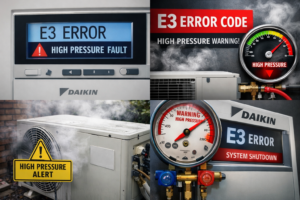
The letters and numbers change between brands, but most faults fall into one of these buckets.
Communication faults. Something in the chain — indoor unit, outdoor unit, wall controller, zone controller, a sensor — has stopped talking. A communication code doesn’t mean the controller is dead. It means the conversation broke down somewhere.
Temperature sensor faults. Sensors tell the system what to do, so when one fails, disconnects, or starts reporting nonsense, the system often shuts down rather than run blind. Intermittent sensor faults are especially annoying because they come and go, and you can’t spot them by looking at the unit. They need testing.
Fan faults, indoor or outdoor. Fans push air across the heat exchangers. If the system sees a fan running at the wrong speed — or not at all — it’ll usually stop to protect itself. Could be the motor, could be an obstruction, could be a connection, could be the electronics reading the motor’s feedback.
Compressor and inverter faults. The compressor is the expensive bit, and inverter systems add power electronics that control it. A compressor-related code is not the same as “you need a new compressor.” Plenty of things upstream can produce a compressor fault. This is the category where proper diagnosis saves the most money, and where guessing costs the most.
Electrical and voltage problems. Air conditioners want a stable supply. Brownouts, voltage spikes, damaged connections, tripped protection devices and failing internal components can all trigger protection codes. Leave the electrical compartments closed.
Airflow problems. Not every fault is a component failure. Clogged filters, blocked return-air grilles, closed or obstructed vents, a dirty indoor coil, or an outdoor unit buried in leaves will all degrade performance, and some systems will throw a code over it. It’s not glamorous, but it’s common enough that it belongs at the front of any troubleshooting list.
Safe troubleshooting, step by step
1. Photograph the error. Again: do this first. The evidence disappears when you restart.
2. Check the controller. Confirm the mode, the setpoint, and whether a timer or schedule is running. It’s a little embarrassing how often a “fault” turns out to be a system in fan-only mode, or a schedule someone set months ago.
3. Check the filters. If your manual says they’re user-accessible, pull them out and look. A thick grey blanket of dust across the surface is restricting your airflow, guaranteed. Clean them the way the manual describes, and let washable filters dry fully before they go back in — damp filters cause their own problems.
4. Look for obvious blockages. Supply vents open, return-air grille clear, no curtains or furniture pressed against anything, outdoor unit not smothered in leaves. Clearing debris from around the outdoor unit is fine. Taking its cover off is not.
5. Do a normal reset — once. If the manual allows it, switch the unit off properly, wait, and turn it back on. This clears genuinely temporary glitches. Be patient afterwards: many systems need two to three minutes after power is restored before they’ll accept commands again, so don’t assume it’s dead because it doesn’t respond instantly.
If the code comes straight back, that’s your answer. Stop there.
Why the code keeps coming back after a reset
Because a reset clears the warning, not the cause.
It’s the same as pulling the fuse on a check-engine light. The light goes out. The engine is still broken. When your air conditioner detects the same abnormal condition again, it logs the same fault again — that’s the system working as designed.
There’s a real cost to resetting repeatedly, too. You erase the pattern of when and how the fault occurred, which is often the most useful thing a technician has to work with.
What to tell your technician
The difference between a fast diagnosis and an expensive fishing expedition usually comes down to information. Have this ready:
- The exact code. “E6” beats “one of the E ones.”
- System type — split, multi-split or ducted.
- Model numbers, indoor and outdoor if you have them.
- What happened. “Cooled fine for twenty minutes, then stopped and flashed.”
- When it happens. Only in heating? Only on 38-degree afternoons? Only in one zone?
- How fast it returns after a reset — immediately, or hours later?
- Other symptoms — noises, smells, water, ice, weak airflow.
- Anything recent — power outage, electrical work, a renovation, a previous service call.
A photo of the controller and a photo of the equipment label cover most of this in two taps.
When to stop troubleshooting entirely
Put the remote down and call someone if you notice any of the following:
burning smells, smoke, melted or discoloured components, a breaker that trips repeatedly, exposed or damaged wiring, damaged refrigerant pipework, loud electrical buzzing, water pooling near electrical equipment, or a system that keeps shutting itself down.
None of these are wait-and-see situations. And as above — electrical wiring work has to be done by someone appropriately licensed, as does refrigeration and air conditioning work in Sydney NSW. This is the area where DIY curiosity turns a routine repair into a safety incident.
Does a fault code mean I need a new air conditioner?
Almost never on the basis of the code alone.
The actual problem might be a $90 sensor, a blocked drain, a loose connector, a control board, a fan motor, or yes, occasionally something major. You can’t tell from the display.
Age is a fair consideration. If a twelve-year-old system suffers a significant failure, it’s reasonable to weigh the repair cost against parts availability, running efficiency, and the general condition of the rest of the system. Sometimes replacement genuinely is the better call.
But diagnose first, then decide. Not the other way around.
Split system vs ducted: what’s different
Both throw codes, but there’s more surface area for things to go wrong in a ducted system.
A split system is fairly contained: indoor unit, outdoor unit, a controller, and the wiring and pipework between them. Troubleshooting tends to be reasonably direct.
Ducted adds ductwork, a return-air system, a wall controller, zone motors and controls, and often several extra sensors and interfaces. As a result, a ducted fault code can easily point to something in the controls or communication network rather than the refrigeration equipment itself — a zone controller that’s dropped offline, a configuration issue, a connection fault. The compressor might be perfectly healthy.
Why Sydney systems fail when they do
Air conditioners rarely break at a convenient moment. They break on the first genuinely hot day in November, or during a five-day heatwave, or on the first cold morning of winter when the system switches to heating for the first time in months. And often right after a power interruption.
That’s not bad luck — it’s load. A restricted filter, a tired fan, an intermittent connection or a marginal component can all look fine when the system is barely working. Ask it to run hard for eight hours straight and the weak link shows itself.
Which gives you a useful habit: if the same fault keeps appearing under the same conditions, write down when. “Every afternoon once it hits about 35” is genuinely diagnostic information.
Worth remembering, too, that not every complaint is a code. Plenty of homeowners find their system has simply stopped cooling well, dig out filters buried under months of dust, clean them, and get most of their performance back. Sometimes it’s that simple. Other times the code only tells the technician which of three possible causes to test first. Both are normal.
Frequently asked questions
Can I fix an error code myself? Sometimes — if the cause is a dirty accessible filter, a blocked vent or a controller setting, that’s fair game. Electrical work, refrigerant work and anything inside the equipment isn’t.
My air conditioner is flashing but showing no code. Why? Many units use blink patterns instead of an alphanumeric display. Record the pattern precisely and check the documentation for your specific model.
Will switching the power off clear the code? It often clears the display. It doesn’t clear the fault, so if the condition is still there, the code comes back.
Nothing’s showing but it’s still not working properly. Not every problem triggers a code. Airflow restrictions, controller settings, supply issues and gradual performance loss can all happen silently.
Should I give the technician the code before they arrive? Yes, please. Code, model number, system type, and a quick description of what it was doing. It genuinely changes how the visit goes.
Are online fault-code lists reliable? Use them as a rough orientation, nothing more. Codes vary between brands and models, so model-specific documentation always wins over a generic list.
How KYNEX can help
If your error code keeps coming back, KYNEX Air Conditioning handles repairs and maintenance for homes and businesses across Sydney. Diagnosis involves proper assessment and testing rather than guesswork — airflow checks, electrical checks and refrigeration-system checks as required.
A typical repair runs in four stages: an initial assessment of the system, diagnostic testing to identify the real cause, a recommendation on repair or replacement, and final testing once the work is done.
Our maintenance checklist covers system operation, outdoor unit voltages, refrigerant pressures, filters, drainage, airflow and the condition of the outdoor equipment.
The team brings more than ten years of combined industry experience and has installed or serviced over 2,000 systems across Sydney homes and commercial properties.
If you’re getting in touch about a code, having the code itself, your model number and a photo of the controller ready will make that first conversation far more productive.
The bottom line
Treat an error code as a clue, not a verdict.
Record the code and the model number. Check the easy things — settings, airflow, accessible filters. Try one normal reset.
But if the code returns, if the system keeps shutting down, if a breaker trips, or if you smell burning or see damaged wiring, stop experimenting and get it looked at properly.
The most valuable thing you can hand a technician is unglamorous: exact code + model number + symptoms + when it happens. That turns “my air conditioner isn’t working” into something someone can actually diagnose.
Related reading
- Daikin Air Conditioner Error Codes: Complete Troubleshooting Guide
- Fujitsu Air Conditioner Error Codes: Complete Troubleshooting Guide
- ActronAir Error Codes: Complete Troubleshooting Guide
- Panasonic Air Conditioner Error Codes: Complete Guide
- Mitsubishi Electric Air Conditioner Error Codes
- LG Air Conditioner Error Codes
- Samsung Air Conditioner Error Codes