
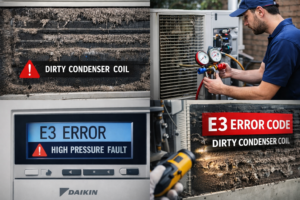
Your air conditioner has been running fine all summer. Then one afternoon it shuts itself down, and instead of the usual temperature on the display you get two characters — U4, maybe P5, or a green light blinking in a pattern that clearly means something.
That code isn’t the unit being cryptic for the sake of it. It’s the system telling you exactly which of its own checks failed. Learning to read it won’t turn you into a refrigeration mechanic, but it will tell you whether you’re looking at a five-minute fix, a service call this week, or a switch-it-off-now situation.
Deciphering the Code: A Comprehensive Guide to Understanding AC Error Codes in Sydney
AC Error Codes: What Are They?
Every modern split system, multi-head and ducted unit has a control board that constantly monitors itself. It’s watching a dozen or more inputs: air and pipe temperatures at several points, refrigerant pressures, fan motor speed, the water level in the drain tray, the voltage coming in, and whether the indoor and outdoor units are still talking to each other.
When one of those readings falls outside the range the manufacturer programmed in, the board does two things. It usually shuts the system down or drops it into a limited mode to prevent damage, and it logs a code.
Two points worth understanding straight away.
First, a code tells you what the unit detected, not necessarily what’s wrong. A code for low refrigerant pressure means the sensor read low pressure. That could be a leak, a faulty sensor, a blocked filter starving the coil of airflow, or a system that was undercharged at installation three years ago. The code narrows the search — it doesn’t finish it.
Second, codes are brand-specific and often model-specific. Daikin, Mitsubishi Electric, Fujitsu, Panasonic, Samsung, LG, Haier and Actron all use their own systems, and a code that means a drain fault on one brand can mean something completely unrelated on another. Never troubleshoot a Fujitsu using a Daikin code list. It’s a good way to chase the wrong problem for an hour.
How to Find AC Error Codes
Where the code appears depends on what you’ve got installed.
Ducted systems with a wall controller are the easiest. The code usually appears on the controller screen in place of the temperature, sometimes with a small warning symbol. Some brands make you press a specific button combination to bring up a fault history, which is genuinely useful — it can show intermittent faults that have cleared themselves.
Wall-mounted splits vary. Higher-end models have a small display on the indoor unit that shows the code directly. Plenty of others have no display at all, and instead communicate through blinking LEDs on the indoor unit — typically the operation, timer and economy lights. The code is the pattern: three flashes of the timer light and two of the operation light means something specific, and you need the manual to decode it. Count the flashes carefully and note which lights are involved, because “it’s just flashing” isn’t enough information for anyone to help you with.
Multi-head and VRF systems often display the code along with the number of the indoor unit reporting it, which matters when you’ve got four heads and only one is misbehaving.
Outdoor units frequently have a seven-segment display or LEDs on the control board behind the front panel. Leave that panel alone. There are live terminals in there at 240V, plus refrigerant lines under pressure. If the code needs to be read from the outdoor board, that’s a technician’s job.
The decoder for your specific unit is in the installation and operation manual, and if that’s long gone, the model number on the sticker on the side of the indoor unit will find it online in about a minute. Take a photo of that sticker now and save it somewhere. It’ll save you time later.
Understanding Common AC Error Codes
Rather than a giant table of codes that may or may not match your unit, it’s more useful to understand the six families most faults fall into. Once you know which family you’re in, you know how urgent it is.
Communication faults. The indoor and outdoor units talk over a control cable, and when that conversation drops out, you get a communication error — U4 on many Daikin units, E6 on a lot of Mitsubishi Electric models, H11 on Panasonic. Causes range from a genuinely failed control board down to a loose terminal, water in a junction, insect damage to the cable, or a tripped breaker on the outdoor circuit. This one’s worth checking your switchboard for before you call anyone.
Drainage faults. The indoor unit pulls litres of water out of your air on a humid Sydney day, and that water has to go somewhere. When the drain blocks or the pump fails, a float switch trips and the unit shuts down rather than dumping condensate through your ceiling. Mitsubishi’s P4 and P5 codes sit here. Sydney’s summer humidity makes this one of the most common faults we see, and a shutdown on a drain fault has just done you a favour — the alternative is water damage.
Sensor and thermistor faults. Small temperature sensors on the coils and in the airstream drift, fail or come loose from their holders. The codes are usually specific enough to identify which sensor. These are typically cheap parts and a quick replacement, but the system won’t run properly with bad data.
Refrigerant and pressure faults. Codes indicating low pressure, insufficient gas or high discharge pressure — Daikin’s U0 and A5 are examples. Low charge almost always means a leak, because refrigerant isn’t consumed in normal operation; a system that’s low has lost gas somewhere. High pressure often means the outdoor unit can’t reject heat, which can be as simple as a coil packed with jacaranda leaves and lint, or something blocking the airflow around it.
Fan motor faults. Either the indoor fan or the outdoor fan isn’t achieving the speed the board expects. Sometimes it’s the motor or its driver. Sometimes something is physically obstructing the blade.
Power supply and inverter faults. Over-voltage, under-voltage, or an inverter compressor drawing outside its expected range. These deserve respect. Repeated inverter or compressor faults can indicate a problem that gets more expensive the longer it runs.
Troubleshooting Based on Error Codes
There is a short list of things a homeowner can sensibly do, and a longer list of things they shouldn’t. Here’s the short list.
Note the code before you clear it. Write it down or photograph it. Power-cycling the unit will often clear the display, and then nobody can tell what happened. If the fault comes back, note how long it took — a code that returns in two minutes is a different problem to one that returns in two days.
Clean or replace your filters. Genuinely. A surprising share of faults trace back to restricted airflow across the indoor coil, and blocked filters are the cause more often than anything else. Pull them out, wash them in lukewarm water, dry them fully before refitting. If they’re pleated paper rather than mesh, replace them.
Check the outdoor unit. Clear leaves, grass clippings, cobwebs and general debris from around the condenser. Make sure nothing has grown against it — Sydney gardens are enthusiastic — and that there’s clear space around the coil and above the fan.
Check the drain outlet. Find where the condensate pipe discharges and check it’s flowing and not blocked at the end. A blocked drain pipe is common and easy to spot.
Check your switchboard. Confirm the aircon circuit breaker hasn’t tripped. If it has, reset it once. If it trips again straight away, stop and call an electrician or your aircon technician. A breaker that keeps tripping is doing its job.
Try one power cycle. Turn the system off at the isolator or breaker, wait five minutes, turn it back on. Genuine transient faults — a brownout during a heatwave, for instance — will clear and stay cleared. This is worth exactly one attempt.
Now the list of things not to do. Don’t open the outdoor unit’s electrical cover. Don’t buy a can of refrigerant online and try to top the system up — in Australia, handling refrigerant without an ARC licence is illegal, and adding gas to a leaking system without finding the leak is throwing money into the atmosphere. Don’t reset a fault repeatedly to force the system to keep running; if it’s protecting the compressor, overriding that protection turns a repair into a replacement. And don’t ignore a burning smell, water dripping from the indoor unit, or ice on the pipework, regardless of what the code says.
When to Call in the Professionals
Book a technician when any of the following is true.
The same code returns after one power cycle and the basic checks above. The code points to refrigerant, pressure, compressor, inverter or control board. There’s water coming from the indoor unit, or ice anywhere on the system. The unit trips the breaker. You can hear grinding, screeching or a loud hum from either unit. The system runs but no longer cools properly. Or you simply can’t identify the code — that’s a perfectly good reason to call.
When you book, have three things ready: the brand and model number from the indoor unit sticker, the exact code or flash pattern, and a short account of what happened before it appeared and what you’ve already tried. That information regularly cuts the diagnostic time in half, which shows up on your invoice.
For anything beyond filters and debris clearing, our team handles air conditioning repairs sydney wide, with fully licensed technicians who can pull the fault history off the board rather than guessing from the surface symptom.
Empower Yourself with Knowledge, Rely on the Professionals for Action
Understanding your error codes changes the conversation. You stop being the customer who says “it’s not working” and becomes the one who says “it’s throwing a drain fault, I’ve checked the outlet and it’s clear.” You know whether it’s urgent. You know when a quote sounds wrong, because you know what part of the system is actually involved.
What it doesn’t do is make the repair a DIY job. The licensing around refrigerant and fixed electrical work exists for good reasons, and the diagnostic gear that separates a failed sensor from a genuine leak isn’t something you’d buy for one repair.
Read the code. Do the simple checks. Then hand it over with good information — that combination gets your aircon back on faster and usually cheaper.
Freeing Customers from Discomfort Across Greater Sydney
KYNEX services homes and businesses right across the Sydney basin — the Inner West, Eastern Suburbs, North Shore, Northern Beaches, Hills District, Sutherland Shire, Canterbury-Bankstown, Parramatta and out through Western Sydney.
That spread matters more than it sounds. A 1920s Federation home in Haberfield, a 1970s brick veneer in Baulkham Hills and a new apartment in Zetland present completely different service problems, from access to the outdoor unit through to how the condensate was run in the first place. Salt air on the coast corrodes outdoor coils faster. Western Sydney’s summer extremes push systems harder for longer. Apartment work brings strata rules and shared risers into it.
Faults have local patterns too, and technicians who work the same suburbs week after week recognise them quickly.
Customers Agree — KYNEX Offers Five-Star Care
Dealing with the KYNEX team for our ducted AC was a fantastic experience. Nothing was too hard, they arrived on time did what they said they would do and were incredibly polite and so happy to explain and answer any questions. A great team and business that deserves supporting!
Price assessmentGreat pricePrice$2,000+
ServicesHVAC duct & vent installation, Install AC…Emma-Charlotte Browne
Fabulous job. From the very beginning to the very end, KYC have been professional and exceeded all expectations. Competitive pricing and the only company who came out to quote us who asked reasonable and logistical questions. They have been solution orientated and friendly to work with. Thanks KYC.
Utopia Art Sydney